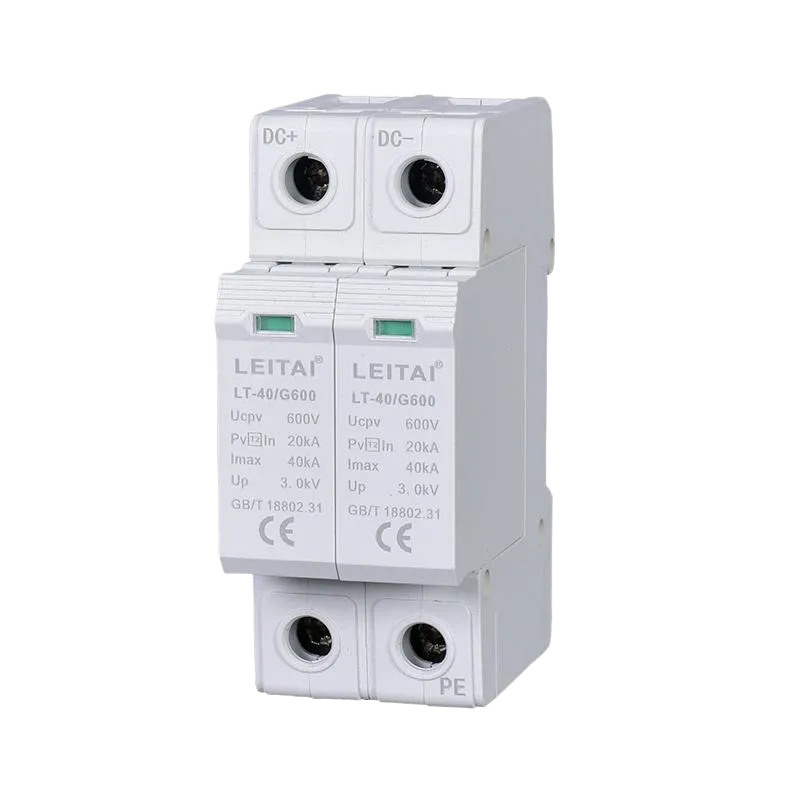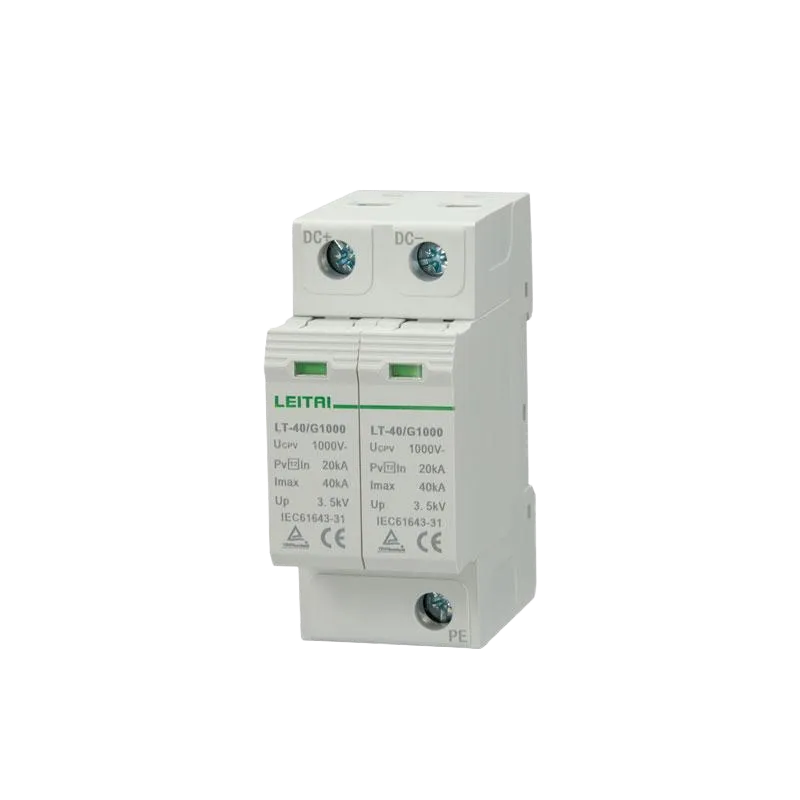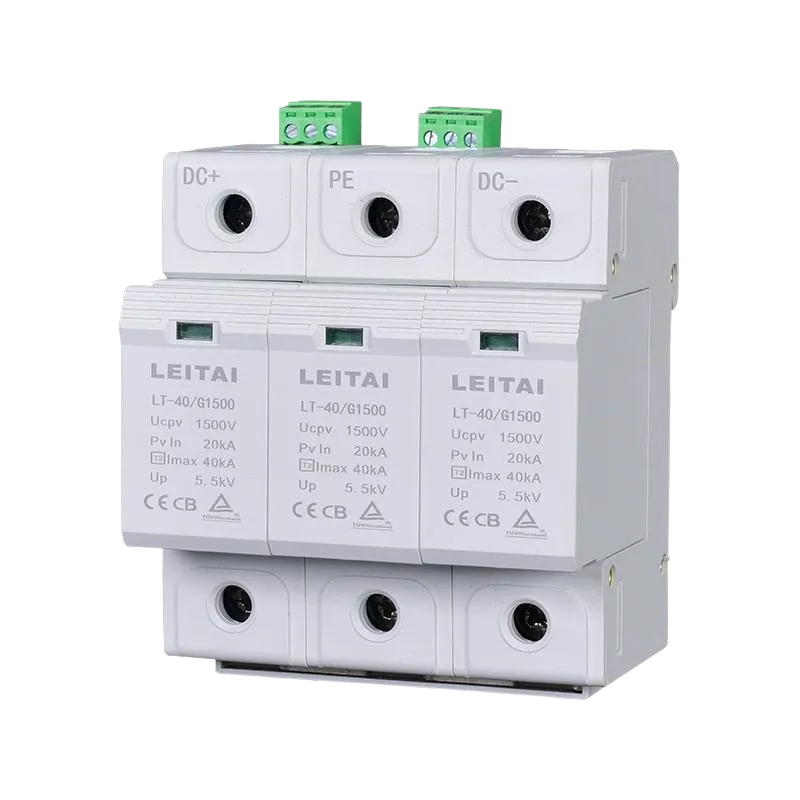

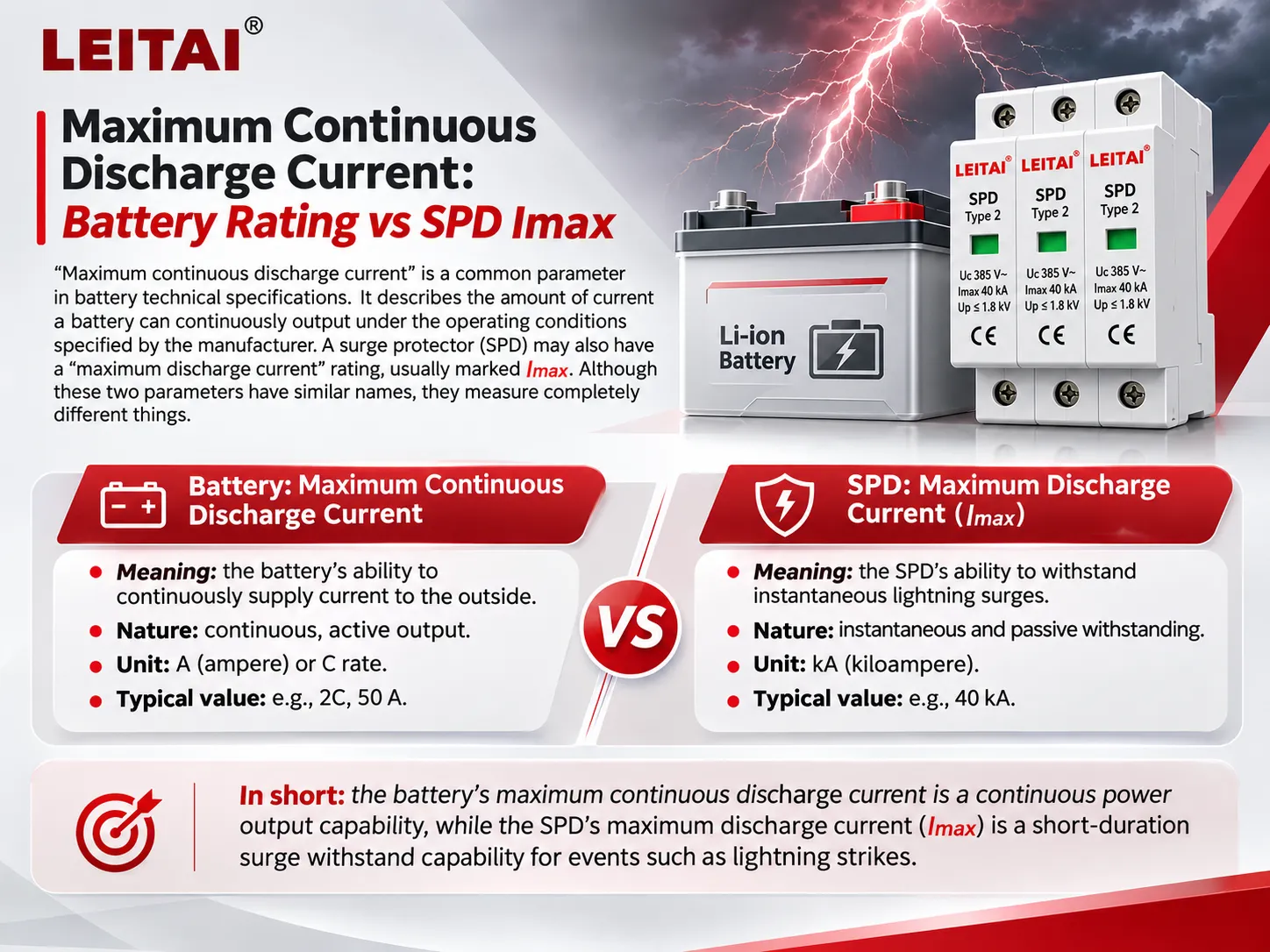
“Maximum continuous discharge current” is a common parameter in battery technical specifications. It describes the amount of current a battery can continuously output under the operating conditions specified by the manufacturer. A surge protector (SPD) may also have a “maximum discharge current” rating, usually marked $I_{max}$. Although these two parameters have similar names, they measure completely different things. To put it simply: the “maximum continuous discharge current” of a battery is its ability to continuously supply power to the outside world, while the “maximum discharge current” of a surge protector is its ability to withstand instantaneous lightning surges.
The battery is a continuous, active output, the unit is usually A or C rate, the value is relatively small (such as 2C, 50A). ; The $I_{max}$ of the surge protector is instantaneous and passive withstanding, the unit is kA (kiloamps), the value is very large (such as 40kA), and it only works in transient events such as lightning strikes.
A battery rated for 100 A of continuous discharge is not directly comparable to an SPD rated Imax 40 kA. The battery supplies current to the load during normal operation; the SPD responds to a brief overvoltage event. The ratings differ in purpose, duration and test conditions.
What does max continuous discharge current mean?
Max continuous discharge current signifies the maximum quantity of current which the battery manufacturing company allows its battery to provide on a continuous basis under certain circumstances. The charging current is typically measured in amperes, commonly referred to as A.
For instance, if the maximum continuous discharge current of a battery is mentioned in the specifications as 100 A, this means the battery can supply this amount of current continuously provided the manufacturer’s conditions are satisfied. However, it should be noted that the mention of A doesn’t guarantee that the battery will always provide this current.
The allowed current is dependent on several factors such as battery temperature, battery SOC (state of charge), cell design and battery management system. The cables, connectors and other components have to be suitable for the application. Just knowing the ratings does not mean that the current can be considered safe for the circuit.
Difference between continuous discharge current and peak discharge current
Many batteries are rated for peak discharge current. It is possible that peak current is higher than the continuous rating thus it can only be used with the manufacturer-defined time and other relevant specifications.
As an example, Renogy states the maximum continuous discharge current of 200 A and peak discharge current of 400 A for the first 10 seconds for its 12 V 200 Ah Core Series battery with the Bluetooth. These two quantities serve different purposes: 200 A denotes continuous operation and 400 A is the peak rating for a limited time.
Starting motor loads or inverter surge must be checked against the current peak and its allowed time. Violating either of the limitations can disable the output of battery management system or put the battery to work beyond its limits.
How does battery current affect power?
A basic estimate of DC power is obtained by multiplying voltage by current:
Power in watts = Battery voltage in volts × Current in amperes
For example, consider an inverter with an operating voltage set at 12.8V and a current of 100A; this results in a power rating of 1280W. However, this figure is derived from basic parameters and does not guarantee that the inverter can consistently deliver 1280W of AC output power. In actual operation, factors such as voltage fluctuations, circuit connections, temperature, and the characteristics of internal components can all affect the real-world output power.
What Is Maximum Discharge Current on a Surge Protective Device?
Maximum discharge current on a surge protective device is often referred to as Imax. Imax refers to the peak current value of a particular impulse test, which is usually measured in kiloamperes or kA.
Imax is expressed in an 8/20µs waveform in many Type 2 SPD data sheets. This refers to a surge test rather than the current being applied continuously to the equipment.
The front time of the 8/20 µs waveform shows a nominal value of 8µs, and the time to half-value is measured at 20µs. The test does not simply stop at the 20µs point. The Imax value given by the manufacturer applies to the tests specified by the manufacturer and the appropriate product standard.
For instance, when the SPD states an Imax of 40kA, it does not indicate that it can deliver a continuous load of 40,000A.
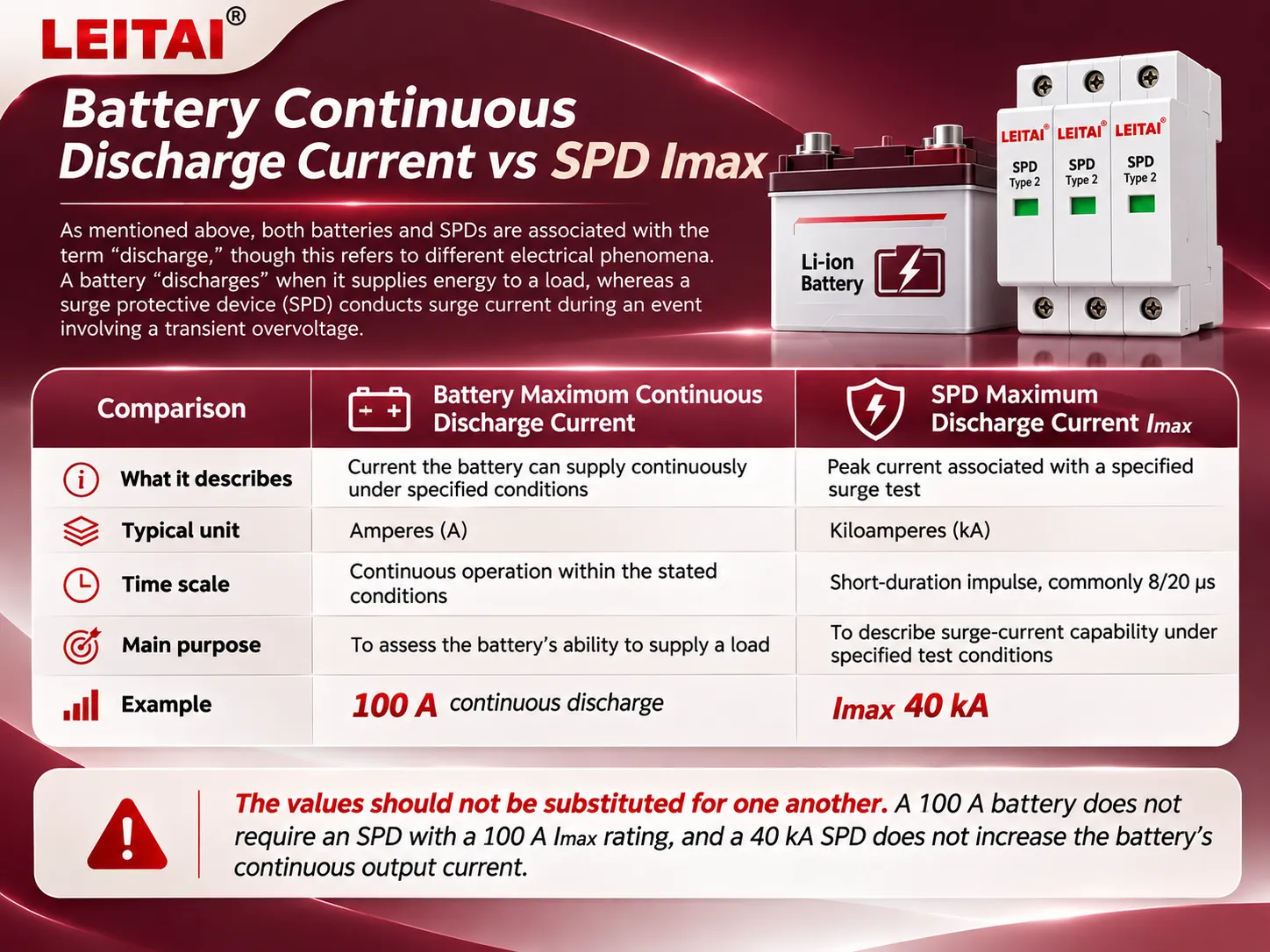
Battery Continuous Discharge Current vs SPD Imax
As mentioned above, both batteries and SPDs are associated with the term “discharge,” though this refers to different electrical phenomena. A battery “discharges” when it supplies energy to a load, whereas a surge protective device (SPD) conducts surge current during an event involving a transient overvoltage.
| Comparison | Battery Maximum Continuous Discharge Current | SPD Maximum Discharge Current Imax |
|---|---|---|
| What it describes | Current the battery can supply continuously under specified conditions | Peak current associated with a specified surge test |
| Typical unit | Amperes (A) | Kiloamperes (kA) |
| Time scale | Continuous operation within the stated conditions | Short-duration impulse, commonly 8/20 µs |
| Main purpose | To assess the battery’s ability to supply a load | To describe surge-current capability under specified test conditions |
| Example | 100 A continuous discharge | Imax 40 kA |
The values should not be substituted for one another. A 100 A battery does not require an SPD with a 100 A Imax rating, and a 40 kA SPD does not increase the battery’s continuous output current.
Maximum Continuous Operating Voltage Uc Looking at another rating
There is an understanding of the continuous idea mentioned in SPD data sheets; the maximum continuous operating voltage with the symbol Uc. In North American literature, the expression could take on MCOV as an equivalent.
In the case of Uc, the unit for this measure is volts. This refers to the maximum voltage which can be safely applied to this SPD protection mode under certain conditions. Discharge current rating is not designated by this term.
Thus, we should be aware of the details provided by the presentation of data by means of symbols as well as numbers:
battery maximum continuous discharge current: battery current output usually expressed in Amperes;
SPD Imax: maximum rating for discharge current based on the impulse test, usually in kA;
SPD In: nominal discharge current usually in kA;
SPD Uc or MCOV: maximum continuous operating voltage measured in volts.
Nominal Discharge Current In vs Maximum Discharge Current Imax
Another difference on SPD ratings is In and Imax. Although these terms are associated with surge current ratings, they serve different purposes.
In refers to the nominal discharge current which is stated in a testing procedure. It is often accompanied by 8/20 µs waveform specification on SPD data sheets. Imax is the maximum discharge current stated under specified test conditions also involving an 8/20 µs waveform for Type 2 appliances.
For instance, if a Surge Protective Device has the designations In 20 kA and Imax 40 kA, it indicates the nominal discharge current and maximum discharge current respectively. The relation between both these values varies with the device basis and testing conditions.
| Parameter | In | Imax |
|---|---|---|
| Full name | Nominal discharge current | Maximum discharge current |
| Common waveform | 8/20 µs | 8/20 µs when specified |
| Test context | Prescribed discharge-test sequence | Maximum discharge test under specified conditions |
| Continuous load current? | No | No |
Neither rating guarantees protection against every surge. Actual performance depends on the surge waveform, installation, device condition and coordination with the rest of the electrical system.
Schneider Electric, Phoenix Contact and DEHN: SPD Rating Examples
The examples below demonstrate how discharge-current ratings are stated for specific Type 2 surge protection devices by three manufacturers. They are given to show common usage of the terms in datasheets. The design of the devices is different, so it is incorrect to consider that these devices can be substituted just because their Imax is the same.
| Manufacturer and Model | Nominal Discharge Current In | Maximum Discharge Current Imax | Other Information to Check |
|---|---|---|---|
| Schneider Electric Acti9 iPF K 40, A9L15687 | 15 kA | 40 kA | Type 2 device; check the manufacturer’s mode-specific Uc and Up values. |
| Phoenix Contact VAL-MS-EE-T2-1+1-320-FM, 1185339 | 20 kA | 40 kA | Type 2 device with a 1+1 configuration; review the stated protection modes and voltage ratings. |
| DEHNguard M TN 275 FM, 952 205 | 20 kA | 40 kA | Type 2 device for the stated TN configuration; verify the relevant protection modes and installation requirements. |
While all the shown instances have the same Imax of 40 kA, the individual In levels and other details are indeed distinct. Make sure you know the details behind each current figure specified, as per the operating mode of the various instances.
The specified data should also be reviewed in terms of the operating voltage, voltage protection level, short-circuit rating, necessary backup protection and other critical data.
How Eaton Describes Surge Current Capacity
Different manufactures have different ways of presenting their surge-current capabilities. The Technical Data related to Eaton’s PSPD series lists surge-current capacities for every single phase of its products. It also shows the discharge current (not necessarily always successful) and the short-circuit current rating for various indicated configurations.
However, it is important to understand that these represent different figures. Per-phase surge-current capacity in Eaton’s case cannot simply be transferred to match the meaning of IEC Imax for a single protective mode. Conduct the necessary comparisons between the marked products by identifying their standard, waveform, measurement method, and type of configuration.
This warning can also be applied to Type 1 and Type 2 designations. Always monitor for their standard and certification when comparing otherwise similar products that have been assigned this classification.
How does Imax Affect the Surge Protection?
More Imax indicates better maximum capacity in the case of surge current discharge. However, it does not show what kind of voltage is protecting the equipment at the occurrence of surge.
The voltage protection level is indicated as Up in IEC data sheets. Uc has to be compatible with the operating voltage of the system. Moreover, other parameters related to the installation such as earthing design, connection length and the presence of other SPDs in the installations also play a significant roleThe earthing scheme and relevant mode of protections.
The SPD category necessary for the implementation and the anticipated effect.
Im, Imax or Iimp with the stated waveform and measurement method.
Up and its influence over the device being protected against surges.
The forecasted short-circuit current and the needed backup protection.
The manufacturer’s installation instruction and coordination guide.
Imax vs Iimp versus short-circuit capacity
Type 1 SPDs designed for installation in cases when part of lightning current is to be recognized usually carry impulse current rating labeled Iimp. This rating is linked to a 10/350 µs waveform. The ratings Imax marked on numerous Type 2 SPD datasheets refers to an 8/20 µs waveform.
These two ratings shall not be compared basing on kA peak values alone, since they represent different waveforms and tests.
Short-circuit current rating differs greatly as it describes the device capability to function in the case of fault current under specific conditions and has nothing to do with SPD surge discharge current rating.
How the Ratings Are Related to Inverters and Battery Systems
Battery storage installation may feature multiple protective devices, each addressing a specific voltage condition.
Battery management system is responsible for battery monitoring and may disconnect it when certain abnormal conditions occur.
Fuses and circuit breakers have to be organized in accordance with the short-circuit and overvoltage conditions.
A proper DC SPD has to be selected to limit certain transients in the connected circuit.
Each device fulfills its function properly. The maximum continuous discharge current of the battery can be determined to check if power supply is sufficient for load problems. The voltage and surge ratings can be applied to know if the SPD is suited for transient application.
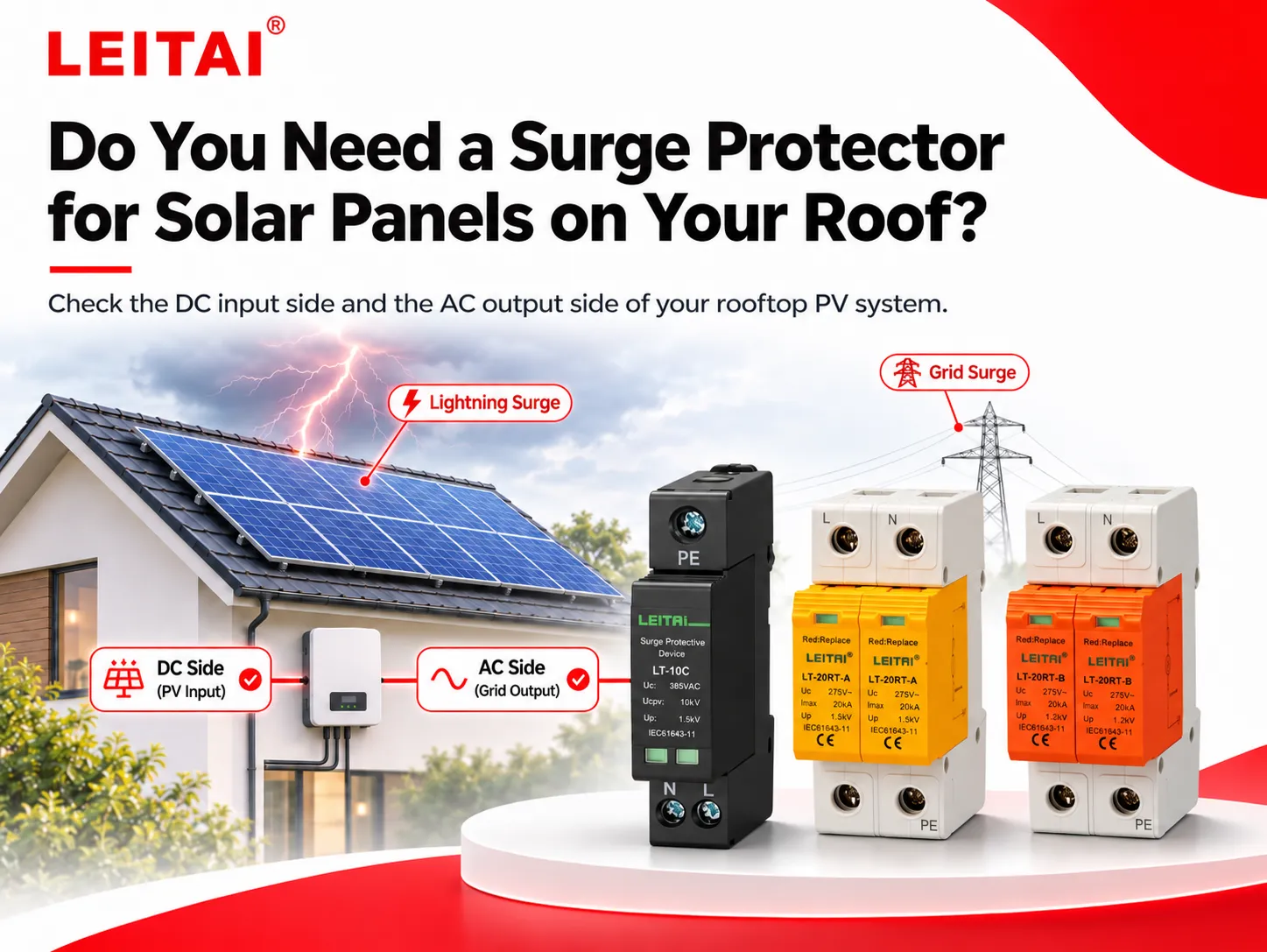
As for photovoltaic installations, it is necessary to treat PV DC and inverter AC sides separately. For battery circuit, it is required to use only the SPD which suits the specific DC system in question according to the manufacturer’s specifications and instructions.
One should check the maximum voltage, polarity and type of earthing scheme of the system, protection modes, fault current capacity, and DC back up protection required.
Where LEITAI Surge Protective Devices Fit
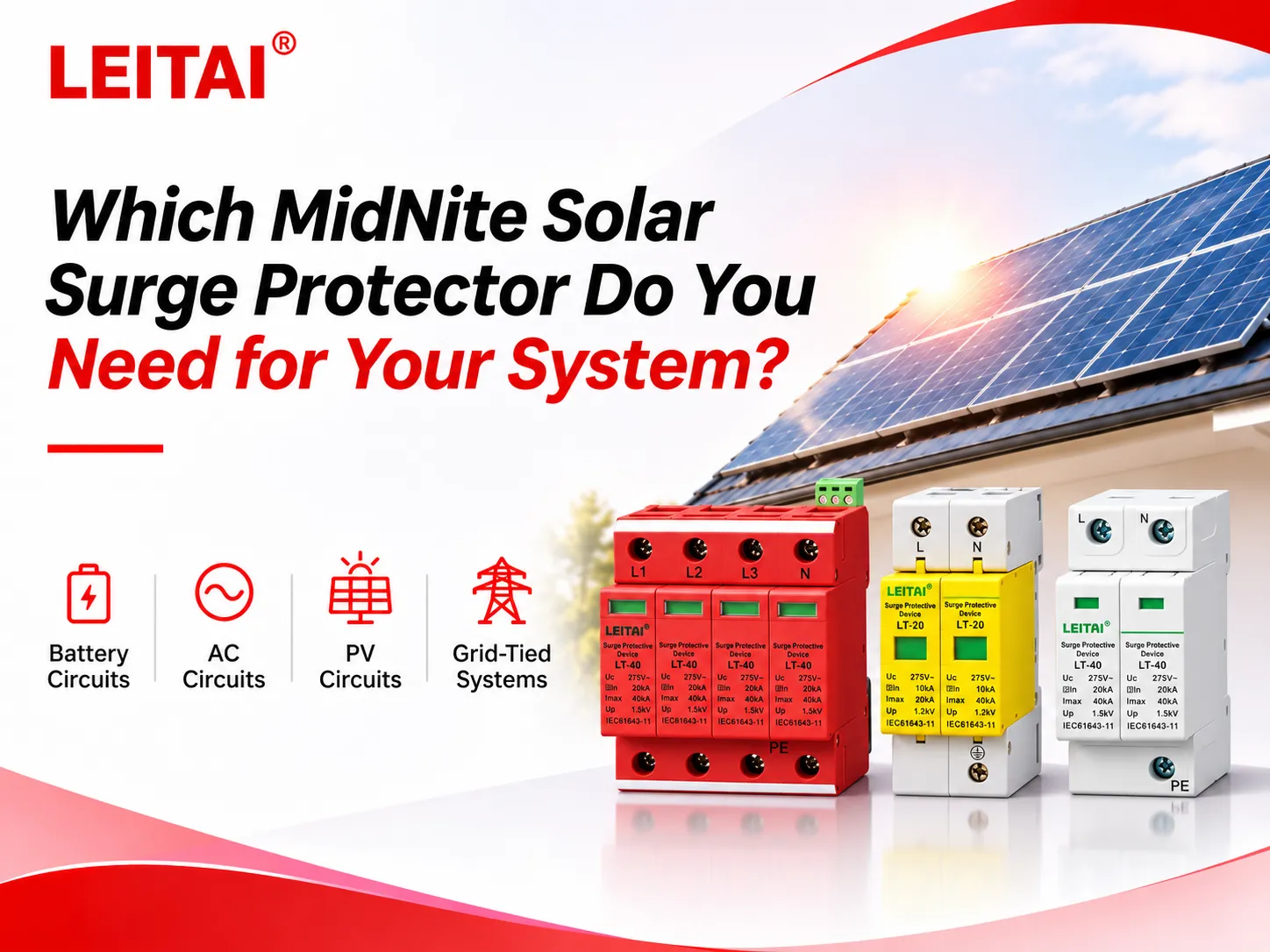
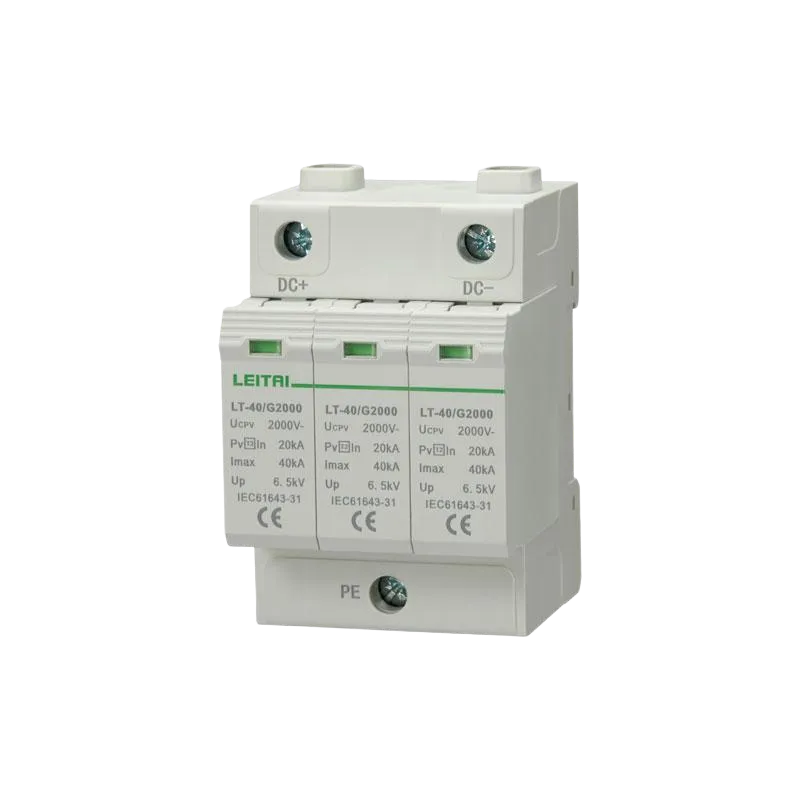
LEITAI offers AC surge protective devices, DC surge protective devices and Type 1 SPDs for different surge protection applications.
If an individual project is to be undertaken, the correct model must be chosen based on the published datasheet and the conditions of the electrical installation. For a DC application, one needs to pay special attention to the operating voltage, polarity, protection modes, and the use specified by the manufacturer.
In order to be able to ask for a requisition, one has to inform about the following:
What kind of voltage is in the necessary system, whether it is alternating current or direct current.
What kind of the earthing is present and which modes of protection are necessary;
Where it is planned to install the appliance, and what conditions are expected in that location;
How high short-circuit current can get and if any backup protection devices are necessary;
What values of In, Imax or Iimp, Uc, and Up are needed for the specific application.
Frequently Asked Questions
What is the maximum amperage a surge protector can handle?
Surge protectors are not the same, and as a result, their current load can fluctuate from one unit to another. A plug-in protector can indicate continuous load current of 15 A on its label. The surge ratings are something separate and may be shown in joules or peak current. A wall-mounted SPD can show In or Imax or the surge current values in kA. One needs to check what the manufacturer refers to as the rating.
What is nominal discharge current?
Nominal discharge current (In) is the maximum current of a certain type of impulse used to test an SPD according to a specific scheme of tests. It may be found in many SPD specifications connected with the 8/20µs signal. The nominal discharge current does not mean the regular current provided to the connected electrical device.
Is 200 or 600 joules better for surge protection?
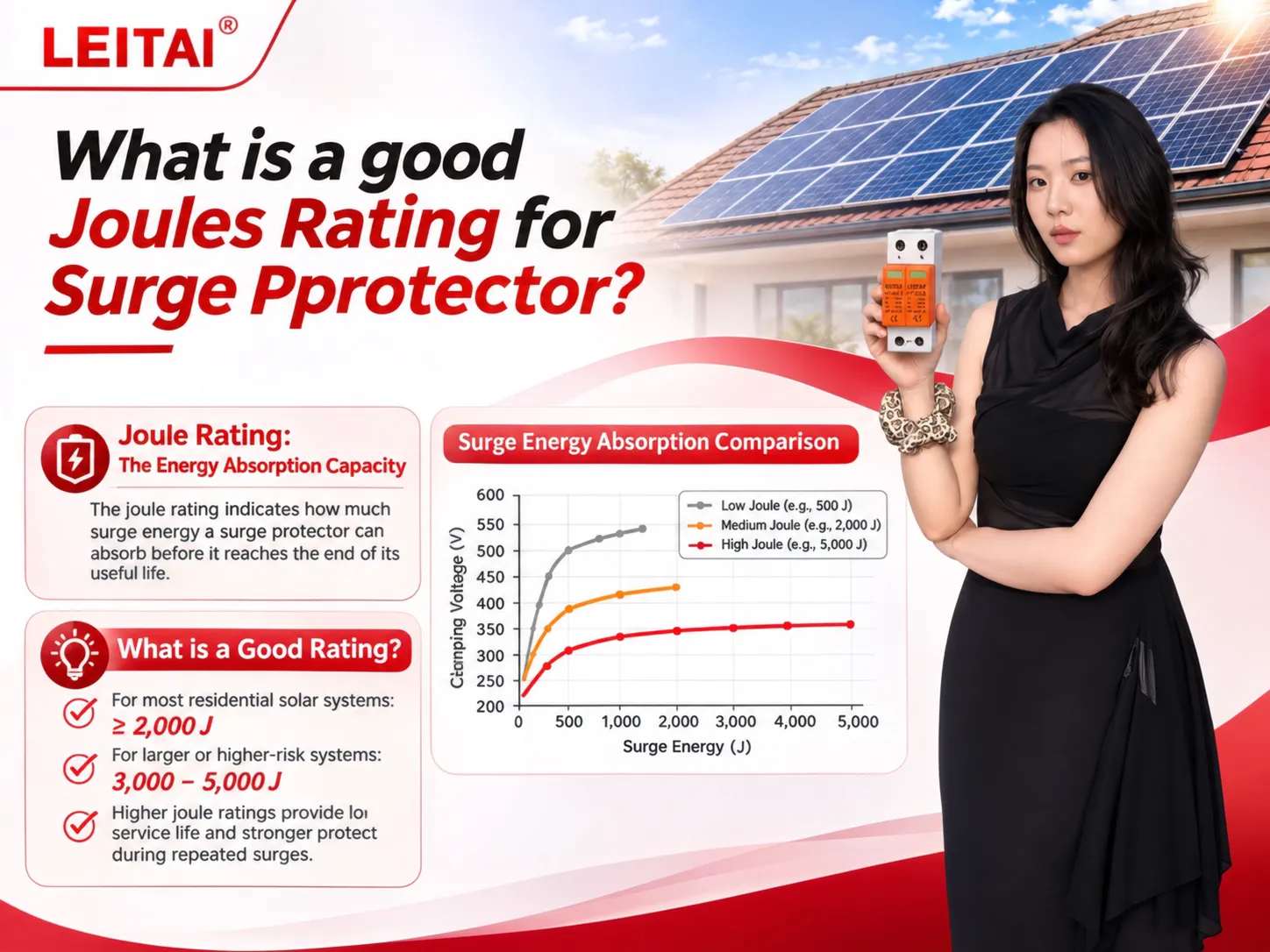
Among otherwise matching plug-in protectors tested and marked according to the same standards, a rating of 600 joules means a bigger energy rating than 200 joules. However, joules do not define the actual voltage protection level of the device, confirm the protection certification, etc. It is important to check all relevant product information.
Is 900 joules of surge protection enough for my electronics?
There is no universal value of joules that guarantees protection for all devices from every surge. It is better to follow the manufacturer’s recommendations concerning the right level of protection.
References
- Renogy — 12 V 200 Ah Core Series Battery Specifications
- Rockwell Automation — Surge Protective Devices Application Note
- Schneider Electric — Acti9 iPF K 40, A9L15687
- Phoenix Contact — VAL-MS-EE-T2-1+1-320-FM
- DEHN — Surge Protection Catalogue
- Eaton — PSPD Series Technical Data
Conclusion
Maximum continuous discharge current tells you about a battery’s ability to supply a load under specified conditions. SPD Imax describes a peak surge-current test. They use different time scales and serve different purposes, even though both specifications contain the word “discharge.”
For a battery system, start by checking the battery, inverter, wiring and protective-device ratings. For surge protection, consider the complete SPD specification—including voltage, current waveform, protection level and installation conditions—rather than selecting a device by Imax alone.