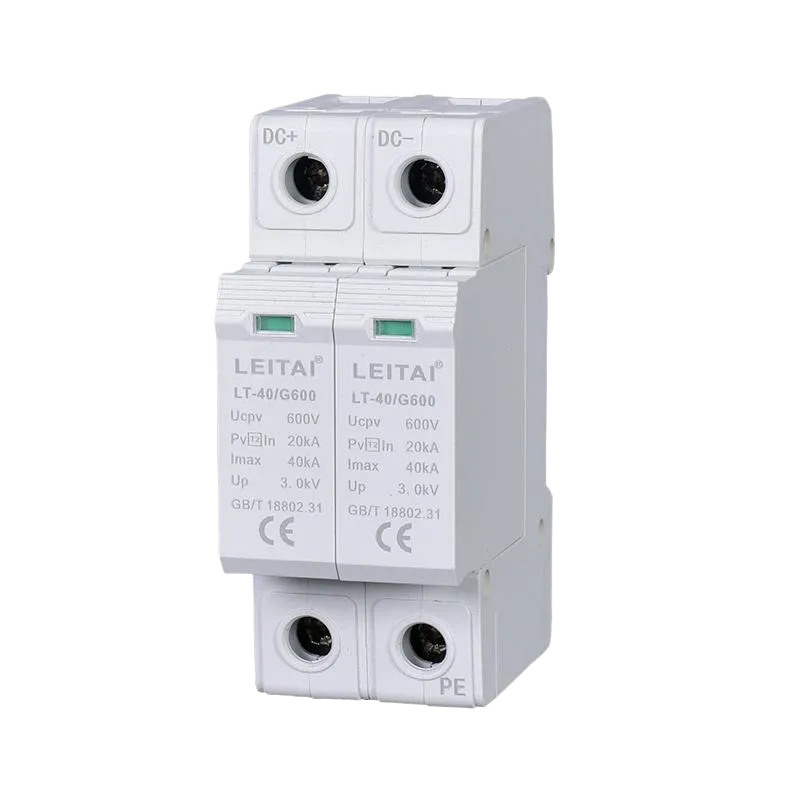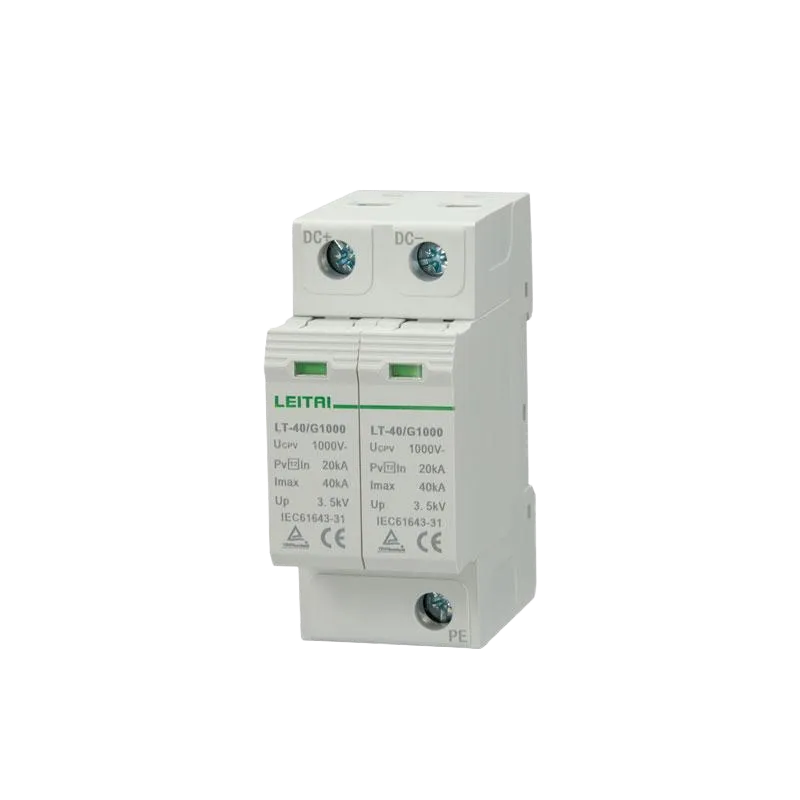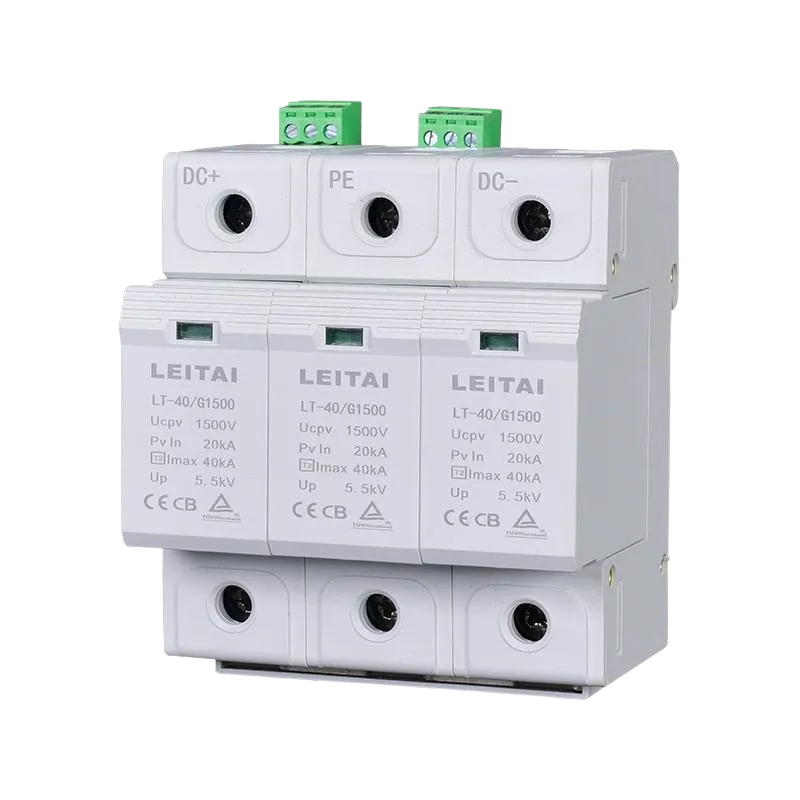

Every surge protector (or surge-protected power strip) features a specification that is often overlooked by consumers: the joule rating. The joule rating of surge protectors does matter—it determines whether your electronic devices can survive a voltage spike (surge). This article explores what the joule rating signifies, how much protection (in joules) different devices require, and how this rating relates to “clamping voltage” and the UL 1449 standard.
Concise answer: A good joules rating for a surge protector is roughly 1,000 to 2,000 joules for everyday electronics such as routers, printers and laptops, and 2,000 joules or more for desktop computers, gaming consoles and home theater gear. Consumer safety guidance treats 200 to 400 joules as the basic floor and 600 joules or more as better. Joules show how much energy the unit can absorb over its life, so also check for a voltage protection rating of 400 V or lower, a UL 1449 listing and a working status light, and plan to replace plug-in units every three to five years.
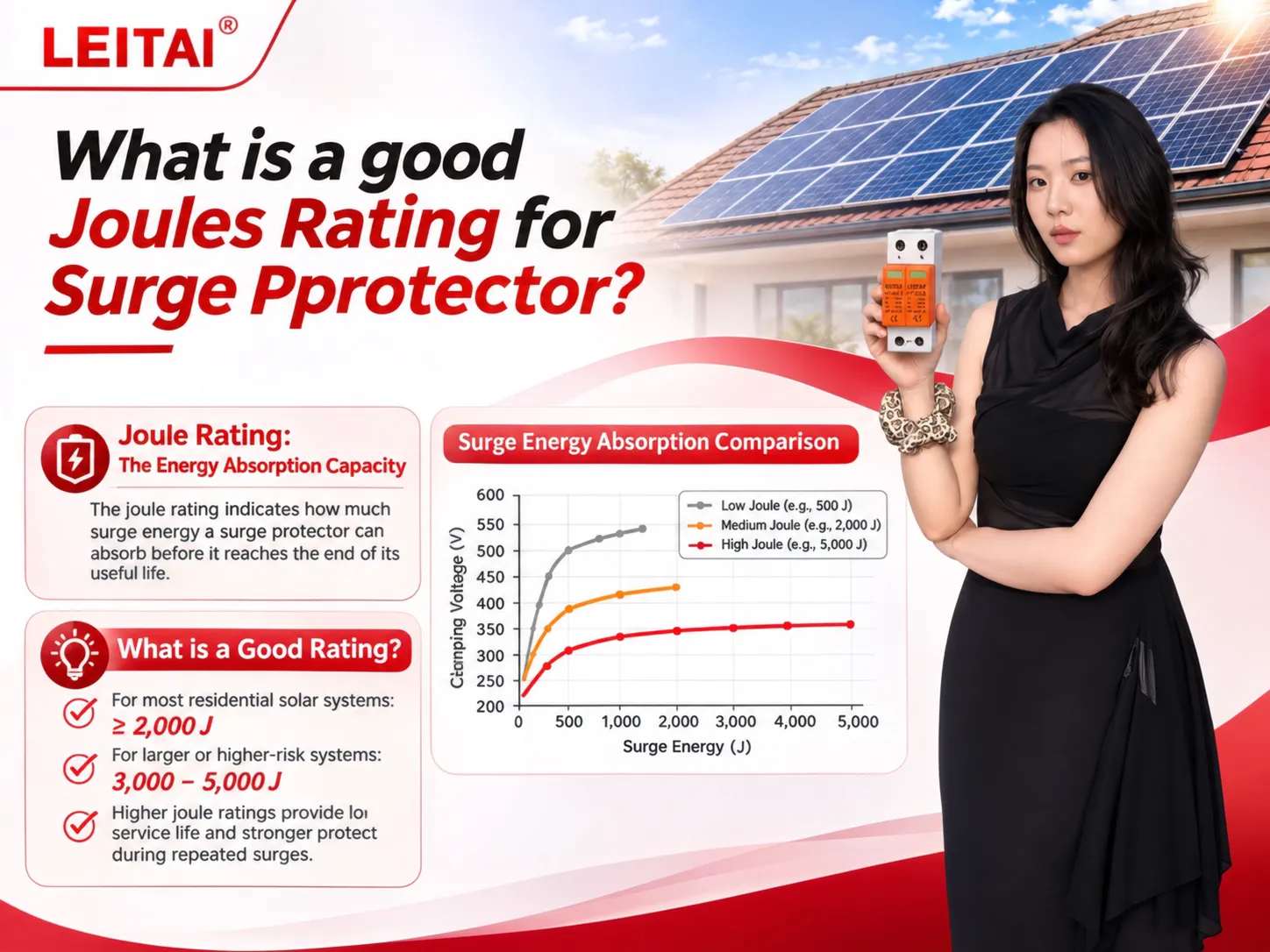
What a Joule Rating Actually Measures
Simply put, a joule rating acts like a “fuel tank” for a surge protector. It represents the total amount of energy the device can absorb before its internal components—such as metal-oxide varistors (MOVs)—burn out or degrade. Because this is a consumable metric, each surge absorbed depletes a portion of that capacity; after absorbing multiple large surges, the device will age, and its protective capability will gradually decline. For example, if a surge protector with an 800-joule rating absorbs eight surges of 100 joules each, its capacity will be completely exhausted.
It is important to note that a surge protector’s joule rating is not permanent. It decreases over time and with repeated exposure to surges, eventually leading to total failure. Since the rating reflects the device’s capacity to absorb surge energy, every absorption event causes slight degradation to the internal components (primarily the MOVs), effectively consuming part of the device’s “lifespan.” Even without major lightning strikes, these internal components will naturally age and lose performance. Therefore, the value indicated on the packaging is merely an initial figure—not a guarantee of performance over several years. It is recommended to check the status indicator lights every six months and replace the unit if it has failed, ensuring that your equipment remains protected.
Additionally, there are two key points to keep in mind:
1. A surge protector’s joule rating only indicates its capacity to absorb surge energy; it is not directly equivalent to its overall lightning protection capability.
2. Most surges are not caused by lightning storms but originate from within the building itself—for instance, surges generated when large appliances like motors, air conditioners, or refrigerators are switched on or off. About this point, can read Eaton’s Tripp Lite.
How Many Joules Do You Need?
Generally speaking, the more valuable or sensitive a device is, the higher the level of protection (in joules) it requires.
| Protection Level | Joule Rating | Suited For |
|---|---|---|
| Basic | Up to 1,000 joules | Lamps, digital clocks, blenders and other inexpensive devices |
| Good | 1,000 to 2,000 joules | Power tools, printers, copiers, routers and general office equipment |
| High | 2,000 joules and above | Home theater systems, gaming consoles and computers that store important data |
In a typical home environment, the level of protection required—measured in joules—varies significantly depending on what is being protected. For most everyday scenarios, a capacity of up to 500 joules is sufficient to cover the vast majority of common risks.
Joules Are Only Half the Story: Check These Specs Too
A Joule rating is merely a reference metric representing energy absorption capacity. While a higher value indicates an ability to withstand larger surges, it does not automatically guarantee superior protection. Other critical factors that determine whether your equipment is truly protected include:
• Voltage Protection Level (Up): The maximum residual voltage present across the device when it is triggered; a lower value is better. For electronic equipment, an Up value of < 1.5kV is generally required, while for power distribution systems, this threshold can be up to 2.5kV.
• Nominal Discharge Current (In): The peak current based on an 8/20μs waveform. This is a core parameter for Class II (Type 2) tests; 5kA is common for household applications, while 20–40kA is typical for power distribution cabinets.
• Maximum Discharge Current (Imax): The peak surge current the device can withstand under extreme conditions. This value is higher than In, but passing the In test does not guarantee that the device can also withstand the Imax level.
• Impulse Current (Iimp): The capacity to handle lightning-related surge currents, based on a 10/350μs waveform. This is the primary metric for Class I (Type 1) protection (at the main service entrance). The energy ratio between this and an 8/20μs waveform is approximately 1:17.5.
• Maximum Continuous Operating Voltage (Uc): The highest voltage the device can withstand indefinitely. Choosing a higher Uc can extend the device’s lifespan, but it also results in a higher residual voltage (Up); therefore, a balance must be struck.
| Spec | What It Tells You | What to Look For |
|---|---|---|
| Joule rating | Total surge energy the unit can absorb over its life | 1,000 to 2,000 joules or more for electronics |
| Voltage protection rating (VPR) | Voltage let through to connected devices | 400 V or lower, with 330 V the best common level |
| UL 1449 listing | The unit was tested as a surge protective device, not just a power strip | UL 1449 printed on the label |
| Protected and grounded lights | Whether surge protection is active and the outlet is grounded | Both lights on, or an audible replace alarm |
| Thermal fusing or automatic shutoff | Whether the unit cuts power when its protection is exhausted | Preferred over units that keep supplying unprotected power |
| Connected equipment warranty | Whether the maker repairs or replaces damaged devices | Read the claim limits and conditions |
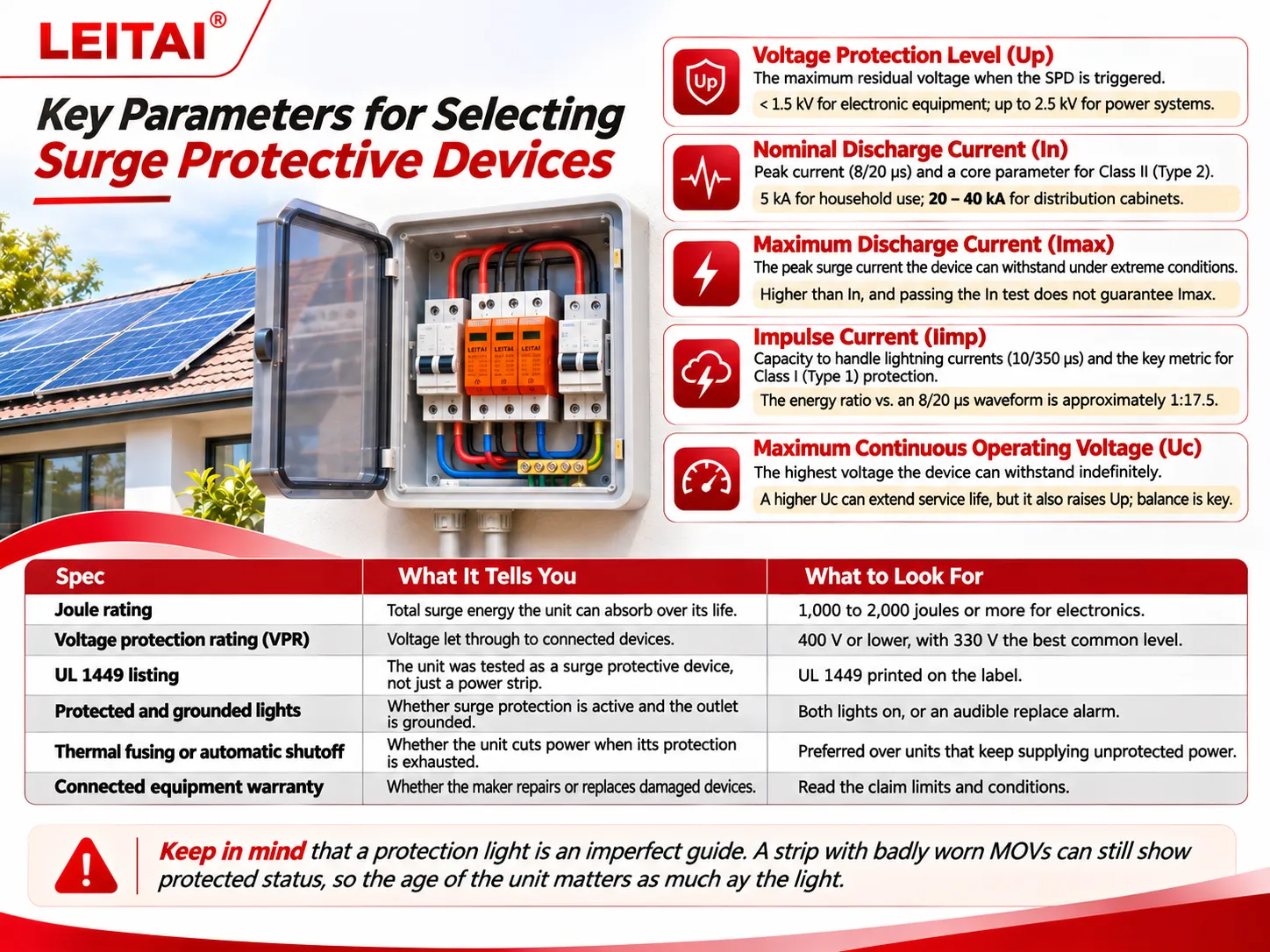
Keep in mind that a protection light is an imperfect guide. A strip with badly worn MOVs can still show a protected status, so the age of the unit matters as much as the light.
What Sits Inside a High-Joule Surge Protector
The energy rating of a power strip-style surge protector is primarily determined by the energy-absorption capacity of its internal metal-oxide varistor (MOV) components. However, this rating does not represent the total amount of energy the power strip itself can absorb; rather, it signifies the maximum pulse energy—expressed in joules—that the MOV can safely dissipate. A higher joule rating is not necessarily better; one must also consider whether the MOV’s maximum continuous operating voltage (Uc), voltage protection level (Up), and maximum discharge current (Imax) are appropriate for the specific electrical environment.
During the production process, only products that pass qualification testing are marked with a joule rating on their housing. The qualification of a surge protective device depends primarily on the quality of the varistor and the assembly process. For consumers, the most practical advice is to look for authoritative certification marks and consult the full technical specifications; do not judge a product’s performance solely based on a “high joule rating” displayed on the packaging.
Best High-Joule Surge Protectors to Compare
There is no single best unit for every setup. The models below are widely sold plug-in strips with published joule ratings, and they show how the number varies between brands.
| Model | Joule Rating | Outlets | Notable Features |
|---|---|---|---|
| Belkin PivotPlug 12-Outlet (BP112230-08) | 4,320 joules | 12 | 8 ft cord, pivoting outlets, coax and phone line protection, connected equipment warranty |
| Belkin Professional 12-Outlet (BE112234-10) | 4,120 joules | 12 | 10 ft cord for larger workspaces |
| Eaton Tripp Lite Protect It! (TLP1208TELTV) | 2,880 joules | 12 | 8 ft cord, tel, modem and coax protection, UL 1449 listed, cuts power when protection is exhausted |
Before making a purchase, always verify the joule rating and Voltage Protection Rating (VPR) in the manufacturer’s official catalog. Product pages on e-commerce sites or third-party review websites may sometimes provide conflicting joule ratings for the same model. Furthermore, some products on the market claim to offer protection of 4,500 joules or higher without any clear, verifiable certification. A stated joule rating is only meaningful if the product has been certified to the UL 1449 standard and clearly displays its Voltage Protection Rating.
What Should Never Be Plugged Into a Surge Protector
It is strongly advised against plugging high-power heating appliances or devices with built-in surge protection into surge-protected power strips. Specifically, you should avoid the following:
1. High-power appliances: Devices such as air conditioners, electric water heaters, microwave ovens, induction cooktops, electric heaters, and hair dryers—all of which have high power consumption and draw large currents upon startup.
2. Devices with built-in surge protection: Connecting a device that already contains an internal surge protector to a surge-protected power strip may result in insufficient power input, potentially preventing the device from turning on or causing unstable operation.
How to Choose and Maintain a Surge Protector
- Check whether the product complies with recognized certification standards, such as UL, CE, or IEC. Verify its specified “joule” rating; if a power strip does not list a joule rating, it is likely just a standard power strip without surge protection.
Select an appropriate joule rating based on your equipment’s needs: for general electronic devices, a rating of 1,000 to 2,000 joules is recommended, while for computers and home theater equipment, a rating of 2,000 joules or higher is advised.Choose a product with a Voltage Protection Rating (VPR) of 400 volts (V) or lower. Prioritize models that include features such as protection status indicators, audible alarms, or automatic power-cutoff functions.
Plug the surge protector directly into a grounded wall outlet; each wall outlet should be used for only one surge protector.Inspect your surge protectors twice a year—especially following any lightning strikes or significant power disturbances. If any signs of malfunction or damage are detected, replace the unit promptly.
For comprehensive protection, install a whole-house surge protection device at the electrical distribution panel, and supplement this by using surge-protected power strips at the point of use for sensitive electronic equipment.
FAQ
How many joules should a good surge protector be?
For most home and office environments, a rating of at least 500 joules is recommended; 1,000 to 2,000 joules is a safer choice, while high-value equipment may warrant 3,000 joules. The joule rating represents the total amount of surge energy a device can absorb—a higher number indicates a greater capacity to handle large surges—though it is not the only metric to consider.
What is the best high-joule surge protector?
No single product is suitable for every scenario. Among mainstream power strips, the Belkin PivotPlug (12-outlet model) offers a 4,320-joule rating and includes a warranty for connected equipment. The Eaton Tripp Lite TLP1208TELTV has a 2,880-joule rating and features an automatic shut-off function that cuts power once its protective capacity is exhausted. When making a purchase, consider a combination of factors: the joule rating, the Voltage Protection Rating (VPR), UL 1449 certification, warranty terms, and the layout of the outlets.
What should never be plugged into a surge protector?
High-power household appliances—such as air conditioners, refrigerators, freezers, microwaves, ovens, washing machines, and dryers—should not be connected to surge protectors. Furthermore, never “daisy-chain” (connect in series) one surge protector or power strip to another. Such loads can cause a power strip to overheat or become overloaded; even a high joule rating does not increase the device’s maximum current-carrying capacity.
Is 200 or 600 joules better for surge protection?
600 joules is better. It can absorb three times as much energy as a 200-joule unit before failing. A rating of 200 to 400 joules provides only basic protection, whereas 600 joules or higher offers a superior level of defense. For expensive equipment, both of these values are on the low side; therefore, for devices like computers and televisions, you should choose a product with a rating of 1,000 joules or higher, while also paying attention to its Voltage Protection Rating (VPR).
Is 4000 joules enough for a surge protector?
For most home and office environments, it is more than enough. However, it cannot protect against a direct lightning strike, so it is best to unplug high-draw electronic devices during thunderstorms.
References
- Eaton Tripp Lite: What Are Surge Protector Joules and How Many Do I Need
- Eaton Tripp Lite: Surge Protector Buying Guide
- CyberPower: Joules, the Key to Surge Protection
- NMSU Safety: What to Know About Surge Protectors
- Hubbell: UL 1449 3rd Edition Overview
- Belkin: PivotPlug 12-Outlet Surge Protector BP112230-08
- Eaton Tripp Lite: Protect It! 12-Outlet Surge Protector TLP1208TELTV
- UC Berkeley EH&S: Extension Cords and Surge Protectors Fact Sheet
- AARP: Tech Guru on Surge Protectors
- Lowe’s: Surge Protector Buying Guide
- Benlong: Surge Protection Device (SPD) Automatic Production Line
Conclusion
A good joule rating of surge protectors starts around 1,000 to 2,000 joules for everyday electronics and moves to 2,000 joules or more for computers, gaming consoles and home theater equipment. A 200-joule unit is the bare minimum, 600 joules is better, and 4,000 joules is enough for most homes and offices. The number only tells part of the story: choose a UL 1449 listed unit with a VPR of 400 V or lower, keep heavy appliances off the strip, and replace plug-in protectors every three to five years so the capacity on the box is still there when a surge arrives.