
With the advent of the AI era, human life has taken another step toward a postmodern society. The AI market has generated an immense demand for power infrastructure, while shifting perspectives among the dominant ethnic groups in developed nations—influenced by prevailing leftist cultural currents—have further shaped the landscape. Both the expansion of computing centers and the transition toward green energy necessitate the continuous evolution of existing power grids; meanwhile, the reliance of daily life on a reliable electricity supply remains as strong as ever. These trends have created new growth potential for the surge protection systems market, though the specific demand for such protection varies by region.
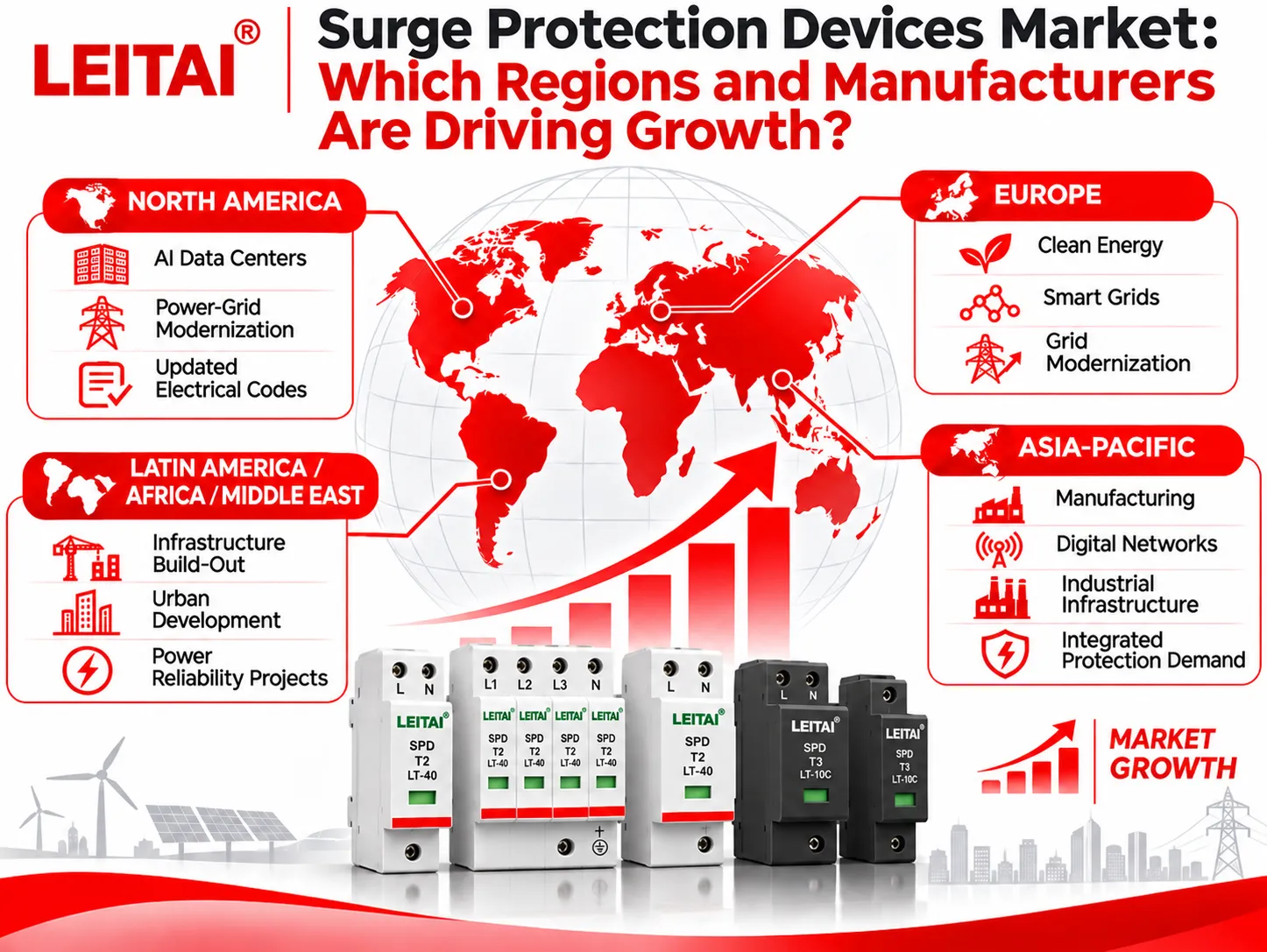
In North America, key drivers include the construction of data centers, the modernization of power grids, and the introduction of new electrical codes. In the Asia-Pacific region, the area’s role as the “world’s factory” for manufacturing remains irreplaceable, while the proliferation of digital networks has given rise to various applications that require integrated protective measures. Europe is focusing on clean energy and the modernization of its power grids, whereas in Latin America, Africa, and the Middle East, ongoing infrastructure projects continue to provide opportunities for the surge protection devices market.
In short: MarketsandMarkets estimates that the global surge protection devices market will grow from USD 2.98 billion in 2025 to USD 3.95 billion in 2030. Asia-Pacific is forecast to record the fastest regional growth in its report, while North America remains a major market. Estimates of which region is currently the largest differ between research firms.
How Big Is the Surge Protection Devices Industry?
The market report released by MarketsandMarkets in June 2025 estimates the worldwide surge protection devices sector to be worth USD 2.98 billion in 2025 and forecast to be worth USD 3.95 billion by 2030. This marks a CAGR of 5.8% during the forecast period.
The figure for the difference between the two periods is USD 970 million. The prediction for 2030 is only that – a prediction. It does not guarantee future sales. The actual numbers are determined by infrastructure expenditure, construction activity, product pricing, standards, supply chains and scheduling.
The report covers several categories of products, from hard-wired to plug-in and line-cord appliances, and accounts for technologies’ Type 1, Type 2 and Type 3 in its scope; thus, it covers more than just the DIN-rail SPD modules installed in distribution boards.
| Market Indicator | MarketsandMarkets Estimate | How to Read It |
|---|---|---|
| Global market, 2025 | USD 2.98 billion | Estimated market value for the base year |
| Global market, 2030 | USD 3.95 billion | Forecast, not actual revenue |
| Forecast CAGR | 5.8% | Projected average annual growth from 2025 to 2030 |
| Forecast increase | USD 970 million | Difference between the reported 2025 and 2030 values |
| Fastest-growing region | Asia-Pacific | Forecast regional CAGR of 6.2% for 2025–2030 |
According to the report of MarketsandMarkets, the segment with the Type 2 accounted for 49.8% of the market in 2024; however, it is necessary to mention that this percentage dealt with this particular report’s technologies’ segmentation for that particular year only and is not applicable to the total number of the Type 2 installations or products from every producer.
Which Region Has the Biggest Surge Protection Devices Market?
Both North America and Asia-Pacific are significant markets for SPDs. The ranks of regions differ according to the source of research.
While Grand View Research recognizes North America as the biggest regional market forecast for 2025 at 39.5 percent of the market, MarketsandMarkets estimates the Asia-Pacific market at USD 1,069.8 million and North America at USD 958.4 million.
These figures cannot be used to create an aggregated ranking or calculation of market shares because of differences in product definitions, geographic scope, data sources and modeling approaches used by research companies. The safest conclusion is that both regions are major demand hubs in the market, although according to MarketsandMarkets the forecast for Asia-Pacific shows a higher growth compared to North America up to 2030.
| Research Source | 2025 Regional Finding | Qualification |
|---|---|---|
| MarketsandMarkets regional pages | Asia-Pacific: USD 1,069.8 million; North America: USD 958.4 million | These are estimates published on separate regional pages. |
| Grand View Research | North America: 39.5% of the global market | The regional share uses this firm’s own market definition and model. |
This distinction is important for companies working in the market. North America offers substantial demand due to data centers and building power protection needs, while Asia-Pacific combines a big mature market with a good outlook for growth.
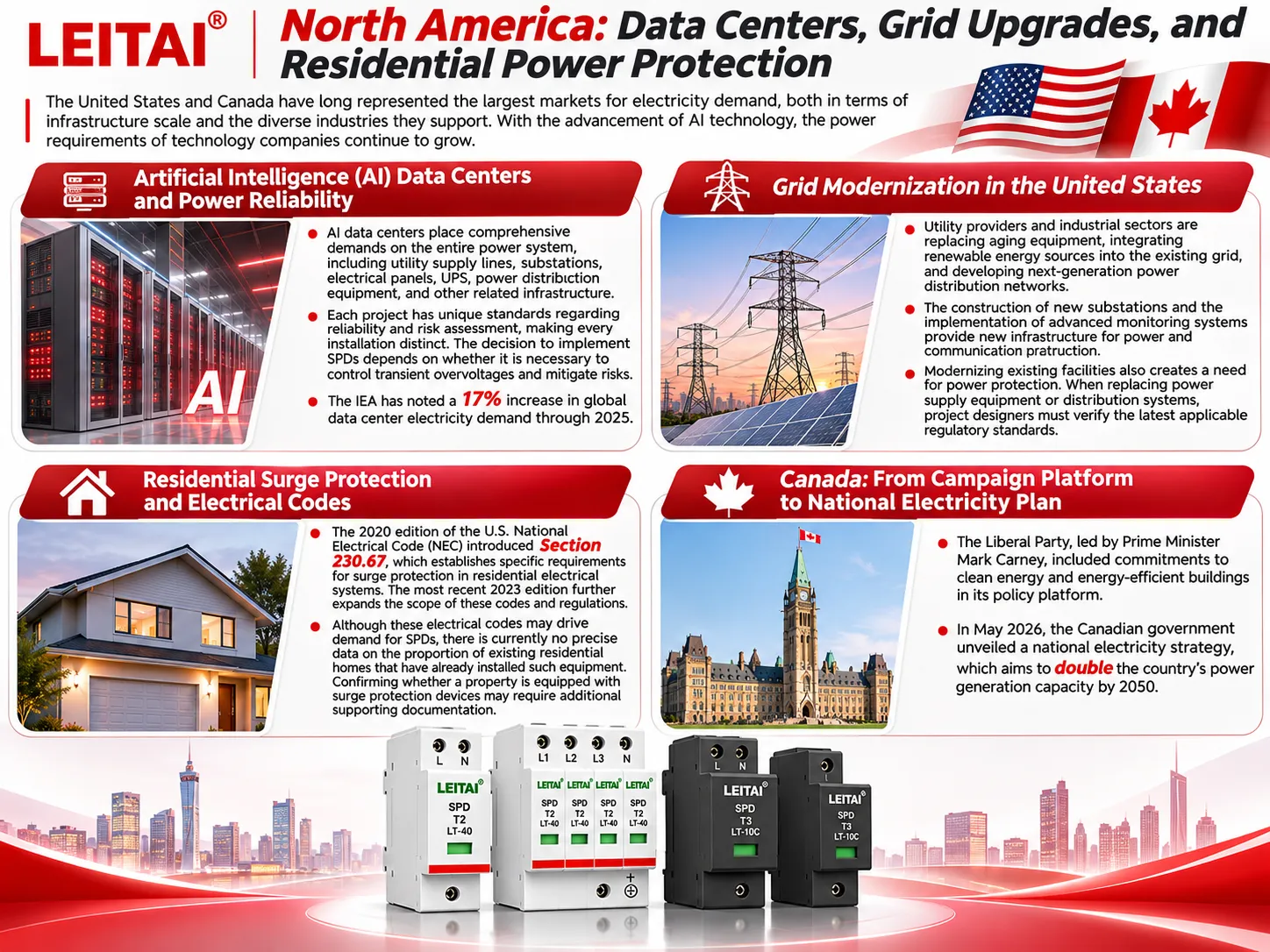
North America: Data Centers, Grid Upgrades, and Residential Power Protection
The United States and Canada have long represented the largest markets for electricity demand, both in terms of infrastructure scale and the diverse industries they support. With the advancement of AI technology, the power requirements of technology companies continue to grow.
Artificial Intelligence (AI) Data Centers and Power Reliability
AI data centers place comprehensive demands on the entire power system, encompassing utility supply lines, substations, electrical panels, uninterruptible power supplies (UPS), power distribution equipment, and other related infrastructure.
Each project has unique standards regarding reliability and risk assessment, making every installation distinct. The decision to implement surge protective devices (SPDs) depends on whether it is necessary to control transient overvoltages and mitigate risks to the electronic equipment housed within the data center.
The International Energy Agency (IEA) has noted a 17% increase in global data center electricity demand through 2025. While this figure reflects power consumption rather than direct sales of surge protective devices, it underscores the growing importance of power protection and distribution. Source:IEA report.
Grid Modernization in the United States
Utility providers and industrial sectors are replacing aging equipment, integrating renewable energy sources into the existing grid, and developing next-generation power distribution networks. The construction of new substations and the implementation of advanced monitoring systems provide new infrastructure for power and communication protection.
Modernizing existing facilities also creates a need for power protection. When replacing power supply equipment or distribution systems, project designers must verify the latest applicable regulatory standards.
Residential Surge Protection and Electrical Codes
The 2020 edition of the U.S. National Electrical Code (NEC) introduced Section 230.67, which establishes specific requirements for surge protection in residential electrical systems. The most recent 2023 edition further expands the scope of these codes and regulations. Source:NEC report.
Although these electrical codes may drive demand for surge protective devices (SPDs), there is currently no precise data on the proportion of existing residential homes that have already installed such equipment. Confirming whether a property is equipped with surge protection devices may require additional supporting documentation.
Canada: From Campaign Platform to National Electricity Plan
The Liberal Party, led by Prime Minister Mark Carney, included commitments to clean energy and energy-efficient buildings in its policy platform. In May 2026, the Canadian government unveiled a national electricity strategy, which aims to double the country’s power generation capacity by 2050.
Asia-Pacific Meets the SPD Prominence in The Forecast
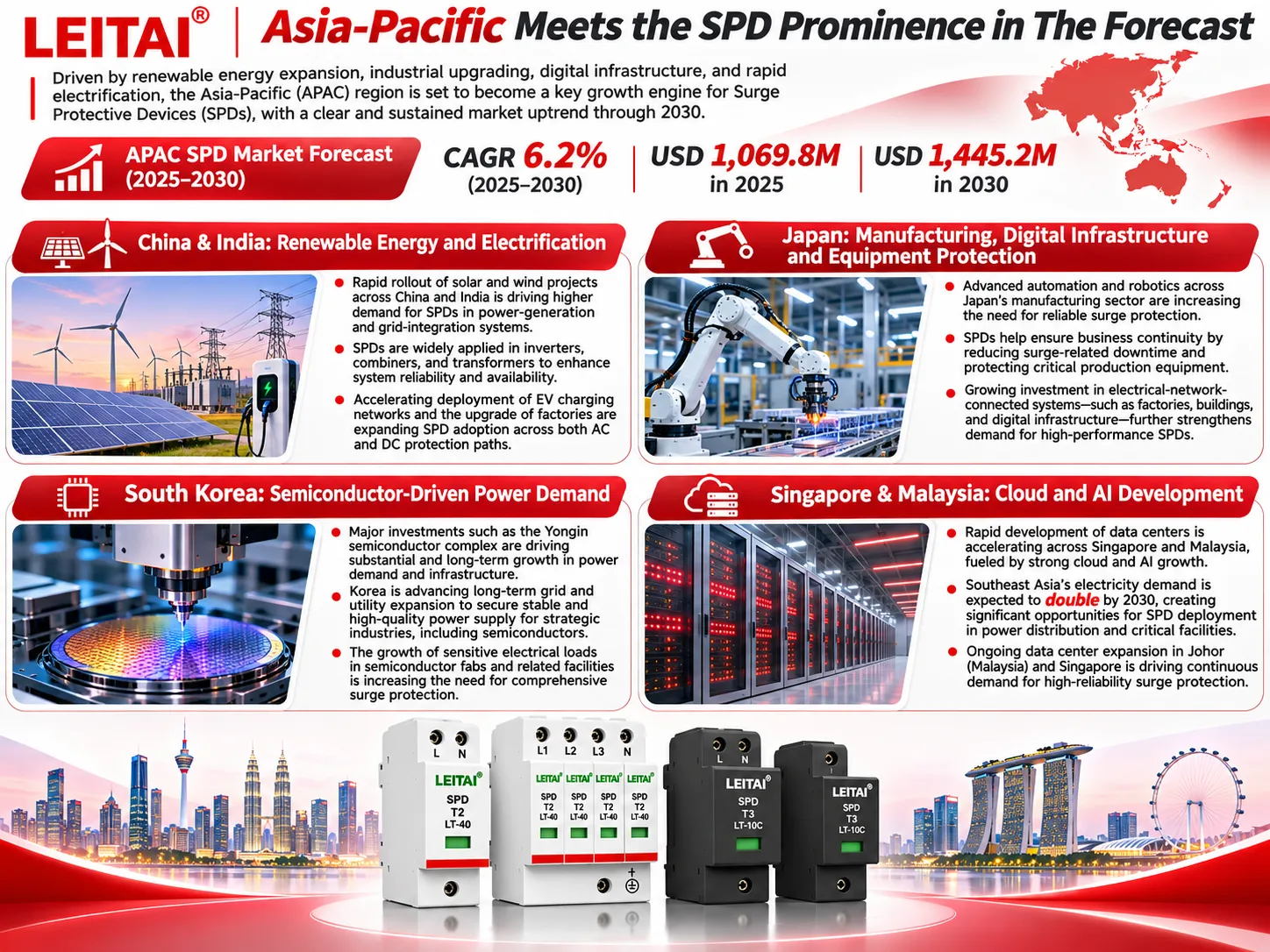
According to the analysts at MarketsandMarkets, the Asia-Pacific market for SPD would record a compound annual growth rate (CAGR) of 6.2% during the period 2025 to 2030. On its website, this market research company estimates the market to grow from USD 1,069.8 million in 2025 to USB 1,445.2 million in 2030.
No single application drives growth in this region. Multiple industries, including solar and wind energy sectors, automation, electric vehicle charging, data centers and growing distribution networks, utilize electrical equipment that requires proper shielding against transients.
China and India Relating to Renewable Energy and Electrification
The extensive construction of renewable energy projects has led to a rise in the number of inverters, combiners, transformers, monitoring systems and electrical distribution points. Protection of solar equipment cannot ignore the fact that this equipment has exposed alternating current (AC) and direct current (DC) wires; thus, protection must contemplat both sectors separately.
In highly industrialized China and India, development of power stations will increase usage of SPDs in factories, charging stations and subsequent distribution systems. The suitable devices depend on existing voltage and exposition.
Japan Adoption of Manufacturing, Digital Infrastructure and Equipment Protection
In Japan, efforts to adopt automation, advanced manufacturing and robotics have been in focus. Manufacturing companies care much about business continuity and safeguarding their equipment, which is connected to the electrical networks.
Digital infrastructure offers yet another way for SPD market growth. In fact, operators need to analyze any electrical systems and develop appropriate strategies.
South Korea’s semiconductors example
The example of semiconductor industry growth proves the relationship between advanced manufacture and electricity. According to the Ministry of Trade, Industry and Energy of South Korea, the electricity network systems and water supplies will be changed due to the operations being carried out in relation to Yongin semiconductor complex as the latter should consume more than 10 GigaWatts by 2053 when the entire investment process is finished.
In fact, it is a long term requirement for the supply of electricity and not the forecast of the SPD market development; however, the mention of it proves that expansion of electric network systems and industries leads to the emergence of many non-guarded electric appliances.
Singapore and Malaysia: Cloud and AI Development
Redington компании Redington has been engaged in cloud and artificial intelligence sector activities in Southeast Asia, especially in Singapore and Southern Malaysia. As the International Energy Agency predicts, electricity needed for data centers in Southeast Asia will double by 2030 and most scenarios will be realized thanks to Singapore and Malaysia.
Among the local investors in the region, there are various Chinese companies. For example, in June 2026 Alibaba Cloud reported the establishment of new public cloud around Johor State, Malaysia.
Europe: Renewable Energy, Smart Factories and Grid Modernization
Europe’s surge protection demand is linked to the integration of renewable power, building electrification and the modernization of transmission and distribution networks. Industrial automation and smart factories add more electronic controls and communication equipment to electrical installations.
Investment Requirements for the European Grid
The Commission of Europe has reported that nearly 40% of Europe’s grid network is more than 40 years old, and in the next decade, some EUR 584 billion is likely to be invested in the upgrade of the grid system. This money refers to electricity grid investment as a whole and not the forecast for the income form SPDs.
In the process of network modernization utilities, and construction companies are supposed to pay special attention to the efficiency of the appliances in use both new and existing ones. The phenomenon of surges can affect various equipment in different ways, including substations, distribution boards, renewable energy sources, generators, as well as monitoring solutions.
Compliance and Product Selection
As for low-voltage SPD products, the buyers can meet IEC and European national standards, including the requirements of IEC 61643 series and various EN standards. The specific market should pay attention to the applicable product standard, installation guidelines as well as national implementation and needed certification.
A SPD which works well for one earthing arrangement and voltage is not as a matter of course effective for another type of earthing arrangement. Nevertheless, European consumers usually want to receive detailed information about Uc, Up, In, Imax or Iimp, working modes of various devices, supplementary protection means, and appropriate applications. This means that manufacturers can receive high demand for solutions that will not always depend on pricing alone.
Latin America, the Middle East, Africa and Australia: Different Sources of Demand
Markets are not uniform as they differ in terms of electrical infrastructure, purchasing needs and susceptibility to lightning strikes. In this work, markets are grouped together for the sake of indicating some infrastructure solutions for surge protection.
| Market | Potential Demand Drivers | Protection Consideration |
|---|---|---|
| Latin America | Renewable generation, utility investment and communications infrastructure | Exposure and installation requirements vary by country and site. |
| Middle East | Solar projects, commercial construction and digital infrastructure | Consider system voltage, environmental conditions and project specifications. |
| Africa | Power access projects, communications networks and solar installations | Review power and communication paths, site exposure and maintenance access. |
| Australia | Solar generation, storage, commercial buildings and exposed infrastructure | Select products and installation methods for the applicable Australian requirements. |
Telecom facilities demonstrate that surge protection does not cover only main AC supply. In addition to AC supply, a telecom facility may also have some DC supplies, antennas, control systems and various communication devices. Depending on a certain design of the system, it might several paths, which should be investigated.
Similar to telecommunication facilities, a solar project may be made up of solar panels, DC circuits, inverters and AC grid. Each component of the project has its own specific voltages and requirements for surge protection. One type of product does not mean that it can be used in other circuits.
Who Are the Major Surge Protection Device Manufacturers?
The SPD market contains international electrical companies along with specialized surge protection producers, and local suppliers. The market position differs among products and application by geographical area.
According to Global Market Insights, Schneider Electric, ABB, Eaton, Siemens and Emerson Electric had an approximate market share of nearly 36% of the world’s surge protective device market in 2025. This refers to the data provided by the firm on the global market. This information does not come from the MarketsandMarkets report and is not referring to a particular premium segment.
| Manufacturer | Market Context | Typical Buyer Consideration |
|---|---|---|
| Schneider Electric | Electrical distribution and energy management | Compatibility with the distribution system and product ratings |
| ABB | Electrification and industrial electrical systems | Protection requirements, configuration and technical documentation |
| Eaton | Electrical distribution and power quality applications | Applicable listing, installation point and surge-current specifications |
| Siemens | Electrical infrastructure, industry and automation | System coordination and application-specific requirements |
| Emerson Electric | Industrial technology and automation markets | Suitability of the specific product for the equipment and circuit |
The above mentioned data provides the background for the companies’ operations. The statement does not mean that all of the companies provide the same SPD devices for the different countries and does not help calculate the verified percentages across the devices’ manufacturers.
The companies providing other types of products also supply the market, namely those concentrating on construction protection, industrial automation, telecommunication, and individual protecting components. The best project for a given installation depends on the appliance and its compatibility with the installation.
What Are Buyers Looking for in Modern SPDs?
As the electrical system is becoming more and more interconnected, buyers need more straightforward information about protection performance and the status of the device. Depending on the application of the SPD, the buyers may consider the following parameters:
Type of SPD (Type 1, Type 2, or Type 3) corresponding to the actual installation point, maximum continuous operating voltage and protection modes to be used for the electrical system, nominal and maximum discharge current ratings, or lightning impulse current ratings when applicable, voltage protection level and line coordination, short-circuit rating, back-up protection requirements, and others; visual indication or remote signaling if required; and tests, standards, and other certifications.
The company MarketsandMarkets speaks about the trend to utilise more smart monitoring and remote diagnostics. This is relevant to various installations as it indicates two types of monitoring: remote is valuable for unattended sites, while simpler visual indication is also meaningful for certain applications.
Where LEITAI Fits in the SPD Market
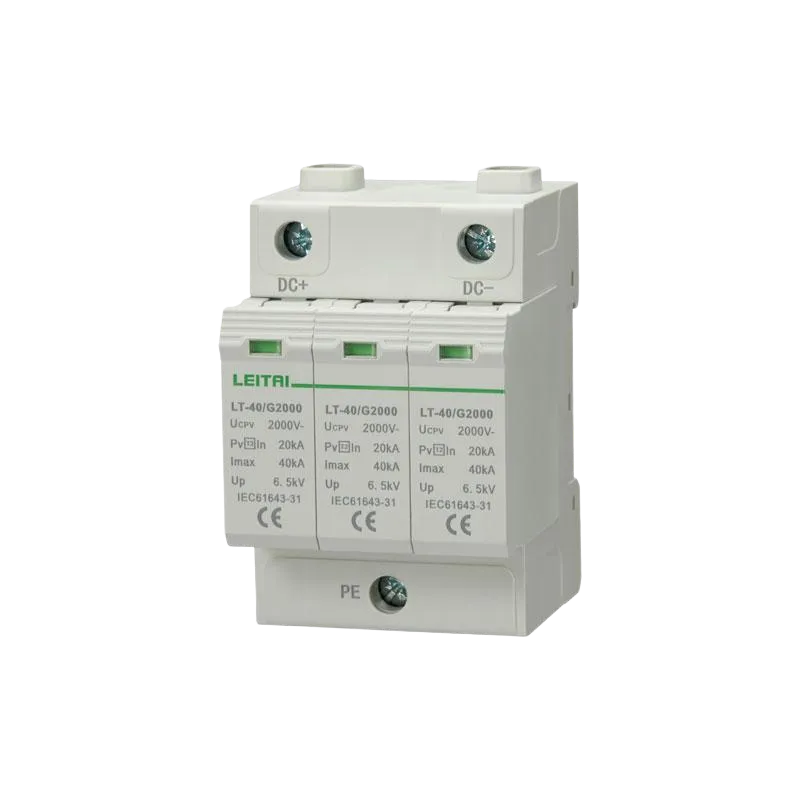
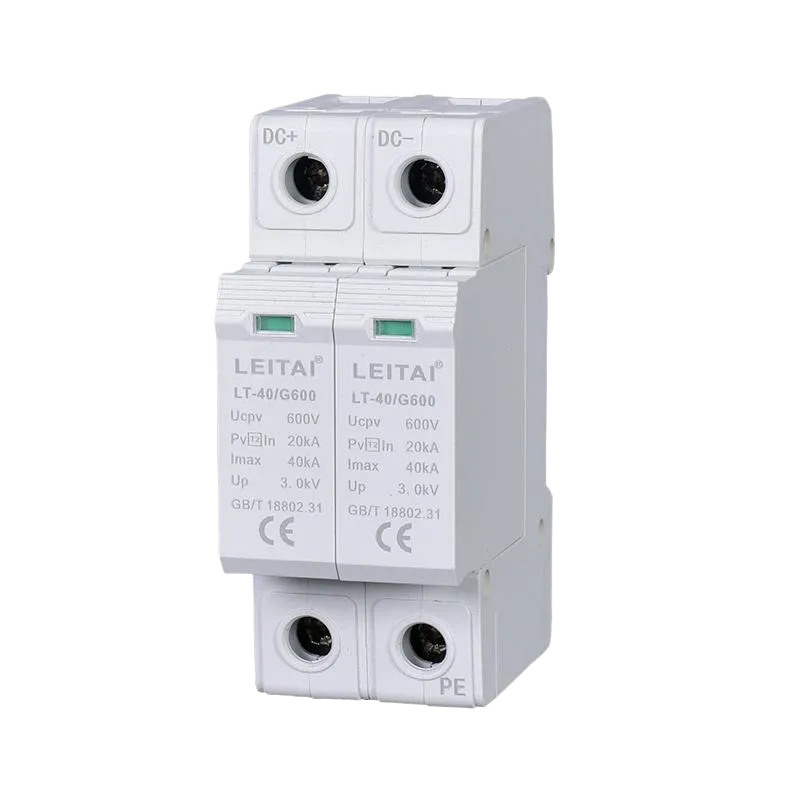
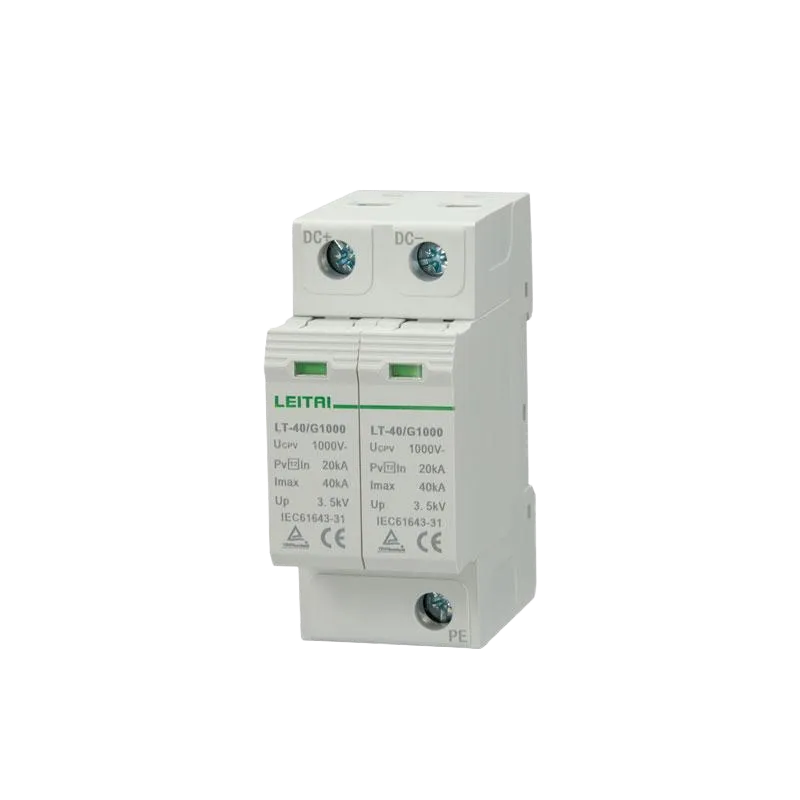
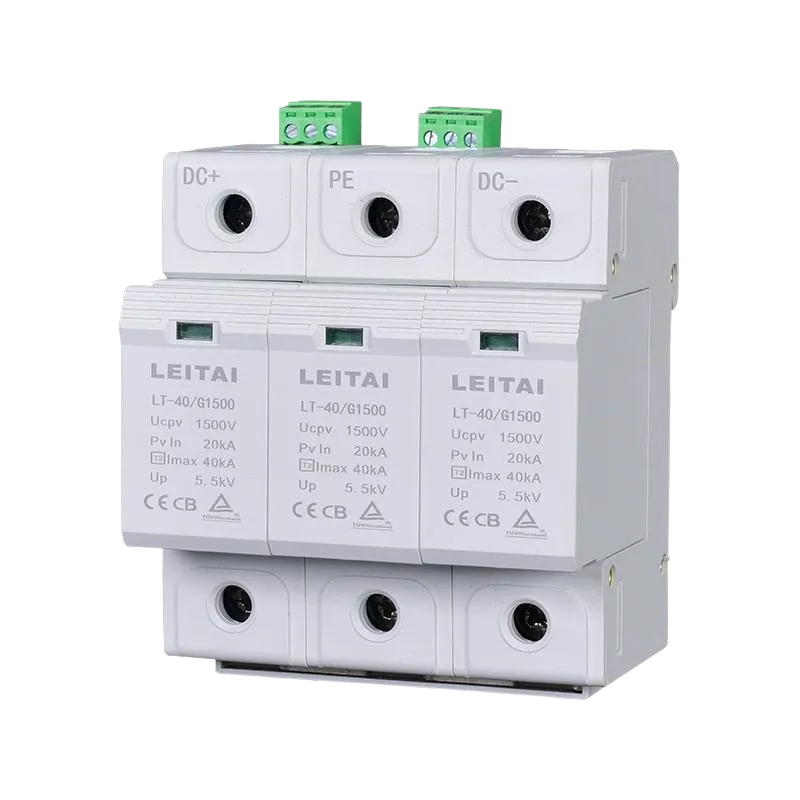
LEITAI’s product categories include AC surge protective devices, DC surge protective devices and Type 1 SPDs. The categories are adjusted to the specifics of the electrical applications and points of installation.
Let’s take, for example, the AC distribution board, a photovoltaic DC circuit, or the facility utilizing the third-party lightning protection system – they require different SPDs. You need to pick the right device based on the precise spec of the exact model used in the project.
Like in the rest of the world, the purchasers face the same dilemma – compatibility of the device with the system it is designed for. The type and the voltage of the equipment, protection modes, and record of ratings prove more useful than the current forecast for the whole industry development.
FAQ
What are the top 5 surge protectors?
Criteria for surge protectors are different depending on the type of equipment. For example, a plug-in surge protector for a computer differs in the features from the device for the service panel in a house, as well as from the one used in solar energy. So it is of utmost importance to check such characteristics as certification, voltage, protection type, rating, place of installation, appropriateness, etc.
Who are some major surge protection device manufacturers?
According to marketing surveys, major manufacturers include Schneider Electric, ABB, Eaton, Siemens and Emerson Electric. Apart from them, there are also local manufacturers. Companies producing surge protective devices can be both national and local, and their offers may differ.
Are surge protectors still a thing?
Of course, surge-protecting devices are widely implemented in houses, enterprises, factories, data centers, energy systems, and communication systems. They limit the transient overvoltage which may occur in the system. This means that different devices will be applicable in different cases.
Is a surge protector a good investment?
Surge protectors will be useful if there is a threat of damage caused by electrical surges, and if the device has been correctly chosen and installed. Each case is unique and the surge protector should be selected depending on the kind of equipment, its environment, costs of downtime, installation and the implementation of the protection strategy.
References
- MarketsandMarkets — Surge Protection Devices Market, Global Forecast to 2030
- MarketsandMarkets — Asia-Pacific Surge Protection Devices Market
- MarketsandMarkets — North America Surge Protection Devices Market
- Grand View Research — Surge Protection Devices Market Report
- Global Market Insights — Surge Protection Devices Market Analysis
- International Energy Agency — Data Centre Electricity Use in 2025
- International Energy Agency — Energy Demand from AI
- Leviton — NEC Code Requirements for Surge Protection
- Prime Minister of Canada — National Electricity Strategy Announcement
- Liberal Party of Canada — Build Platform
- Korea Ministry of Trade, Industry and Energy — Yongin Semiconductor Infrastructure
- Alibaba Cloud — Johor Public Cloud Region Announcement
- European Commission — European Grids
- Benlong Automation — Surge Protection Device Automatic Production Line
Conclusion
The surge protection device market across the globe gets support from a broad spectrum of electrical infrastructure investment. Demand comes from a number of sources such as data centers and constructions in North America, industrial and renewable energies in Asia-Pacific, and grid modernization in Europe.
Also, market numbers must be interpreted with the source and range in mind. Forecasts are different, regional rankings may vary depending on research companies, and infrastructure investment does not mean surge protector revenues. For buyers and producers, the strongest prospects depend on the possibility of proving the efficacy of the product in every application.