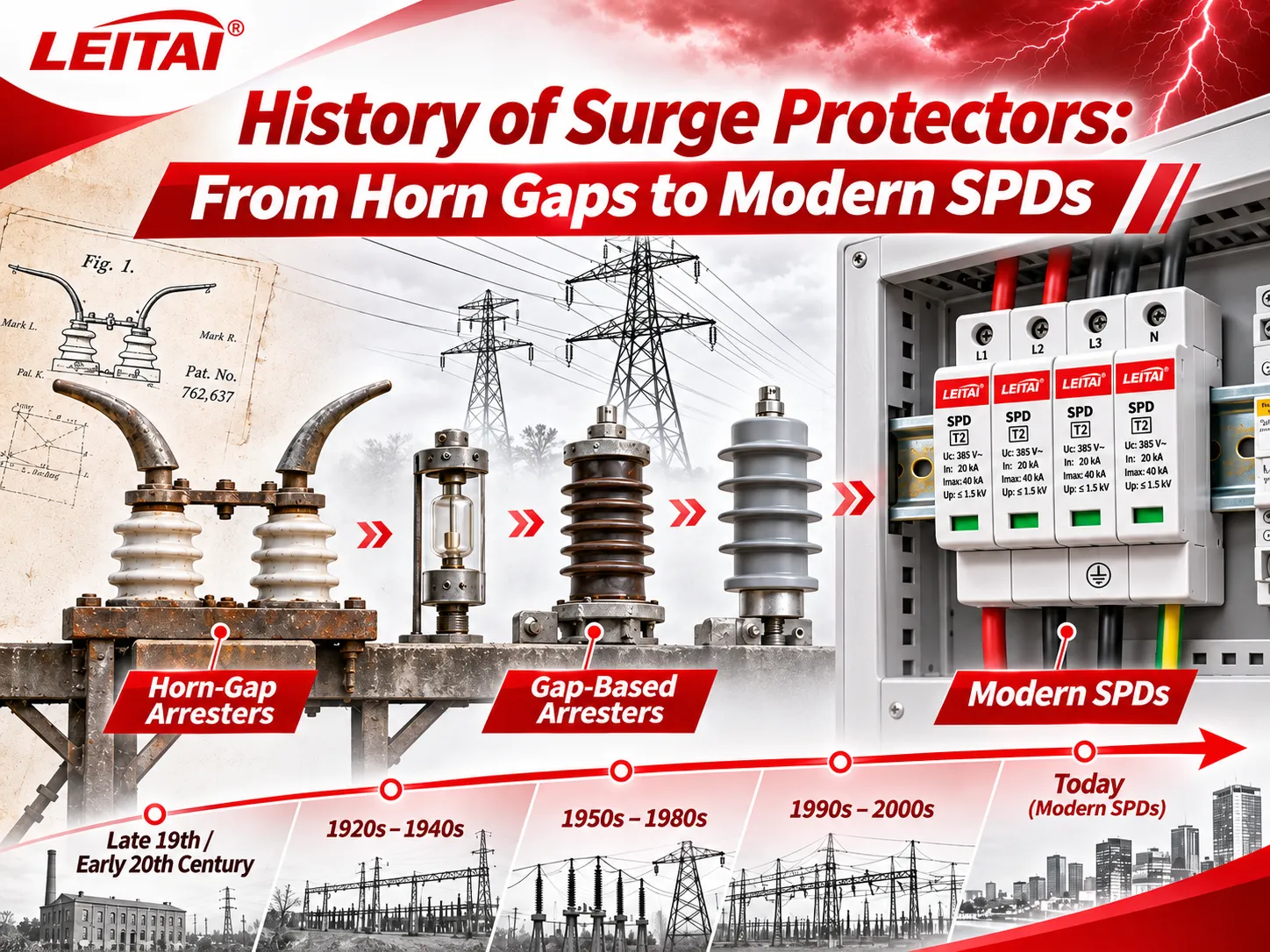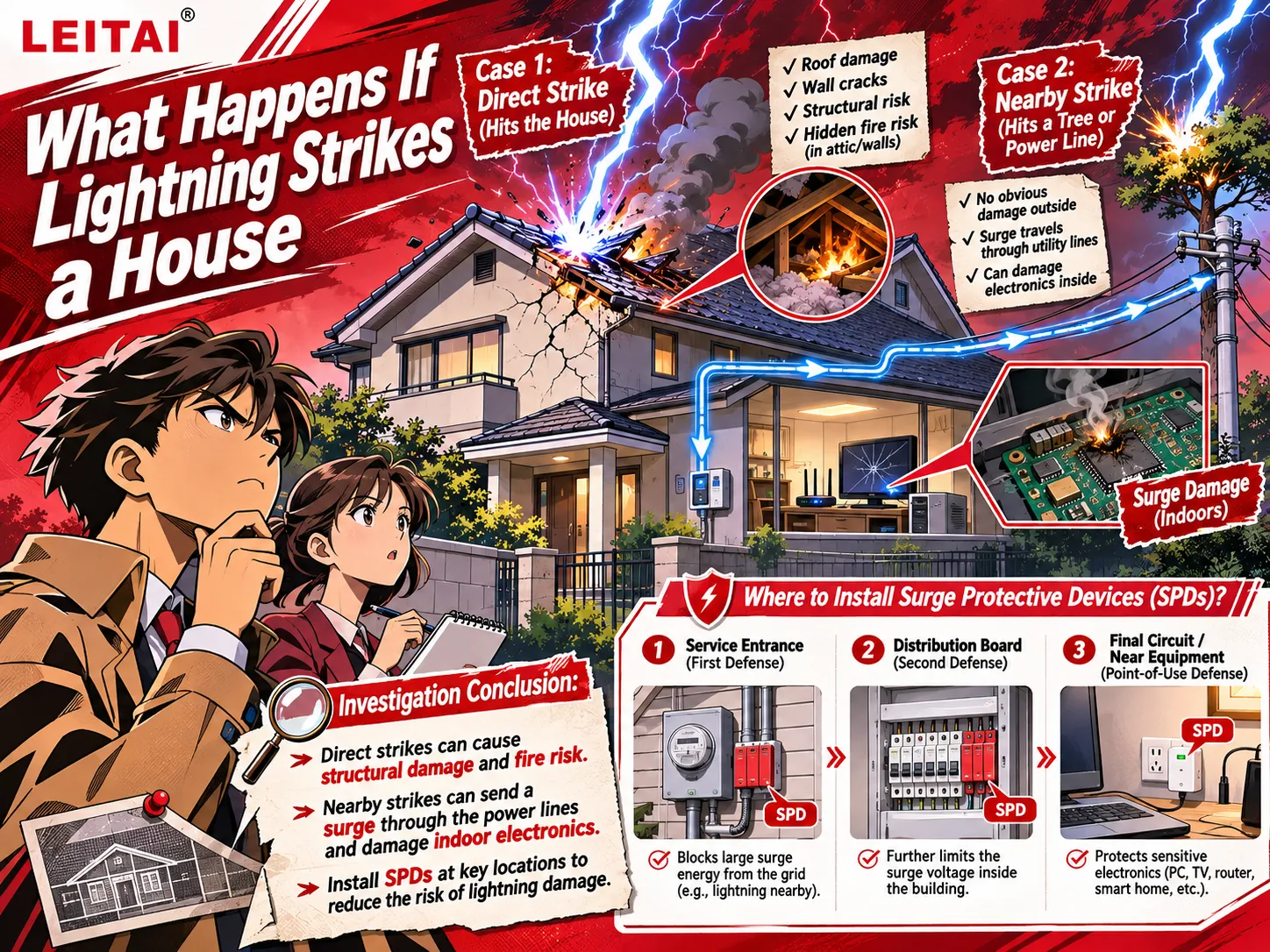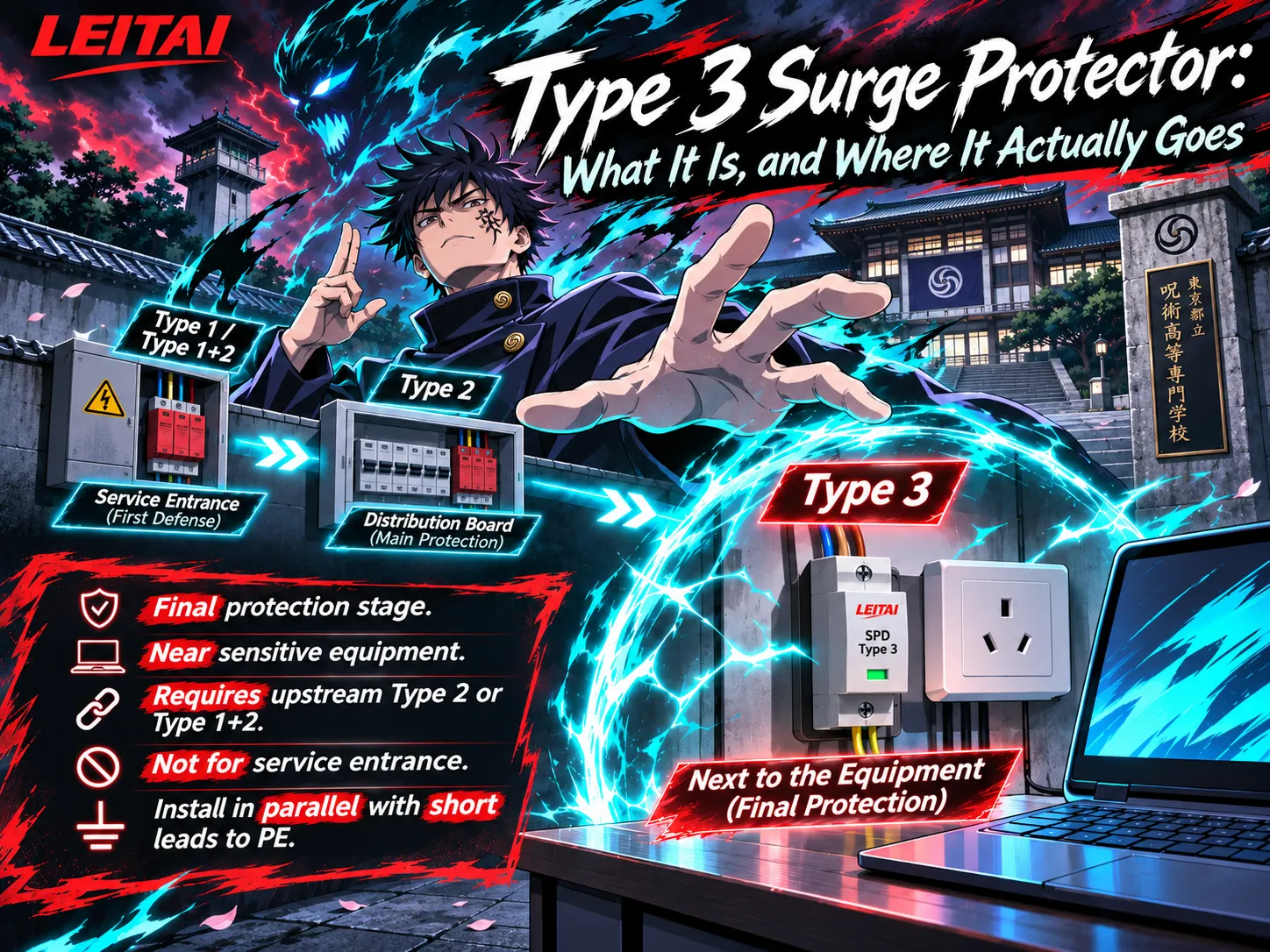

When searching for whole house surge protectors, you will notice that only a small handful of models keep repeating in every list, i.e. Square D, Eaton, Siemens, and ABB. The lists rank those models based on their one single number—kA value printed on the package, which in fact doesn’t tell much regarding the surge protection level.
We are engaged in production and testing surge protective devices using our patented impulse station of 250 kA, thus, we know how to read specification sheets like an engineer. This manual does the same for you: we will explain to you what each number on the specification sheet means and why most of them are important in surge protection.
In short, whole-house surge protector is the panel mounted SPD device that prevents surges from affecting virtually all circuits in the house. Most households will definitely need it, since Homeadvisor.com advises to install whole-house surge protector at an average cost of $500 (costs may vary from $200 to $800) when considering the costs of devices, home appliances, HVAC systems, and electric vehicle chargers, which are many times higher.
What a Whole House Surge Protector Does — and What It Doesn’t
A complete surge protector is in parallel with your electrical service, either connected to a double-pole breaker or directly to the main lugs. Inside such a surge protector are metal-oxide varistors (MOVs) that do not draw power at normal voltage. However, when there is a voltage surge above the MOV threshold, it reacts within nanoseconds and directs the surge current into neutral and ground wires, so that the voltage is limited.
Being at the very panel, a surge protector protects equipment that does not have a surge protector, such as a furnace control board, igniter, well pump, stove, washing machine, LED drivers in the ceiling, and EV charger.
What is also important is the limitations of such a device, namely:
It does not protect your home from a direct lightning hit because that is the job of the lightning protection system, while surge protection devices are designed to deal with predictable induced and conducted electrical surges.
It does not clamp surges effectively as you can never get rid of these electrical surges but can only control their voltage level. Therefore, sensitive devices need their separate surge protecting devices.
It is not going to work if the grounding system does not have a grounding and bonding system in place. If the ground connection is weak, every surge protection device in the house will suffer.
It only protects the electrical lines. If there is a surge in coaxial, phone, or Ethernet lines, they need separate surge protection systems.
If you are still unsure whether to get a surge protector, you can read our post on whether surge protection is necessary runs through the economics.
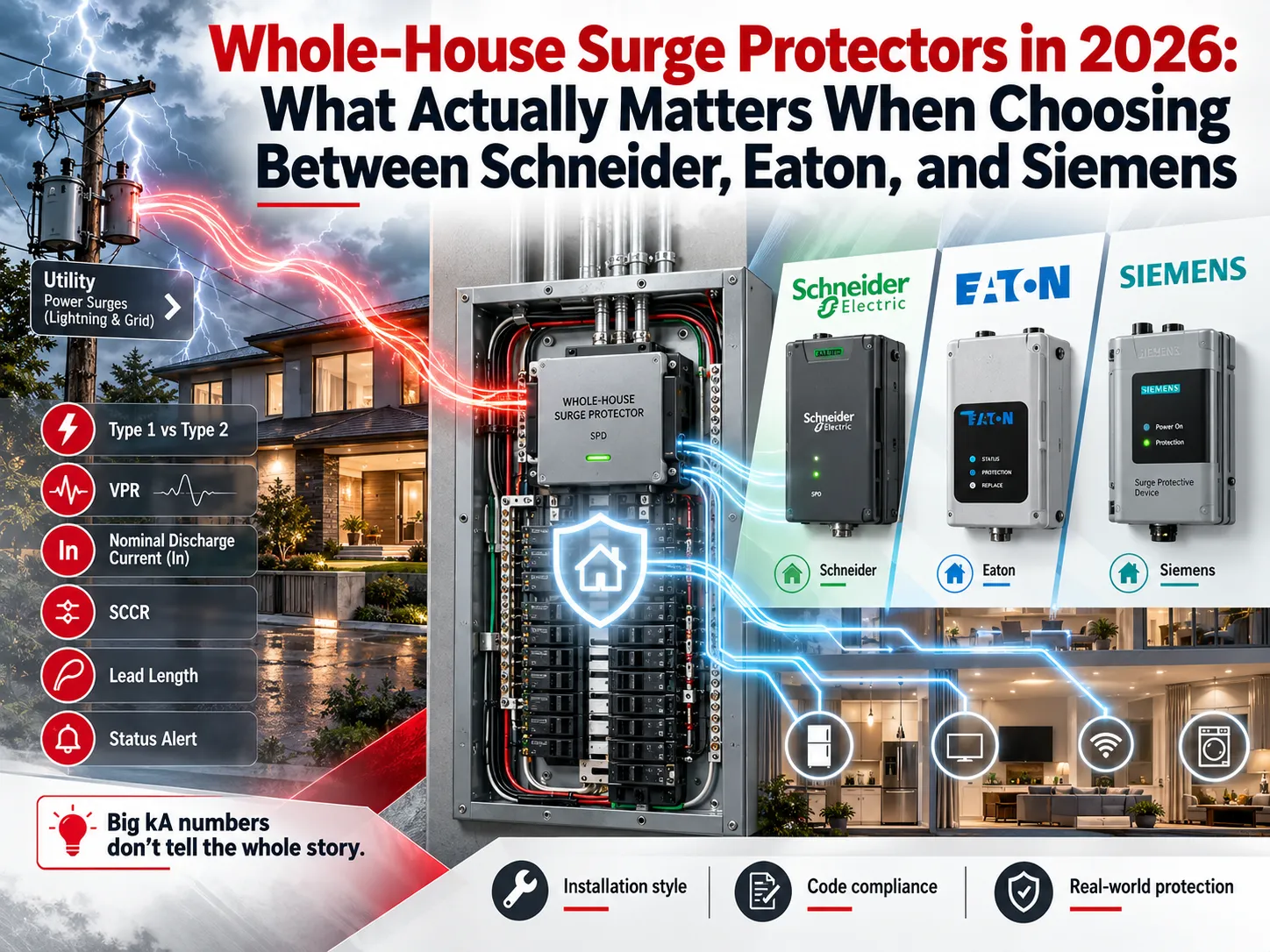
Type 1 vs Type 2: What the Label Really Means
In North America, Type 1 vs Type 2 is defined by UL 1449, and it is mostly about where the device may be installed:
| UL 1449 type | Where it can go | Overcurrent protection | Typical home use |
|---|---|---|---|
| Type 1 | Line side or load side of the main service disconnect, including the meter base | Not required by its listing | Service entrance, outdoor installations, homes with overhead feeds |
| Type 2 | Load side of the main service disconnect only | Connected through a breaker | The main panel or a sub-panel — the most common choice |
| Type 3 | Point of use, at least 10 m (30 ft) of wire from the panel | Built in | Plug-in strips and surge receptacles |
The reason many current home units and the reason a lot of electrical contractors use Type 1 units is that they may go anywhere in the power system, including outside by the meter, and they meet requirements for both Type 1 and Type 2 installations.
One of the pitfalls of comparing international equipment is that the UL Type 1 and the IEC Type 1 are not the same. The IEC Type 1 equipment is defined under IEC 61643-11 as the equipment that has been tested for 10/350 μs lightning current surge, and its Iimp rating is required for the facility using the lightning rod. Moreover, UL Type 1 indicates the installation location, and UL Type 1 equipment is usually tested for the 8/20 μs surge, which is similar to the IEC Type 2 test.
What the NEC requires
NEC 230.67 first required a Type 1 or Type 2 SPD on services supplying dwelling units in the 2020 edition, including when an existing service is replaced. The 2023 edition extended the rule to dormitories, hotel and motel guest rooms and nursing home sleeping rooms, added feeder panels for those occupancies, and set a minimum nominal discharge current of 10 kA. According to the Minnesota Department of Labor and Industry’s 2026 NEC FAQ, the 2026 edition expands this again to cover replacement distribution equipment as well as new installations, and adds sleeping quarters in fire, police and ambulance stations. Each state adopts its own edition, so check with your local inspector.
The Big-Brand Models Side by Side
Here is what the makers and their retail listings publish for the models that appear in most recommendation lists. The figures are per the sources cited below the table, as of October 2026.
| Model | Mounting | UL type | Max surge current | In | VPR (L-N) | SCCR | Status alert |
|---|---|---|---|---|---|---|---|
| Square D HEPD80 | External, any brand of panel, NEMA 4X | Type 1 | 80 kA per phase | 10 kA | 600 V | 25 kA | Green LEDs |
| Eaton CHSPT2ULTRA | External, any brand of panel, NEMA 4 | Type 2 | 108 kA | 20 kA | 600 V | 22 kA | LEDs |
| Siemens FSPD140 (BoltShield) | External, any brand of panel, NEMA 4X | Type 2 | 140 kA per phase | 20 kA | Not on listing | 200 kA | LEDs + audible alarm |
| Siemens QSPD (BoltShield) | Plugs in like a Siemens QP breaker | Type 1 | 65 kA per phase | 20 kA | Not on listing | 200 kA | Flag, LED + audible alarm |
| ABB / GE THQLSURGE2 | Plug-on, GE / ABB load centres | Type 1 | 25 kA per phase | 10 kA | Not on listing | 22 kA | LED |
Sources: Square D HEPD80 listing, Eaton CHSPT2ULTRA listing, Siemens FSPD140 listing, Siemens QSPD data sheet, ABB THQLSURGE2 product page. Check the current data sheet before buying; ratings change between product revisions.
Look down the VPR column first. Where makers publish it, the line-to-neutral figure is the same 600 V. The headline kA ratings run from 25 kA to 140 kA. The short-circuit ratings run from 22 kA to 200 kA. The rest of this guide explains why that pattern matters more than any ranking.
Reading the Spec Sheet: Which Numbers Matter
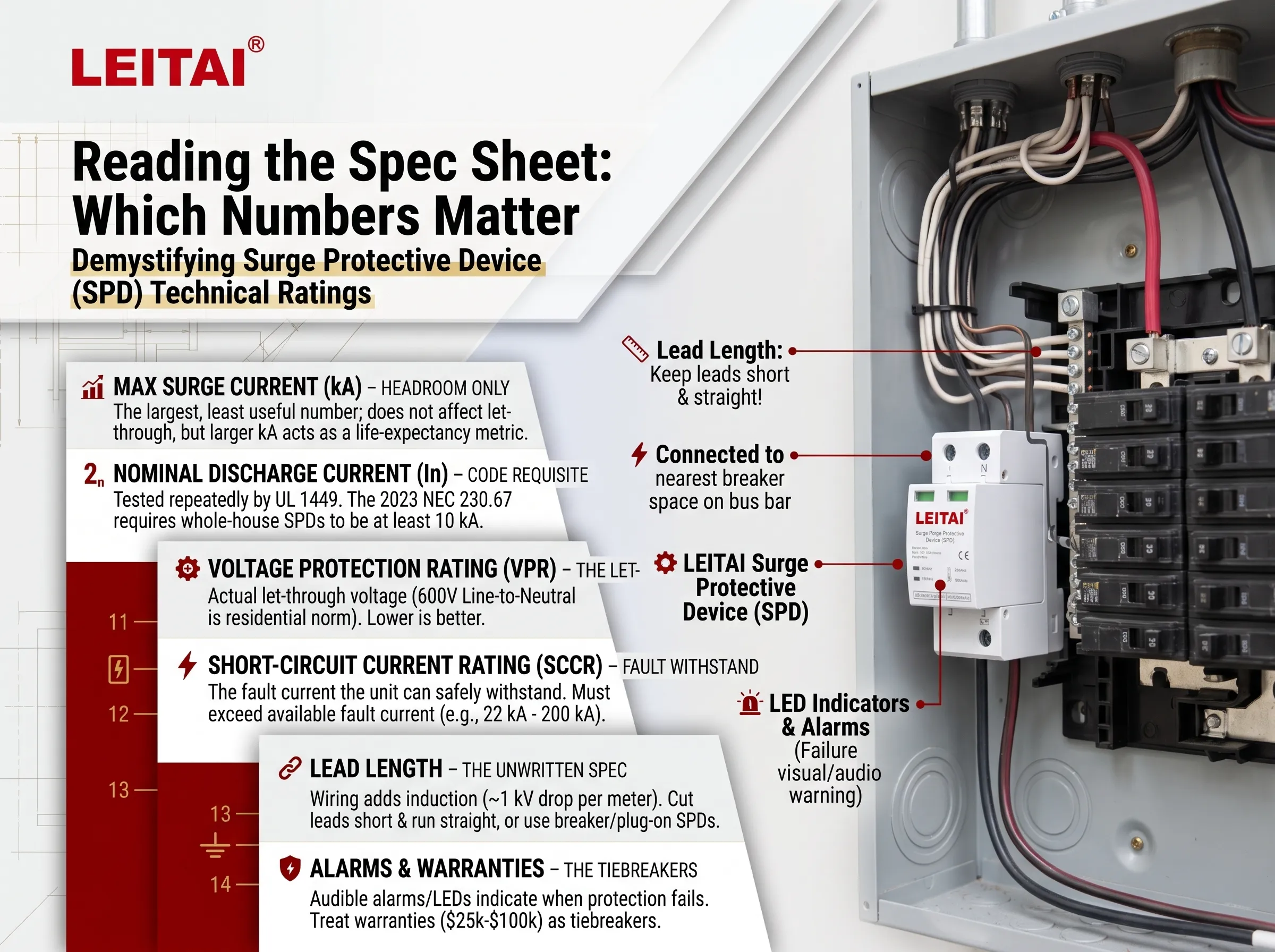
Maximum surge current (kA): the biggest number, the least useful
The highest surge current is the largest single surge that the equipment can endure one time. While it is helpful in some instances, it isn’t in the sense mentioned in the advertisements.
In most cases it is derived by calculating. As “per phase” sums the line-to-neutral and line-to-ground values. For example, Leviton states the values of 50 kA per mode and 100 kA per phase in its 51120-1 datasheet. Thus, two devices may have different values even if the components are identical.
It doesn’t change the level of surge current going to your equipment. The units rated 140 kA and 80 kA and working at the same voltage let through the same voltage.
The only thing it gives you is the life. According to Schneider Electric, having higher kA ratings usually implies longer lifetime of the device, as the MOVs are not stressed too much when working.
Think of kA as the device lifetime parameter. In areas exposed to lightning it should be as high as possible; in other cases it doesn’t matter that much.
Nominal discharge current (In): the number the code cares about
Nominal discharge current (In) frequency with which an apparatus can withstand without succumbing to UL 1449 test failure. According to one of the most recent changes to the 2023 NEC code, all devices intended for whole-house application under 230.67 should have In which is no less than 10 kA. All the units given in the table conform to that requirement. Older ones may not which makes the discontinued Leviton 51120-1 rated In 3 kA. If you happen to find a very inexpensive unit among older ones, make sure to verify In as a first step.
VPR: what actually reaches your equipment
The voltage protection rating (VPR) refers to let-through voltage that is defined in UL 1449 by means of a specified testing surge of 6 kV / 3 kA and rounded to predetermined values. The VPR gives potential users a good idea of how good the low VPR product is compared to high VPR ones.
In case of residential panel SPDs, the value of 600 V across line-to-neutral is considered standard by all major players in this market. Hence, VPR cannot make much difference between the leading brands; however, it can separate reputable instruments from cheap ones with the value of above 1,000 V.
SCCR: the number almost nobody checks
The short-circuit current rating (SCCR) is the amount of current which the SPD can endure safely in the event of a breakdown along with its accompanying circuit-breaker. According to NEC, the stamped SCCR of an SPD must match or exceed the existing fault current over the location it has been installed.
Take a look at the table again: 22 kA, 25 kA, 200 kA. Many homes are far less than 22 kA; however, a home that is near a big power transformer, a building that has a short service run, or a multi-family unit home can go above that figure. Should the fault current in the installation goes beyond the SPD’s SCCR, it will not comply with the code no matter how many kA the box claims. Your electrician can measure it while numerous utility companies might give you the necessary information upon your request. We cover this in more detail in our whole house surge suppressor installation guide.
Lead length: the spec no data sheet prints
The VPR of every SPD is recorded at the terminals of the device. The apparatus sees VPR together with the voltage drop across wires connected from SPD to bus. In the course of fast surge, the wire acts as an inductor: approximately, each meter of wire adds an extra kilovolt for 10 kA surge. For instance, a 600V unit connected with 1.5 meters of twisted wire is not a 600V unit anymore.
This is the real reason for why breaker-style devices or plug-in modules like Siemens QSPD or ABB THQLSURGE2 are used: they are placed right on the bus with minimum lead. Our surge protector wiring diagram shows how.
Alarms and warranties
SPDs fail silently; the system continues to function, and protection is no longer present. A green light only indicates that it has stopped functioning if someone notices it. Sound-alarm units like Siemens BoltShield are good for installations in garages and outdoors as they alert people.
Warranties on connected equipment differ between $25,000 for (ABB THQLSURGE2) to $100,000 (Siemens FSPD140). In most cases, consumers need to provide evidence of proper installation and claim procedures. Pick an SPD based on VPR, In, SCCR, and installation quality, and the warranty should be the last factor.
Is a Whole House Surge Protector Worth It?
For most homes, yes, and the case is financial. HomeAdvisor’s cost guide puts the national average at $500 installed. In terms of what is present behind the panel is an HVAC control board, a refrigerator, a range, and also a home EV charger along with a solar inverter. Just one damaged board can cost more than the protector.
In addition to that, most surges come from inside the house and not from lightning; in fact, Schneider Electric, as source of NEMA information, claims 60-80% of the surges happen within the house. The result of the repeated small events that take place over time is negative impact on electronics, which is strongly diminished with SPD panel in place.
This option may not be attractive if the panel itself is going to be changed in the nearest future. In this case there is a need to consider an SPD with the new panel since it may be required by law anyway.
Whole House Surge Protector Cost and Installation
Typical whole house surge protector cost figures from HomeAdvisor:
| Item | Typical cost (USD) |
|---|---|
| Type 1 device, installed | $250–$800 |
| Type 2 device, installed | $200–$450 |
| Device only, whole-house | $60–$500 |
| Electrician labour | About $150–$200, often a minimum service fee |
| Permit | $50–$200 |
| Inspection | $100–$400 |
The device is often the smaller part of the bill. The variables are whether the panel has two free breaker spaces, whether a sub-panel needs its own SPD, and local permit fees.
Do you need an electrician? In practice, yes. Whole house surge protector installation means working inside an energised panel, and a Type 1 unit may be connected on the line side of the main breaker, which cannot be switched off from inside the house. Most jurisdictions require a permit and many require a licensed electrician; the job usually takes an hour or two. Our installation guide covers how to choose and vet one.
How Long Does a Whole House Surge Protector Last?
Life expectancy can’t be predicted with absolute certainty. MOVs deteriorate with every lightning strike they receive, which means that a MOV that is located in an urban grid may stay functional for many years, while one that is placed on a long-distance rural power line will burn out within some seasons. One strike abroad may kill the MOV in one day.
That is why the status indicator matters more than the date of the purchase. You should replace the MOV if:
The status light turns off or changes color, as well as if alarm starts going off.
There are heat spots or change in color on the MOV housing.
Lightning strikes occur within vicinity of the house, even if everything is working before.
Check the indicator at least once or twice a year and after every severe storm. The guide from Schneider Electric concerning MOVs’ life suggests the same list of warnings.
Layered Protection: Why One Device Is Not the Whole Answer
A SPD device reduces a voltage spike to a couple of hundred volts over normal and while that’s acceptable for a stove or a furnace, sensitive electronic items may require a secondary level of protection. The protective measures can be divided into four levels:
- Service entrance/main panel: a Type 1 or Type 2 SPD absorbs the majority of the excess voltage.
- Sub-panels: detached garages, workshops, or EV charging sub-panel. This sub-panel must be situated at least a few meters away.
- Point-of-use: a Type 3 protector to be plugged in for use with computers, TVs, and network equipment. In case the devices also have issues with power outages, a UPS should be used that performs the function of both surge protection and backup power supply. see our comparison of a surge protector vs UPS.
- Data/DC lines: coaxial, telephone, PoE cameras, and DC part of the solar system require certain protection measures. A rooftop array, for example, uses a DC-rated PV surge protector at the inverter or combiner box.
The efficiency of every stage is higher than that of its predecessor since each of them handles an enormous amount of energy.
How to Choose the Right One for Your Home
- Square D QO or Homeline, Siemens, or GE/ABB panel: initiate by utilizing the manufacturer’s plug-on SPD or breaker-style SPD. The goal would be to ensure the smallest leads are used.
Any branded panel or lack of space next to the bus: utilize an external SPD such as Square D HEPD80, Eaton CHSPT2ULTRA, or Siemens FSPD140 that is used with the shortest leads.
Overhead service or a rural line or places with a lot of lightning activity: install the type 1 SPD that has a higher kA for its lifespan purposes.
For large service and a short run to a large transformer or a building comprising many units: ask for the available fault current and ensure that the SPD being used has its SCCR higher than the available fault current.
If the panel is being used outdoors or in garages: ensure that the NEMA 4X enclosure is used and an audible alarm is present in it.
In case solar, battery storage, or EV charging is being utilized: ensure that the whole main panel is being protected and the sub-panel which supplies power to the charger.
Beyond the Home: When the Spec Sheet Has to Go Further
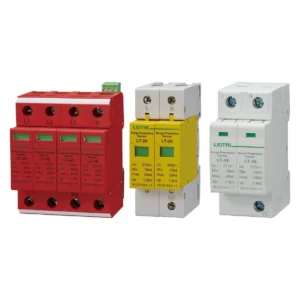
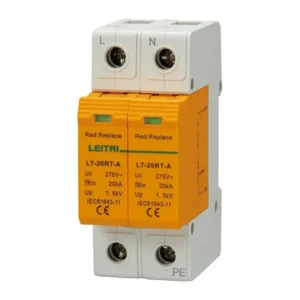
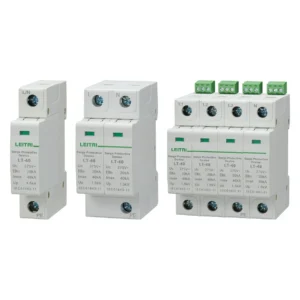
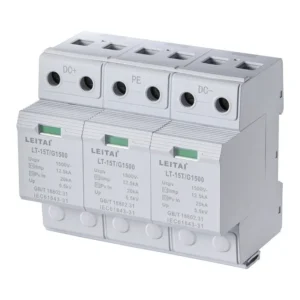
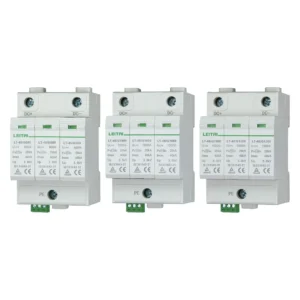
Residential SPDs are built for one 120/240 V service. Commercial buildings, factories, telecom sites and solar plants need devices specified to IEC 61643-11, in three-phase configurations, often with tested lightning current ratings. A building with a lightning rod system needs an IEC Type 1 or Type 1+2 device, such as the LT-T25 B+C Type 1+2 surge protector with Iimp 25 kA or the LT-X series Type 1 SPD rated up to 50 kA Iimp, coordinated with Type 2 and Type 3 stages downstream and an external SPD disconnector sized for the site’s fault level.
LEITAI designs and manufactures these devices in Zhejiang, China, and verifies them on its own test station rated 250 kA at 8/20 µs and 50 kA at 10/350 µs. Distributors and panel builders who need a private-label or custom SPD can see our OEM and ODM services.
Frequently Asked Questions
Is it worth it to get a whole house surge protector?
For the average homeowner, the answer is yes. A unit installed cost approximately $500 on average, thus protecting each and every circuit of the electrical system, be it hard-wired appliances, HVAC equipment, or electric vehicle charging equipment that the input power cannot reach through the use of power strips. The cost of replacing only one inverter or control board usually exceeds that of installing the device. In many places, the user ought to comply with the NEC requirements regarding installation of the device when the service or panel is replaced.
How much does a whole house surge protector typically cost, including installation?
According to HomeAdvisor, the average costs for installation across the country are at about $500, while the general range of prices usually fluctuates between $200 and $800. If we talk about the costs of a Type 2 unit, it usually varies from $200 to $450 when it comes to installation, and for a Type 1 unit, the prices fluctuate between $250 and $800. Apart from that, there may be permits, inspections or even the installation of a sub-panel SPD.
Do you need an electrician to install a whole house surge protector?
Certainly, this is the practical approach to working with electricity. Working inside a panel board means that a Type 1 installation can actually connect to the line side of the main breaker, which cannot be disconnected from the inside of the building. Obtaining the proper permit is a requirement in most places, and more requirements exist including using approved installers. Using the right type of installation is vital for effective operation, including the use of short leads, the right breaker, and an effective grounding system.
What is the life expectancy of a whole house surge protector?
It is less about how old the units are but rather how many surges they absorb throughout their life cycle. For instance, while units in a calm grid could last longer 10 years, those placed in high lightning areas could fail within just a few years or even after one nearby strike. It is important to replace the unit once the status light stops lighting up or the alarm goes off as well as check it after larger storms.
Is Type 1 or Type 2 better for a home?
Neither type is intrinsically more protective than the other. UL Type 1 devices may be installed on either side of the main breaker, including outside at the meter; Type 2 devices are connected downstream of a circuit breaker. Both comply with NEC 230.67. The VPR, In, and SCCR should be compared instead of the UL type number of the device.
Does a whole house surge protector protect against lightning?
It protects against surges induced or conducted on the power lines by nearby lightning, which is how most lightning damage reaches a home. It does not stop a direct strike to the building; that needs a lightning protection system. Our article on whether a surge protector protects against lightning explains the difference, and our guide to the difference between a surge arrester and a lightning arrester covers the terminology.
Do I still need plug-in surge protectors?
For sensitive or expensive electronics, yes. A panel SPD reduces a surge to a few hundred volts above normal; a plug-in Type 3 protector near the device reduces it further and also catches surges generated inside the home on that circuit. Use both.
References
- Minnesota Department of Labor and Industry — 2026 National Electrical Code FAQ
- Schneider Electric — Why every panel needs a surge protective device and what contractors need to know
- Schneider Electric — How long should a surge protector last?
- HomeAdvisor — Whole house surge protector cost guide
- Square D HEPD80 specifications
- Eaton CHSPT2ULTRA specifications
- Siemens BoltShield FSPD140 specifications
- Siemens BoltShield QSPD data sheet
- ABB THQLSURGE2 surge protective device
- Leviton 51120-1 Type 2 surge panel
- UL Standards & Engagement — UL 1449, Surge Protective Devices
- IEC 61643-11 — Low-voltage surge protective devices connected to power systems
Conclusion
The top whole house surge protector isn’t one that boasts of a high kA value. Rather, it is one that displays a VPR close to 600V, In greater than 10kA, SCCR exceeding the fault current level at your breaker panel and leads that are short enough to ensure the VPR on the label matches the one that your appliance experiences. Fortunately brands have similar numbers across the board, leaving you to look for the one that best fits your breaker panel and environment, have it installed by a certified installer and add point of use protection in the right places while checking the indicator light after every storm.