
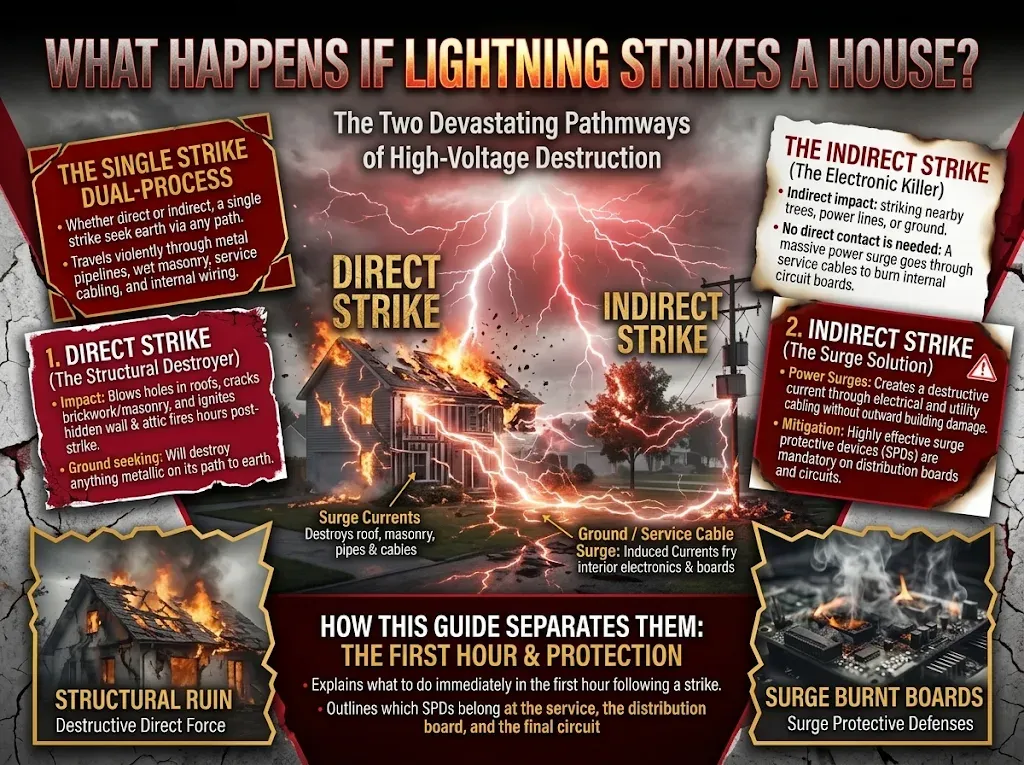
A single lightning strike hitting a building consists of two different processes. A lightning bolt that directly strikes a building is looking for a way to reach earth, which means that it will travel through any metallic part of the house, wet masonry, pipelines, and a service cable. However, the bolt hitting a tree or, for instance, a power line does not have to touch the house and yet could burn a circuit board inside the house.
So the honest answer to what happens if lightning strikes a house depends on which of the two happened. This guide separates them, explains what to do in the first hour after a strike, and shows which surge protective device, if any, belongs at the service, the distribution board and the final circuit.
A direct lightning strike can cause holes in the roof, cracked brickwork, and fire in the walls and attics hours after the strike. The reason for this is that the electricity needs to work its own way to reach the ground. When it comes to strikes happening in the vicinity of the house, the lightning can only create a current which travels through the electrical installation without causing any external damage to the building. In this case, surge protective devices are efficient.
Two Different Events People Call a Lightning Strike
“The house got hit” is one expression applied to both an actual strike and an incoming surge. Often the costs are similar. The physics is not.
In an actual strike, the lightning current connects to the building. The current will follow various conductive paths: rooftop flashing, satellite dish mount, metal flue pipe, plumbing vent, rebar in the concrete, and the utility service. Physical and electrical damage occur.
In the case of a nearby strike, the affected building is not the connecting point. An electric surge and voltage rise on the overhead lines still create a short high current in the building’s wiring system. The roof appears undamaged but various equipment that is connected to the house power supply might go dead.
What a Direct Strike Does to the Building
When lightning strikes a home, immediate damage is visible:
Tiles strip off around the ground.
Cracked bricks and concrete as water vapor rapidly transforms into steam.
Charring, rafters or roof deck damaged.
Smoked out power outlets and light switches on the way of current.
But the most dangerous damage is possible fires. The wood, insulation and dust in the roof space or walls may get smoldered long after the hit. That is why a house that seems completely intact should be checked for signs of fire.
Conductors do not need to be made from special lightning equipment. Gutters, pipes, cyclone gas pipelines do work. If that way of the current becomes blocked, the electric charge is going to jump to the next conductor. This process creates pits in metals, holes in gas pipes and other damages.
The holes created by the hit do not mean that all appliances are out of order while broken appliances don’t imply that the house suffered. The damage happens when one considers where the current is going.
What a Nearby Strike Does to the Wiring
Most electronics damaged in storms were not in the path of attachment. When lightning strikes a tree, pole, or overhead line, it causes the voltage to rise on every service connected to that transformer. The surge that enters the home lasts for microseconds.
A circuit breaker does not see it as an overload, so the lights often continue to work.
The equipment that fails is anything with a circuit board connected to the wiring:
Heating furnace, boiler, or heat pump controllers which can be wired directly without the use of a plug-in strip.
Ovens, washing machines, or dishwashers with electronic controls.
Garage-door openers and doorbell transformers.
TVs, routers and modems but only if we have a cable involved.
The plug-in surge strip protects only the plugged-in devices.
Are You Safe Inside When Lightning Strikes a House?
Being inside a building with electrical and plumbing systems gives better protection from lightning of strikes while being outdoors. But this is not the ultimate protection, as the lightning does not reach indoors as a visible lightning bolt. What it does, is following its ways via wires and tubes going through the house.
The ways to reach humans inside are pipes, wires, and anything connected to these pipes and wires. During a thunderstorm it is necessary:
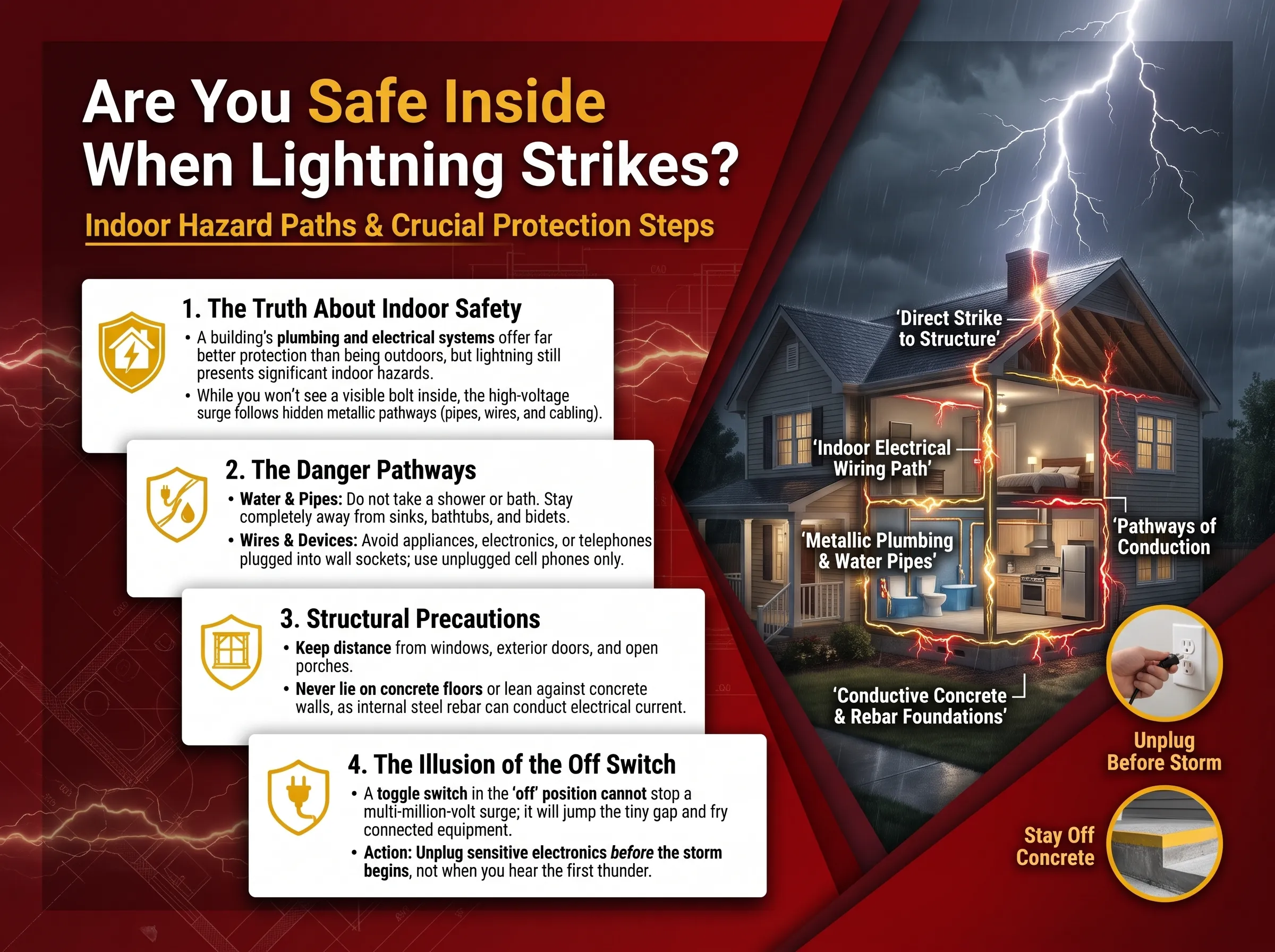
Do not take a shower and stay away from sinks, bids, and bathtubs.
Use cell phones only, do not use telephones or devices plugged into sockets.
Keep away from windows, doors, and porches.
Never lie on concrete or lean against the walls of houses made of concrete.
Once the surge reached the electrical equipment, it reaches everything connected to the system and therefore goes over all cables, which means that even turning off the switch in the opposite corner of the room does not stop the surge. It is better to unplug your devices before the storm begins, rather than when the thunder is heard.
What to Do in the First Hour After a Strike
①.If you notice smoke or flames, then immediately evacuate all people from the house and call the firefighter department.
②.If you think that the house might be impacted directly, then immediately call the fire department even if nothing seems to burn. The firefighters can check the walls and attic using thermal imaging cameras.
③.A burning smell coming from the panel should be taken seriously. Try to switch off the main breaker safely. Avoid touching the burnt wiring, wet appliances, and outlets.
④. Check the surge protector in the panel. Look for the status window that indicates that the electricity has been cut off.
⑤.Make sure to take pictures of the affected areas and make a list of the damaged items before throwing anything away.
⑥.Call a licensed electrician to check the service, the panel, and earthing and bonding before putting the systems back into operation.
How Common Is It, and What Does It Cost?
A direct lightning strike is uncommon for any one location. However, taken together in total within a country, the figures can add up. In 2025 alone, the Insurance Information Institute estimates that insurance companies paid out more than $1.65 billion in lightning strikes to homeowners in around 62,000 claims. The average payout per claim was close to $26,600, almost 43% more than in 2024 due to rising cost of rebuilding and huge amount of electronics in buildings today. Florida came first in the number of claims, closely followed by California and Texas.
Most typical homeowners insurance policies include coverage against lighting fire damages. Coverage against damages from power surge varies from one company to another, which is even more of a reason to keep records of all devices malfunctioning.
What a Surge Protector Can and Cannot Do
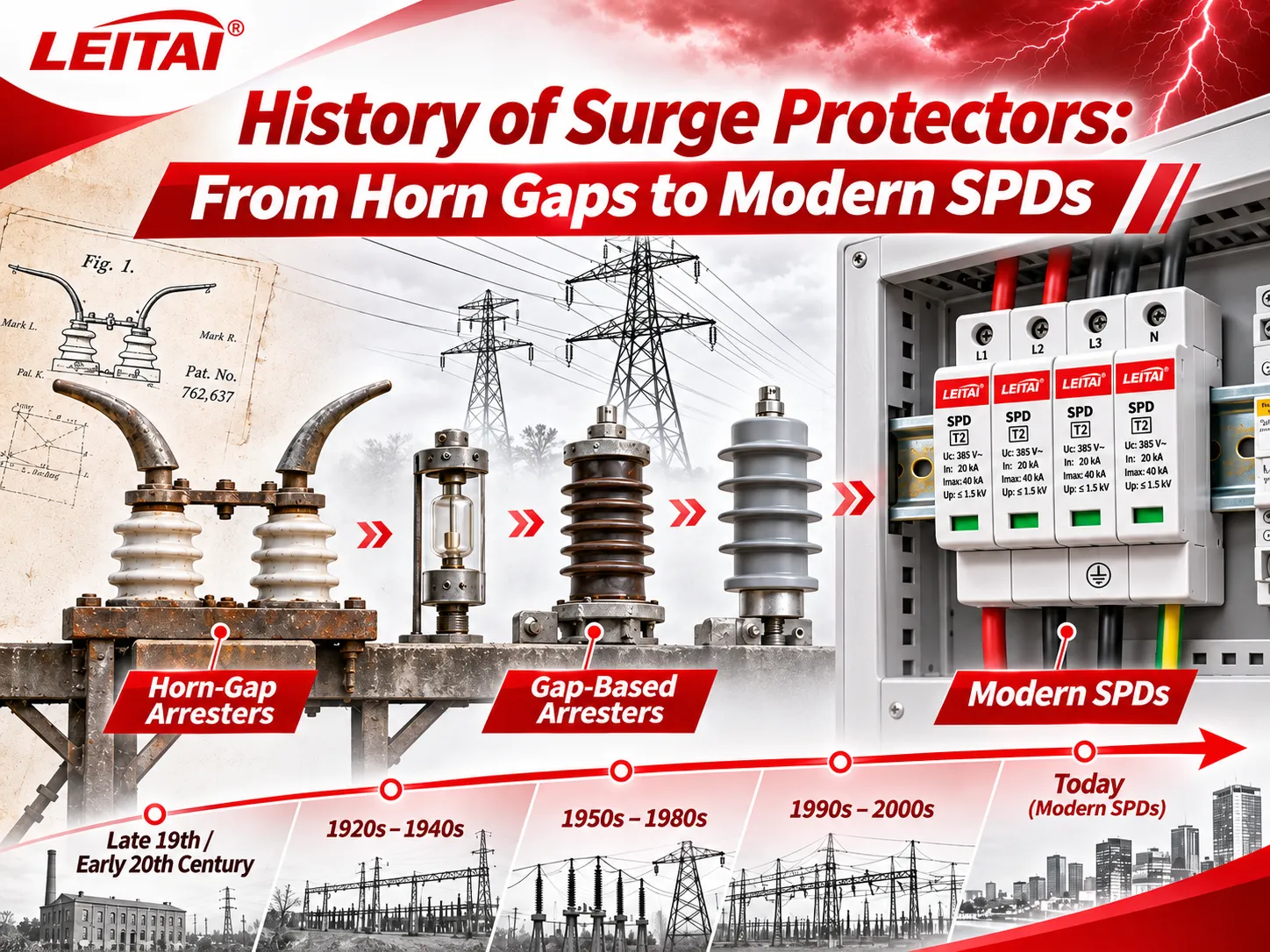
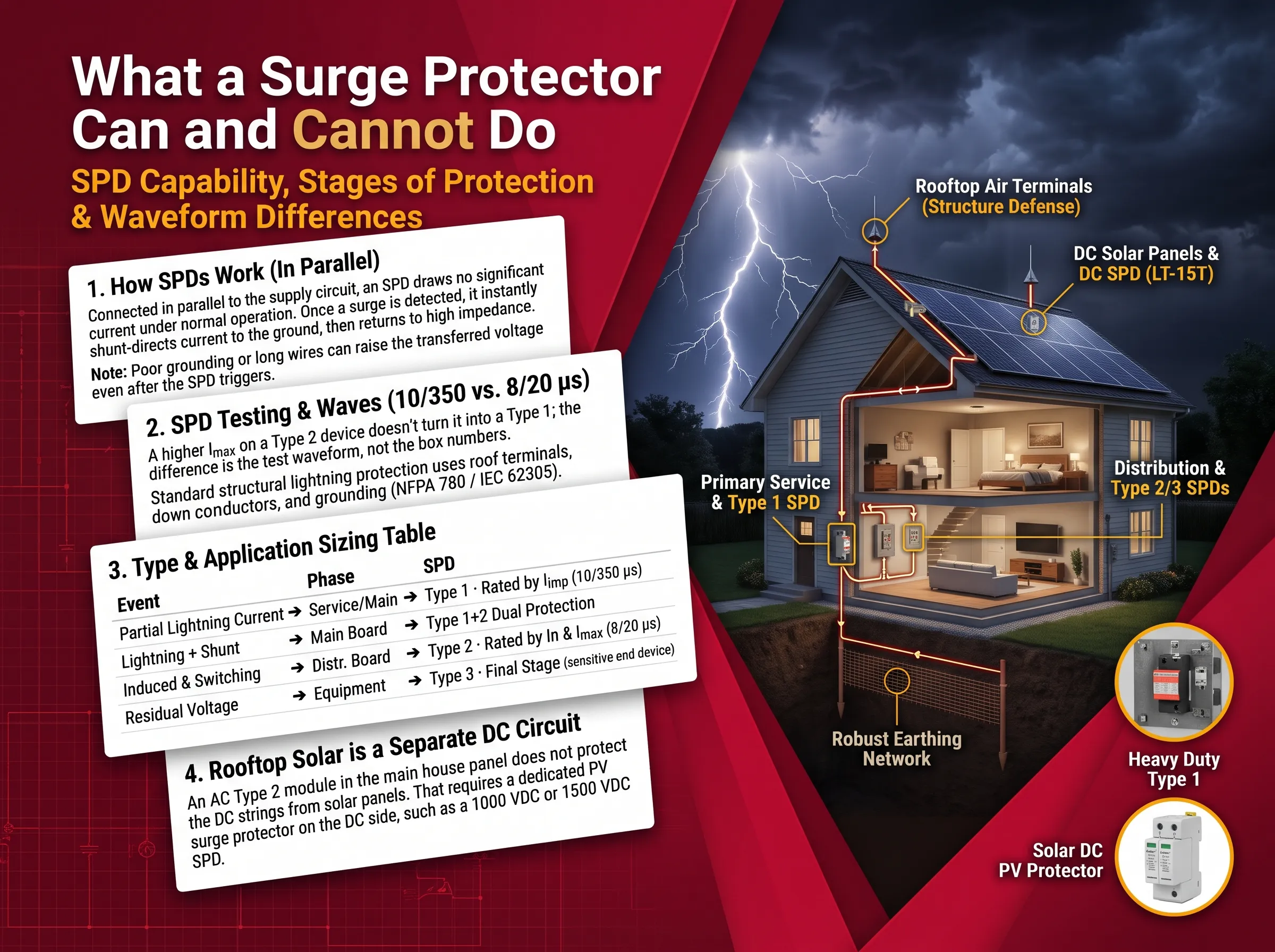
A surge protective device (SPD) is connected in parallel to the supply circuit. It does not draw any significant current when there is no surge. Once a surge is detected, it conducts current and directs it to the ground and returns to high impedance position. If the ground connection is poor or the wires are long, the voltage that gets transferred to electrical devices may rise even though the SPD has done its work. More about the limits can be found in Does a Surge Protector Protect Against Lightning?
The lightning protection system protects the structure from the direct impact of lightning. This system consists of air terminals on the roof, the down conductor and the earthing network and is built following NFPA 780 or IEC 62305.
Each SPD type is tested for a different kind of surge:
| What you need to handle | The stage that applies | Leitai model |
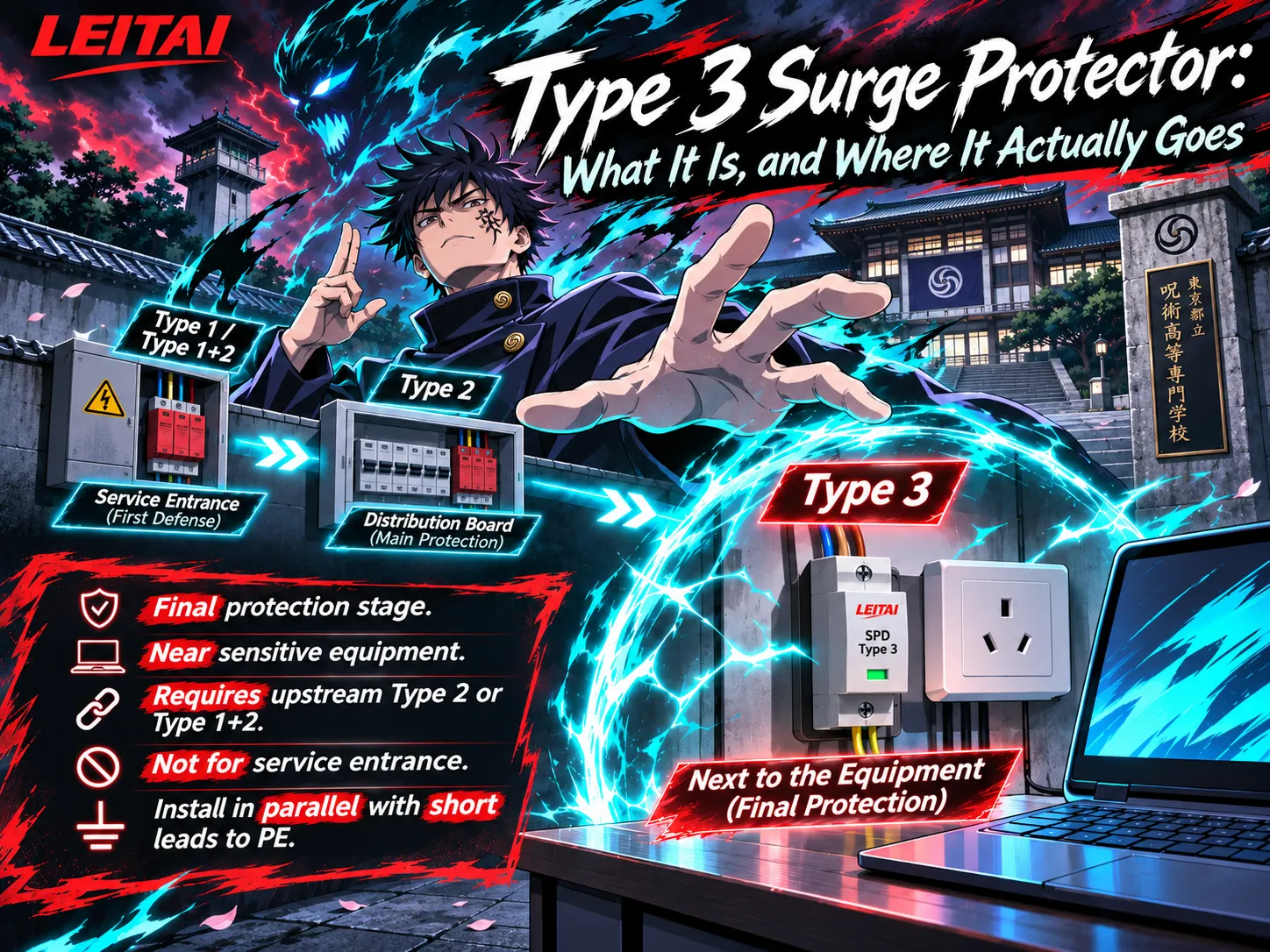
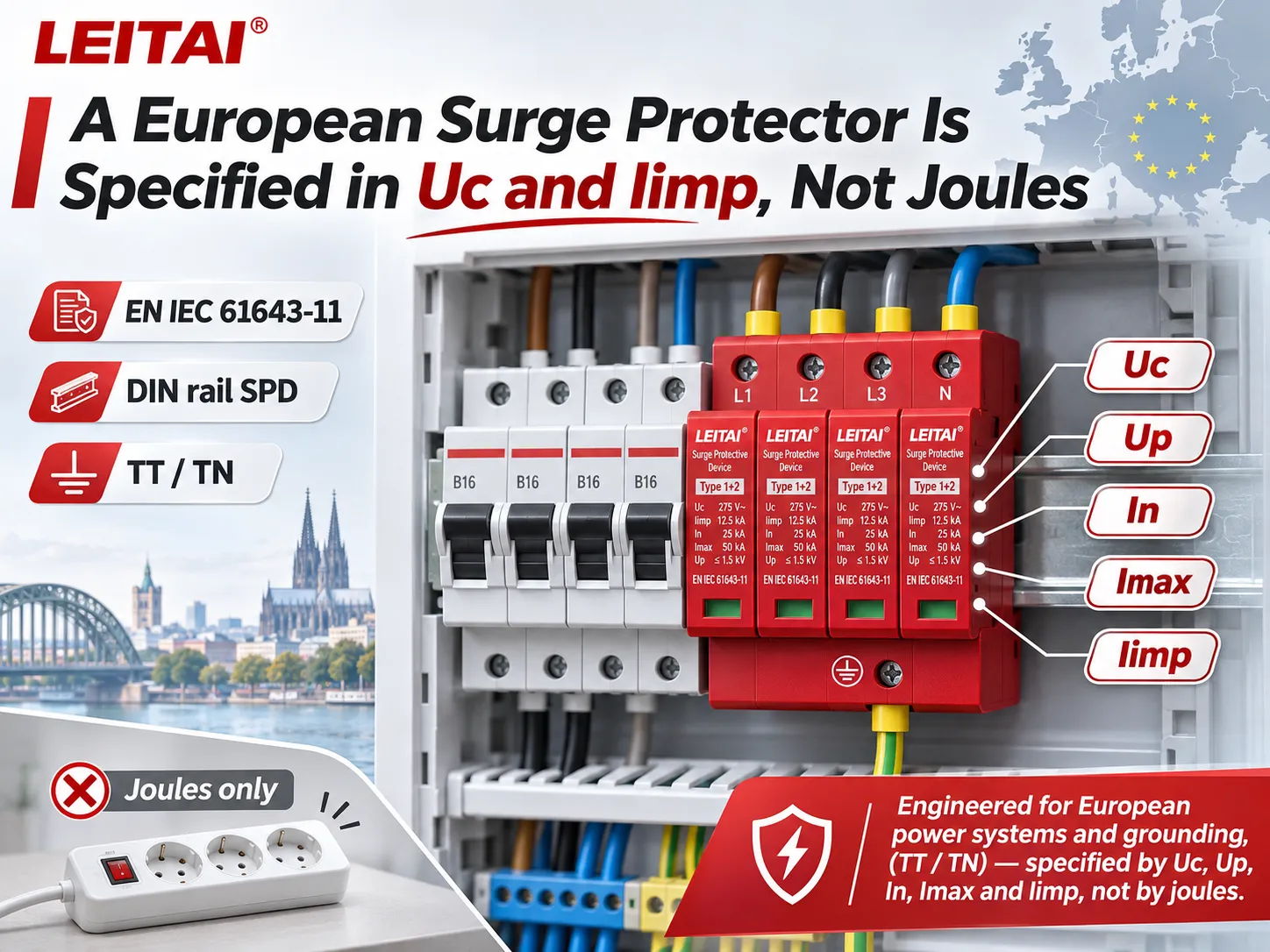
| Partial lightning current at the service, on a house with a lightning protection system or an overhead supply | Type 1 SPD, rated by Iimp (10/350 µs) | LT-T25, or the LT-X15 / X30 / X50 series for higher lightning current |
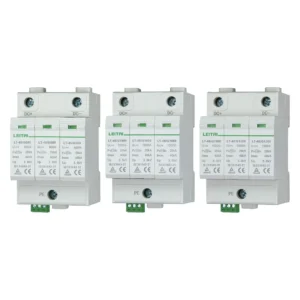
| One device at the main board that both discharges lightning current and limits what follows | Type 1+2 | LT-T15 B+C, 12.5 kA |
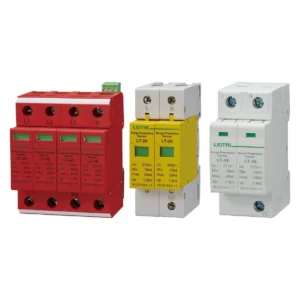
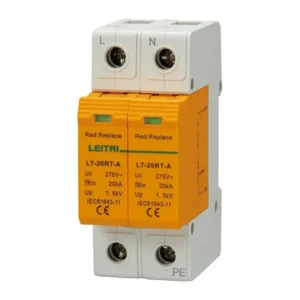
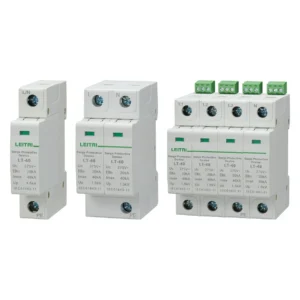
| Induced and switching surges at the distribution board | Type 2 SPD, rated by In and Imax (8/20 µs) | LT-20 / LT-40 |
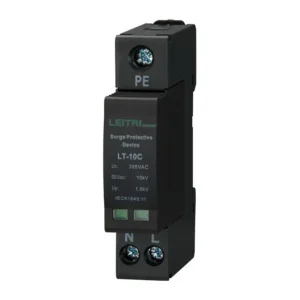
| Residual voltage at sensitive equipment at the end of a long circuit | Type 3 | LT-10C |
Read the table from the event, not from the largest number on the box. A higher Imax does not turn a Type 2 device into a Type 1. The test waveform is the difference. A Type 3 device is only the last stage, as explained in Type 3 Surge Protector: What It Is, and Where It Actually Goes.
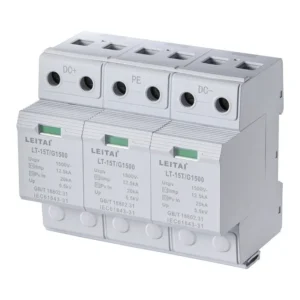
Rooftop solar is a separate circuit. An AC Type 2 module in the house panel does not protect the DC strings from the panels. That needs a PV surge protector on the DC side, such as the LT-15T for 1000 VDC and 1500 VDC systems.
After the Lights Come Back On
In an SPD, it is possible to sacrifice itself whilst keeping the circuit functional. In case the device reaches an end of life, the thermal disconnector will separate the device from the surrounding circuit, which is necessary in order for the device to avoid any overheating. Each of the loads being safe from surge protection will still be able to operate normally. Most of the DIN-rail SPDs indicate whether it is in service with the help of a green window, whilst a red window states that the surge protection device is in disconnection mode.
As soon as the device gets tripped, a new one needs to be installed right away instead of waiting for the next storm encounter with unprotected installations. While the board is open, the length of the SPD leads should be checked to ensure that the earth of the device is connected to the same earthing system as that of the service. Sizing a whole-house device for a typical panel is covered in What Size Surge Protector for 200 Amp Service?
Where Leitai Fits
Leitai manufactures surge protective devices at its factory in Liushi, Zhejiang. It does not inspect houses, handle insurance claims or install roof lightning protection. What it does offer is the right stage for each point in the installation: lightning current at the service, induced surges at the distribution board, residual voltage at the final circuit.
Homeowners can hand that list to an electrician. Panel builders and brands that need IEC 61643-11 modules under their own name can use the OEM and ODM programme.
Frequently Asked Questions
Can lightning strike a house?
Yes, houses can get struck by lightning, particularly those that are higher than others or separated from the others, as well as those that are located on elevated areas, and also those that have some metal elements on their roofing or equipment like the service line. How frequent this can happen within a certain locality depends on the density of lightning strikes in that part of the world.
Can lightning strike through a house?
The current does not act like a bolt of lightning that travels through the various parts of a room. When the electric current is looking for its way to reach the ground, it travels through the conductors as pipes, wires, and steel in concrete. When there is a lightning strike, the current can also jump a short gap in the air. As the result, during a thunderstorm people should stay away from plumbing fixtures, devices using wires, and windows.
What happens if lightning strikes a house with no lightning rod?
The current finds its own way to earth through the roof, framing, pipes and wiring. That uncontrolled path is what causes fires, cracked masonry and side flashes. A lightning protection system gives the current a planned path outside the building instead.
Does a whole-house surge protector stop a direct strike?
No. A service SPD can discharge part of the lightning current that enters on the conductors and clamp what continues down the wiring. It does not intercept the bolt and does not replace a lightning protection system where the risk justifies one.
What should be checked in the panel after a strike?
The first step would be to examine the SPD status indicator. Next, make an extensive search for a burnt breaker, burned neutral wire, or a malfunctioning outlet. Even after the SPD has been deactivated, the fact that the light is switched on does not mean that the device is safe to use. Any electric work on the panel must be carried out by certified professionals.
Does home insurance cover lightning damage?
Standard homeowners policies generally cover fire and structural damage caused by lightning. Cover for appliances damaged by an electrical surge depends on the policy wording, so check it and document everything before repairs start.
References
- NOAA / National Weather Service, Lightning Safety
- NFPA, Lightning
- Insurance Information Institute, Lightning-Related Homeowners Claims in 2025
- Does a Surge Protector Protect Against Lightning?
- The Difference Between Surge Arrester and Lightning Arrester
- Is Surge Protection Necessary?
- Surge Protection Device (SPD) Automatic Production Line
Conclusion
When lightning hits a house, the structure will join the loop. In this case, damage to the roof and walls should be anticipated, concealed fires should be searched, and firefighters should be notified. After a nearby lightning strike, damages will be detected mainly in the wiring, and the event is the reason of using a complete line of surge protective devices, namely Type 1 where lightning strike is possible, Type 2 at the distribution board, and Type 3 in the end of the line. After every storm, the SPD state window should be checked. The fact that lights are on in the house does not mean that the house is protected.