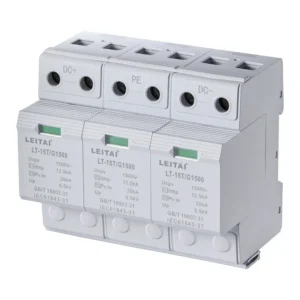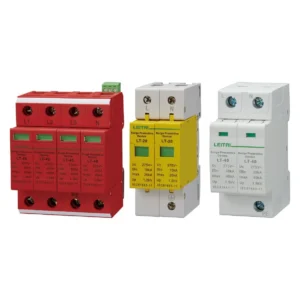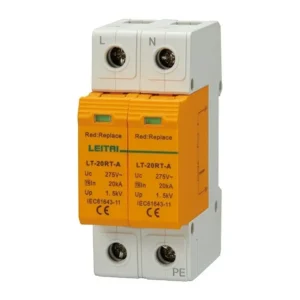

Surge protection is vital wherever the loss from a single unprotected failure exceeds the price of the device, which defines the necessity of the surge protector for conventional buildings. It can be seen that there is no necessity for a surge protector as is the case with that of a fuse. The absence of surge protection on the panel does not lead to anything burning down! The electronics in house or plant counts have increased, while the wiring density has not gone up, causing surge protection to be so significant.
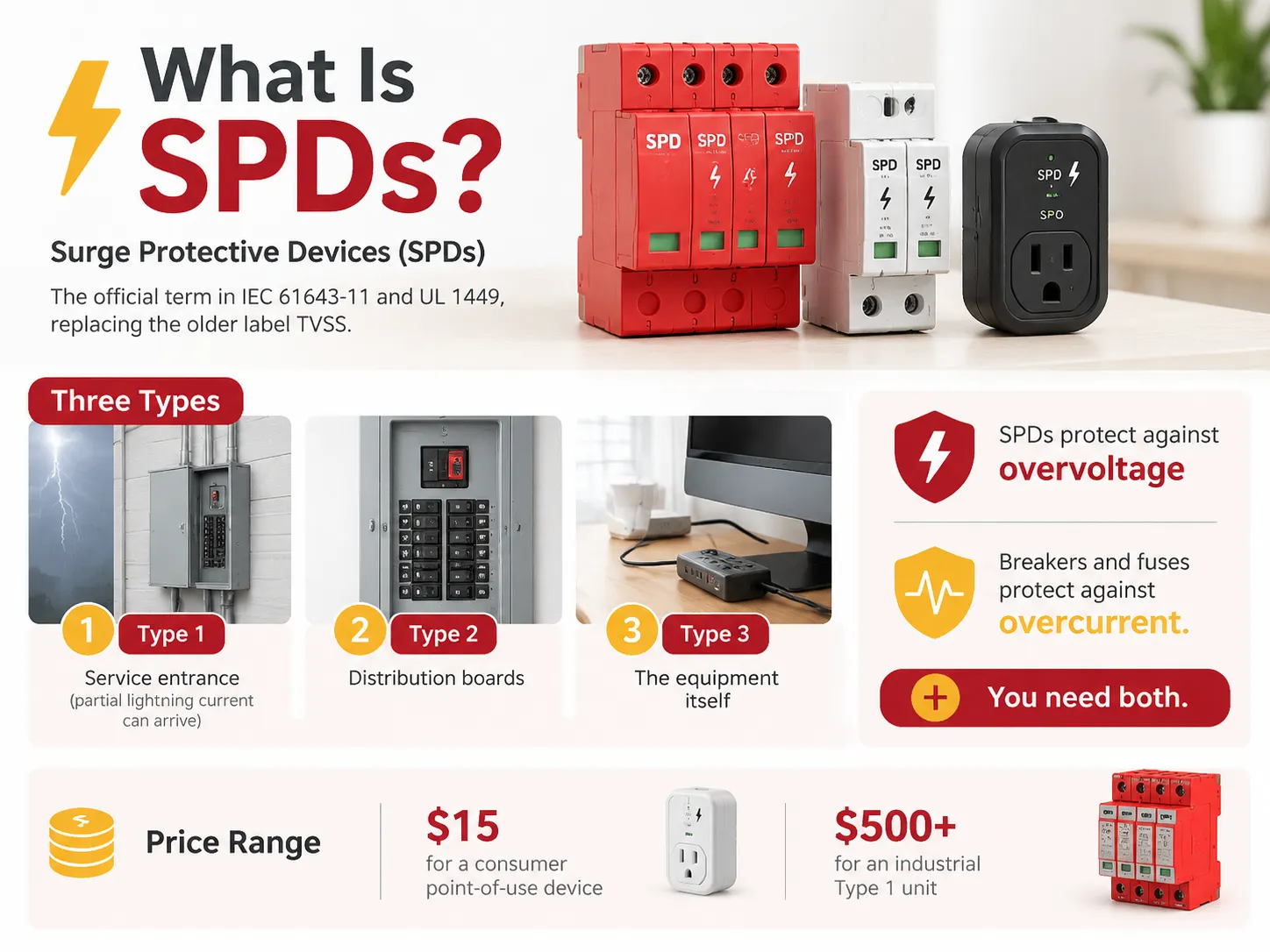
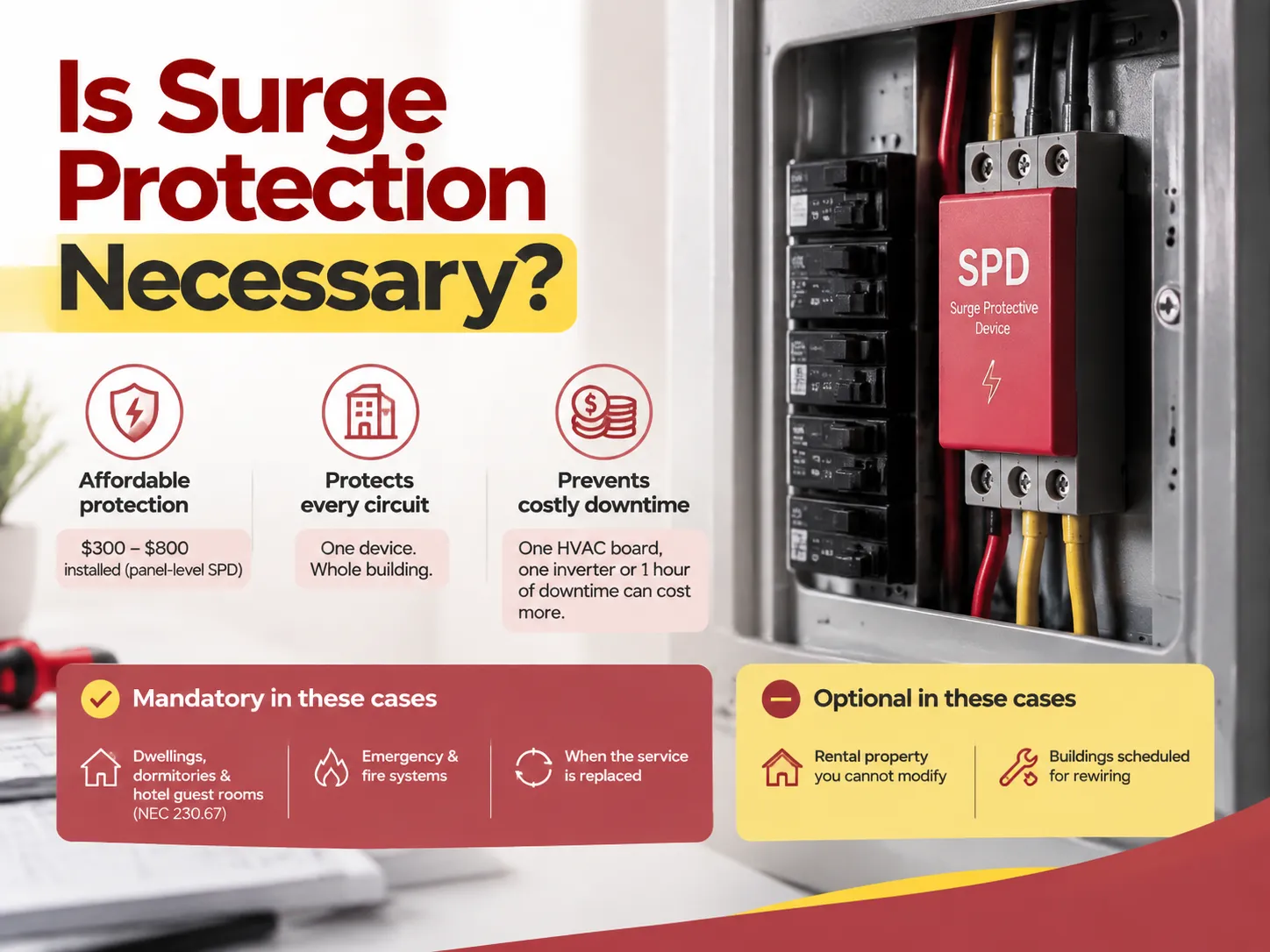
A short answer is affirmative, as it is the case in most structures, although this is due to financial reasons and not due to safety issues. One SPD at the panel level costs $300 to $800, and safeguards all circuits in the building, whereas devices like an inverter, HVAC control board, etc., or the unused hour of the production downtime usually costs a lot more. SPDs are practically obligatory once the equipment is replaced, which applies to homes, dormitories, and hotel rooms according to NEC 230.67 provisions, as well as to the emergency and fire systems.
Where the Surges Actually Come From
Most individuals associate lightning with destruction. However, data from utilities and experience suggests that most destructive events happen within premises. Motors, compressors, switches, capacitor banks and inverters cause voltage surges in the process of turning on and off. Every time air conditioning starts, lifts operate or LEDs start working, there is a voltage surge.
Events may seem less dramatic than lightning, but they happen all the time, leading to the degrading of insulation systems and semiconductors, which causes failures in a few years of operation. In addition to the sources of internal surges, there are external sources of voltage fluctuations. Lightning strikes near overhead or underground wires, transformer operations, and actions performed by the service provider may lead to voltage fluctuations of up to five kilovolts.
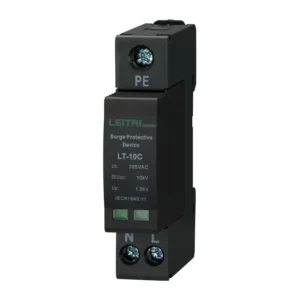
The response time in this case has to match the time of events, which is why metal-oxide varistors are often used for this purpose. A Type 2 distribution SPD rated In 10 kA and Imax 20 kA with protection levels from under 1.3 kV across four voltage variants is the typical answer for an AC distribution board, and it is sized for exactly this steady background of induced and switching events rather than for a direct strike.
What It Protects Against — and What It Doesn’t
Overpromising has led to the disappointment of several customers, and this is why it is important to know the limits involved.
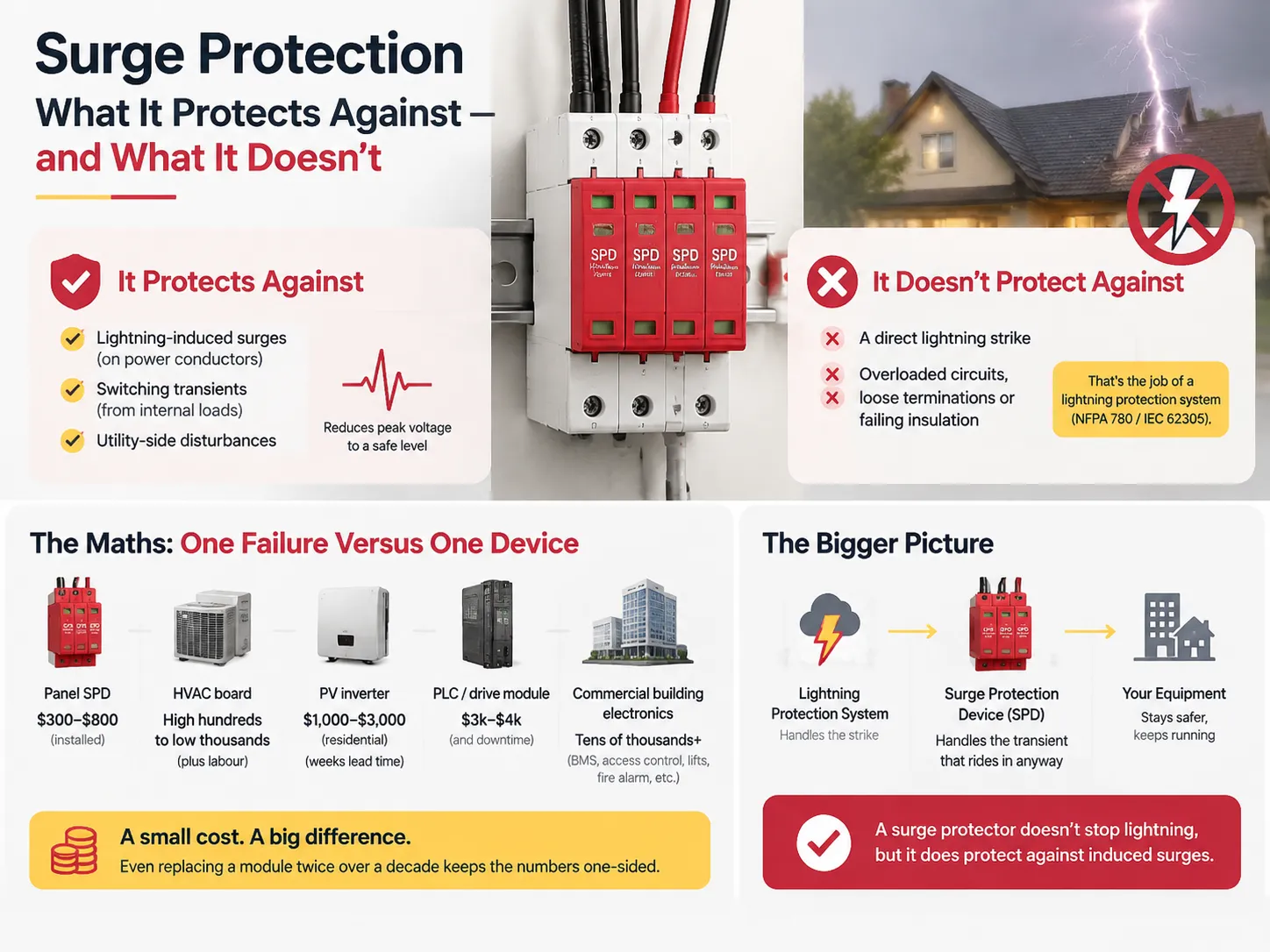
- It works to eliminate temporary overvoltages caused by lightning hitting power lines, internal equipment switching transients, and utility company malfunctions. The appliance reduces the maximum voltage that travels to the devices downstream to a certain protection level.
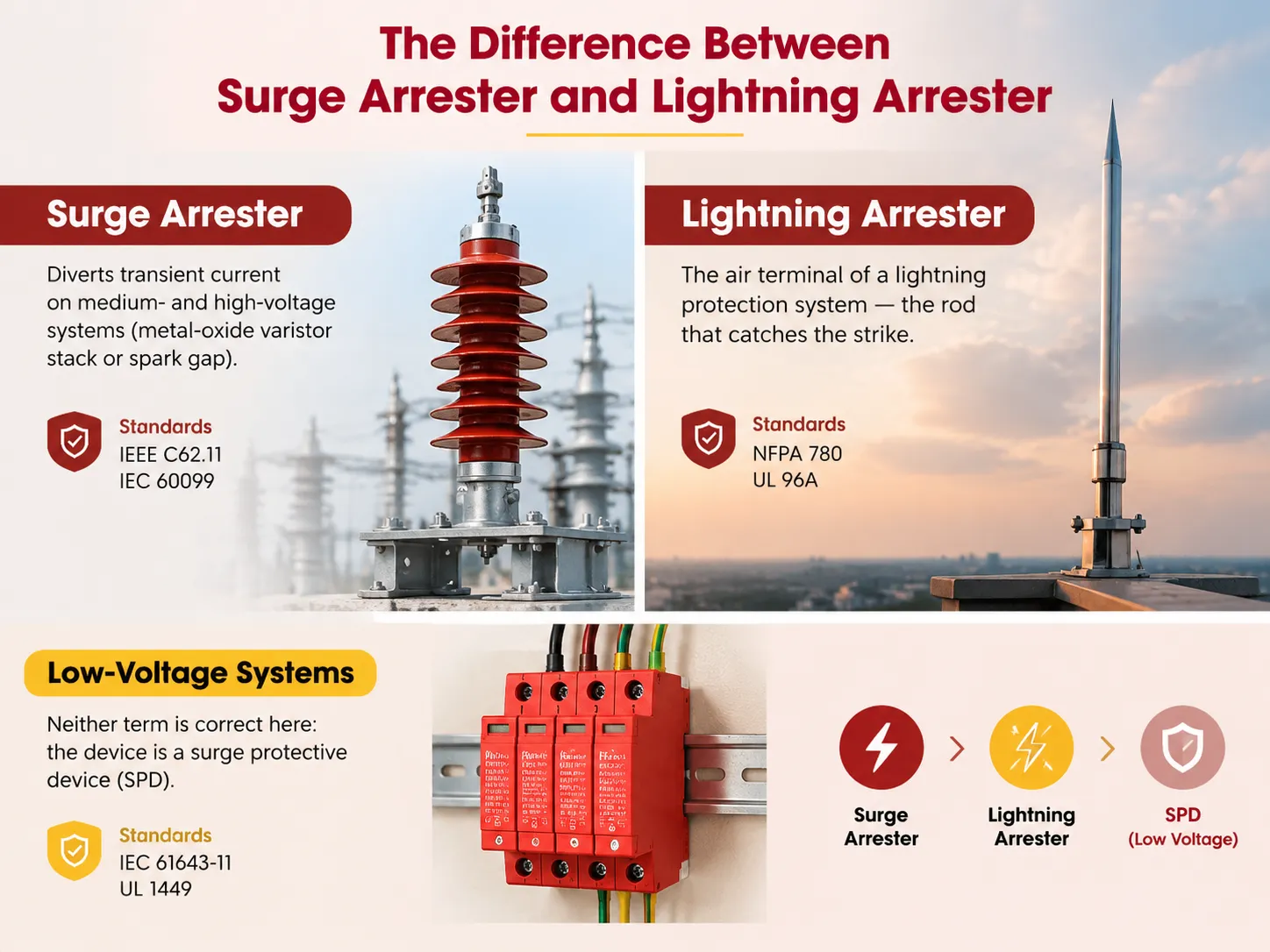
- It should be pointed out that this does not prevent lightning from coming into contact with the building, nor does it act as the primary route of getting direct lightning strike current to the ground. The latter is the role of the lightning protection system designed according to NFPA 780 or IEC 62305.
- It does not mean that the device can manage to survive the lightning strike. Even if it is well designed, there are no guarantees that it can cope with the energy of the strike, while the point-of-use device does not stand any chances. The most effective means of protecting the electronic equipment from the lightning strike remains unplugging all devices before the thunderstorm arrives, as the devices do not have any connection to the power source and cannot be affected by lightning.
- It does not resolve the issue of overloaded wiring, loose connections, and worn insulation. When the protection devices keep operating, this is not a solution to the problem.
To summarize, the lightning protection system functions on one level, while the surge protection device operates on a different level, without being able to act as an alternative. Anyone weighing up whether the panel device is worth it should know where that line sits, and the answer to whether a surge protector protects against lightning is a qualified yes on induced surges, no on a direct strike.
The Maths: One Failure Versus One Device
This case compares two figures, with the second one being quite greater than expected.
- A panel surge protection device costs around $300 to $800 installed in the house, while it’s between $250 and $700 for the three-phase commercial unit with remote signaling.
- Replacing a HVAC control board will cost around hundreds up to more than a thousand dollars, plus labor and callout costs.
- Roof-mounted solar panel inverters cost between $1,000 and $3,000 for residential installation, while it is even more for commercial installation and takes weeks to get one.
- PLC and a drive module have been known to break down when the production line gets stopped by am impulse of three or four kilovolts, and downtime usually costs more than the part.
- The electronics inventory of a commercial building includes building management system, access control system, lifts elevators, fire alarm system, LED drivers, and electric vehicle chargers, and costs many thousands of dollars, but these installations are not protected from the surge.
- The element itself is a consumable with an estimated lifetime of five to ten years in low lightning areas. However, even with two replacements during the decade, the age of the comparisons stays greater in favor of our product, given the downtime hours and spoiled products.
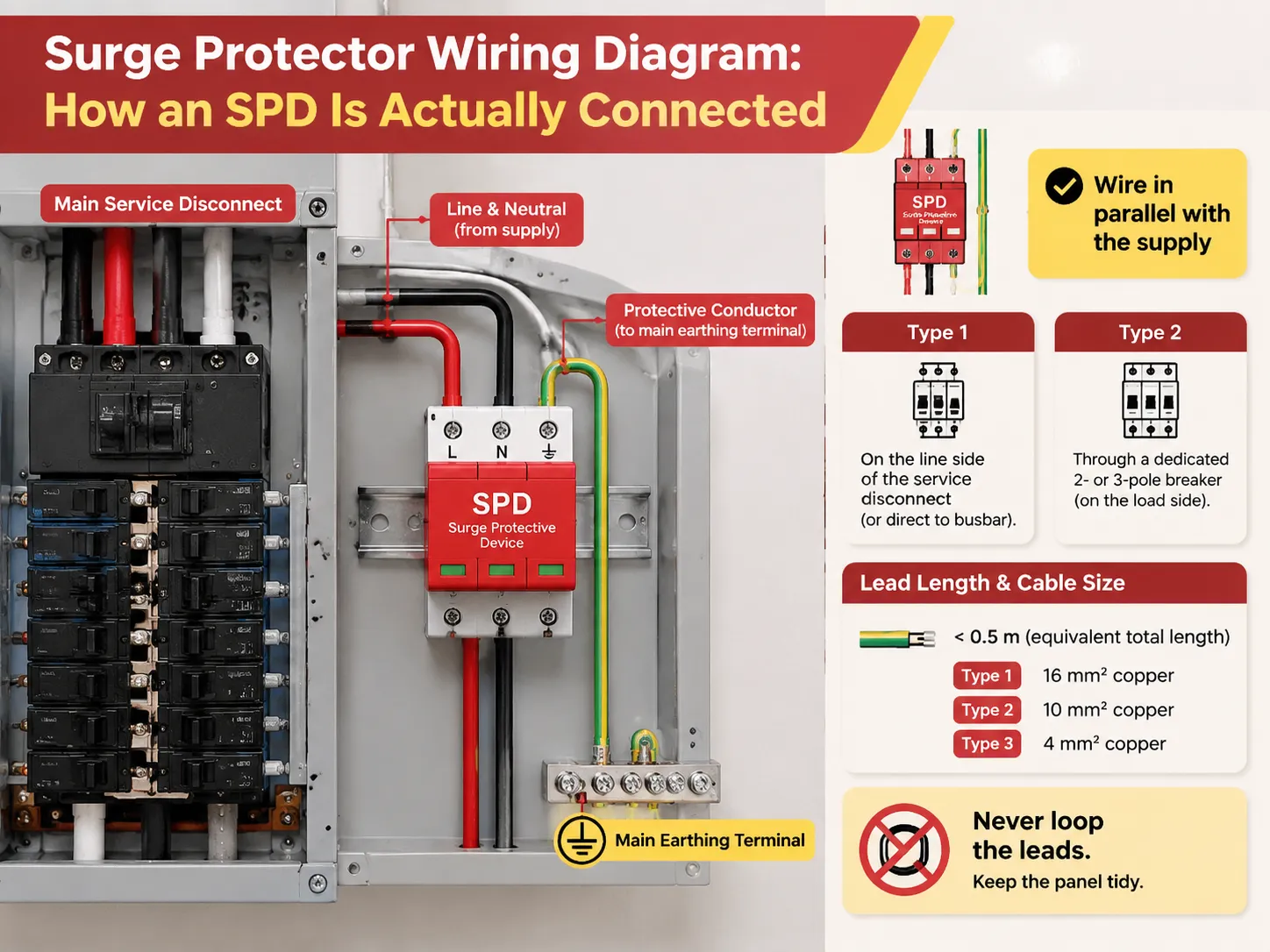
On sites where a failure is disruptive rather than merely expensive, the case stops being about money and becomes about continuity — which is why combined Type 1+2 protection rated 25 kA Iimp and 50 kA Imax with remote signalling is commonly specified for commercial buildings where nobody will be standing at the panel watching an indicator window.One honest caveat on warranties. Connected-equipment warranties of $25,000 or more are marketing as much as assurance; the claim process typically requires returning the failed device for laboratory analysis, and the outcome is often a denial based on the pattern of internal damage. Buy on the technical specifications — discharge rating, protection level and build quality — and treat the warranty figure as a tiebreaker at most.
When It’s Genuinely Optional
There are indeed situations where it may make more sense to invest money elsewhere.
- A rental property that forbids alterations. Electrical panel work usually has to be approved by the landlord and permits obtained. The best compromise using a quality point-of-use device for any expensive electronic equipment.
- A building due for a rewire or demolition. Adding protection to equipment that is about to be replaced is simply inappropriate.
- The panel has a defect. Some old panel brands have a track record of missing trips. Here the right decision is to get a new panel instead of installing a surge protector on the dangerous panel. Electric protection does not help a faulty interrupting device.
- When the actual issue is something else. When circuit breakers constantly trip or a wire is being operated at maximum capacity, adding an SPD will not change the situation.Protection against too much current for too long is a different discipline with different hardware, and the distinction is set out plainly in this comparison of surge protection versus overload protection.
Where It Stops Being Optional
There are many cases where the codes are doing the work of the codes instead of people.
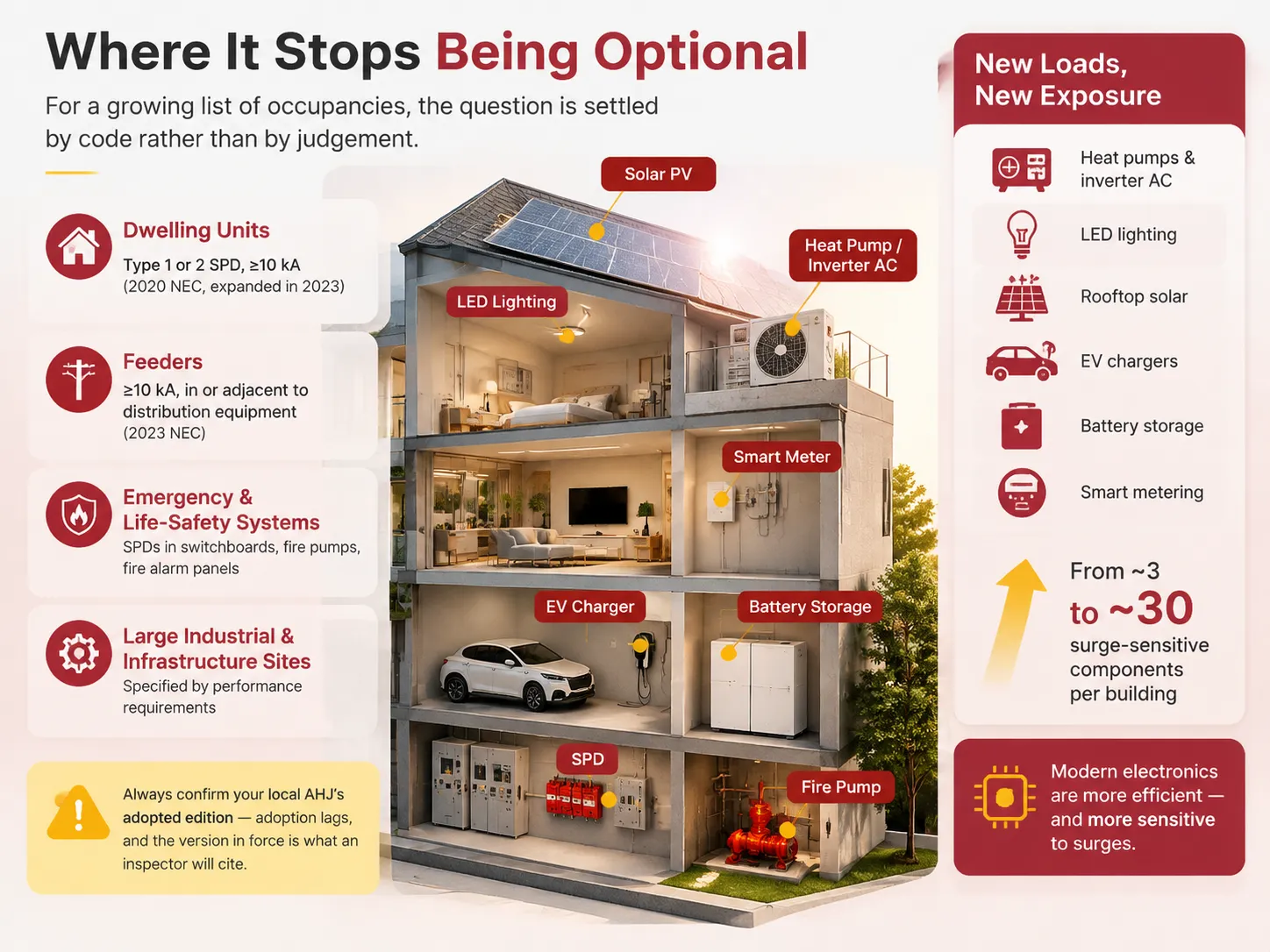
- Dwelling units. The 2020 NEC calls for the installation of a Type 1 or Type 2 SPD in systems used for dwelling, specifying that in cases where the service equipment is replaced, devices rated for no less than 10 kA must be installed. The 2023 version of the code has added dormitory rooms, hotel guest rooms, and nursing home sleeping rooms to the list of occupancies requiring protective systems.
- Feeders. The 2023 NEC Article 215.18 extends the requirement to feeders for said occupancies, as per Article 225.42 covering outside feeders, mandating the installation of devices rated not less than 10 kA in or near the circuit, which contains overcurrent protection devices.
- Emergency systems and life safety systems. The codes will be listed in the electrical switchboards and panels used in emergency systems and fire pump circuits, as well as fire alarm control systems, which is often a surprise for people working on generator-powered commercial projects.
- Major industrial and infrastructure locations. Although these devices are not required by the code, they can be found among other specifications because it is a requirement of the reliability analysis involved.
Be sure to verify the edition that your local authority having jurisdiction has enforced. In many states, the time lag between the adoption and publication takes several years, as the adopted edition is the one to which inspectors will refer.
New Loads, New Exposure
The reason this topic is so common is that the number of surge-sensitive components in buildings has increased greatly, while their associated wiring and protection systems have not changed much.
Heat pumps and inverter air conditioning put in place electrical units instead of motors and switching devices, while LEDs have taken over from lamps containing drivers and electronic parts. Rooftop solar puts power electronics on the most exposed part of the structure, on long DC conductors, at the exact point where induced voltages are highest — and the DC side of a PV installation has its own certification family for that reason, which is why surge protection for solar and renewable energy systems is specified around inverter inputs and combiner boxes rather than around the AC panel alone. Adding EV charging points and battery storage and smart meters could mean that a building with 3 devices prone to surges in 2000 may now have around 30.
Setting up the most important aspect of inverters, this counter-argument states that devices are built with better strength than before. But that is not the case. Modern electrical devices work at lower voltages and the thin gate oxide layer provides less protection against the stress of transients. If a device saves 30% of its energy consumption by utilizing 20 kHz switching frequency that means that it has done exactly the opposite; the switching process causes transients to appear in the network.
Frequently Asked Questions
Do you actually need a surge protector?
If the electrical devices in the building are valued at a few hundred dollars and you have control or ownership of the electrical system, the answer is yes and for economic reasons not safety ones. If you are a tenant and can’t modify the electrical panel, use good point of use protection instead. If the service is being updated or the building is a residential unit, dorm, hotel room, or a room in a nursing home, you will no longer have to answer the question: the applicable wiring regulations stipulate that a Type 1 or Type 2 SPD with a minimum rated discharge current of 10 kA has to be used.
What is better than a surge protector?
While not something which could surpass surge protection devices, there are many devices that can be a great precursor to them. Unplugged equipment gives you much better protection than any surge suppressors. Properly installed and tested earthing system is the base of every SPD. Lightning protection system according to NFPA 780 is acting on the strike that SPD cannot cope with. Also, properly sized and cared installation of electrical apparatuse eliminates whole category of incidents which no SPD can. Ultimately, surge protection gives you the first layer of protection only.
What are the downsides of using surge protectors?
There are three realities that are need to be kept in mind and one illusion to be understood. The realities are such that these surge protectors are consumables, which get used up after every instance of surge; a badly designed setup with long leads suffers from a much diminished performance compared to what is stated in the specifications; and a cheap surge protector equipped with low joule rating can be fried by a mere nearby strike. The illusion is that the surge protector is somehow ‘wasting’ energy or affecting the supply.
What should never be plugged into a surge protector?
High-power appliances which produce a lot of heat such as space heaters, irons, hair dryers, toasters, kettles, microwave ovens, and portable air conditioners may cause the 15 amp circuit of an extension cord to become overloaded and overheat as the cord is not designed for that. It is important to use only power strips specifically designed for medical devices used for life support. Using an appliance power strip in this case is not acceptable. Additionally, power strip must not be plugged into another power strip.
References
- NFPA 70, National Electrical Code — Articles 215.18, 225.42, 230.67 and 242
- NFPA 780 — Standard for the Installation of Lightning Protection Systems
- UL Standards & Engagement — UL 1449, Surge Protective Devices
- National Weather Service — lightning safety and the 30/30 rule
- U.S. Consumer Product Safety Commission — electrical safety and power strip guidance
Conclusion
Surge protection is important in the same way that insurance is important: for being cheap enough to put into place and too expensive to absorb the loss. To put it honestly, the device is cheap but what it protects is not, and the fact that transients can be produced internally makes exposure ever-present. Make an investment into properly mounted surge protection device providing short leads and matching short-circuit current rating, add point-of-use surge protection to expensive units and use the indicator window to prepare for replacement of the device. Avoid buying a cheap twenty-dollar strip and considering the problem solved.