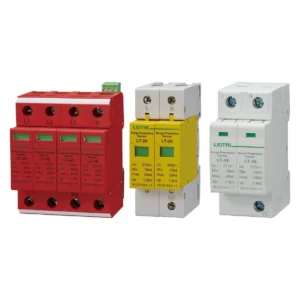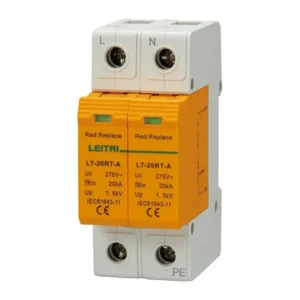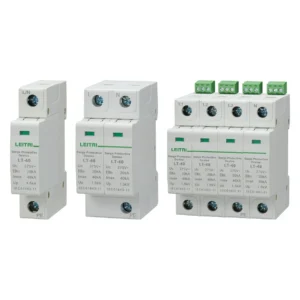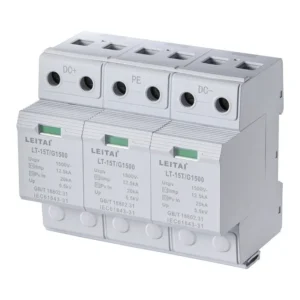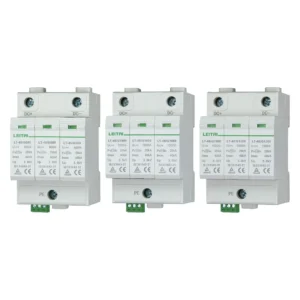

If you ask an electrician, utility engineer, and roofing contractor to explain what a “lightning arrester” is, you’ll probably hear three different definitions. This is the reason why it’s difficult to explain the distinction between surge arrester and lightning arrester since these two terms refer to three distinct types of devices used depending on the industry and country of the catalog you are checking.
Short answer: A surge arrester is a device connected between a live conductor and earth diverting surge current and limiting overvoltage in power grid, transformers, and substation equipment usually equal to or over 1 kV. An old-fashioned term “lightning arrester” refers to the same device but nowadays this term is usually used for lightning rod which intercepts direct strikes of thunder. Consider devices working below 1 kV that are usually called surge protective devices (SPD) inside buildings.
Why the Two Names Get Mixed Up
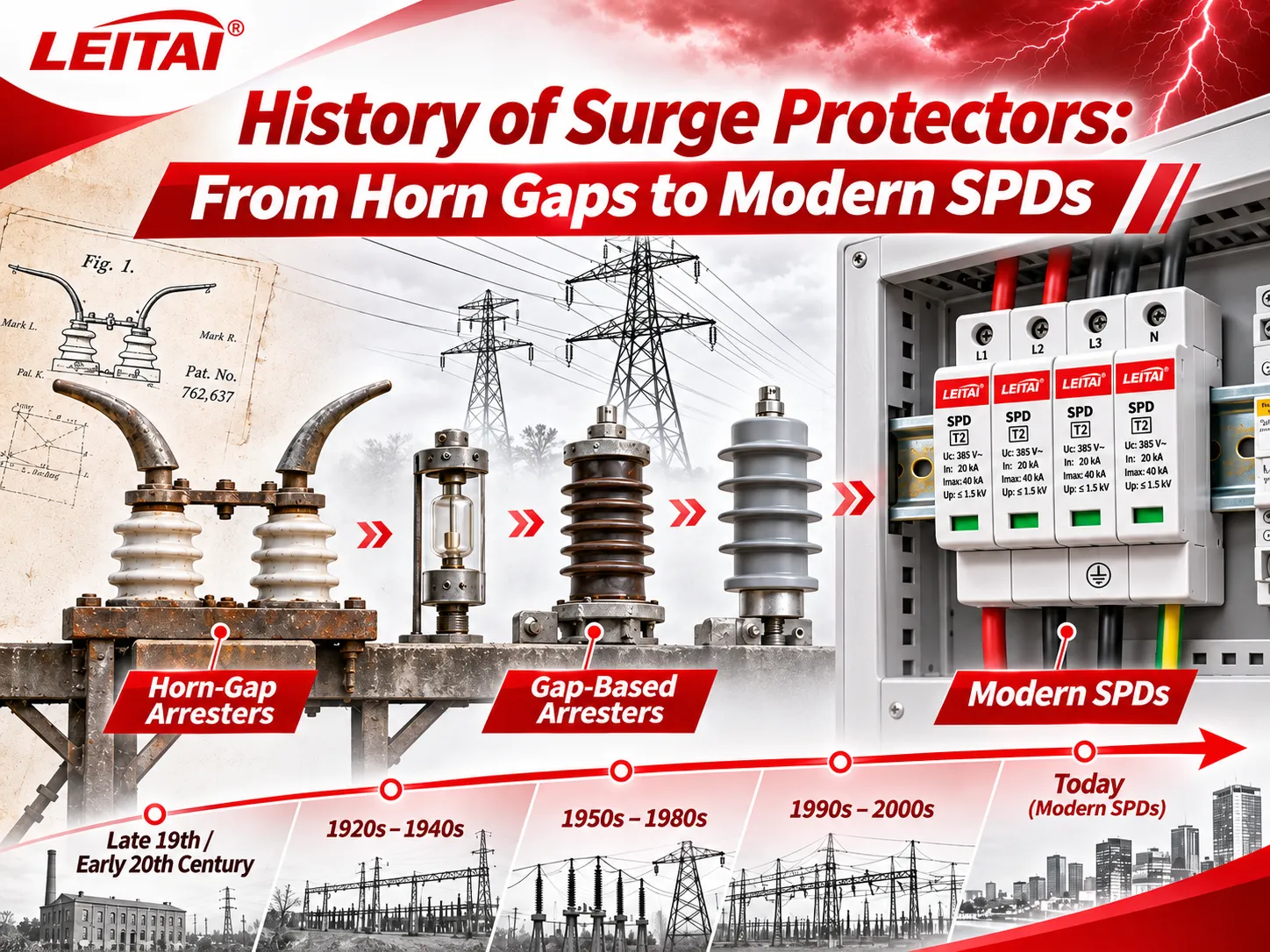
The confusion has its history. Originally, in the 1800s, the first protective devices for telegraph and power lines consisted of rod gaps engineered to protect them from lightning. They were simply referred to as lightning arresters. After this, in 1930, silicon carbide arresters with serial spark gaps were introduced and used for the next forty-plus years, according to Hubbell’s metal-oxide surge arrester application guide . In Japan, in 1967, metal oxide varistors were invented, while the first metal oxide surge arresters were produced in 1976.
With time, as these devices started protecting their users from switching surges and various overvoltages apart from lightning, the terminology used began to shift towards using the term “surge arresters”. That is exactly the term used today in IEEE C62.11 as well as in IEC 60099-4. However, the old term has not faded into oblivion. For example, plenty of product catalogs written in Chinese use the literal term for this device (避雷器) – the lightning avoiding device. Furthermore, lightning arresters also came to be commonly used to refer to the rod on the roof.
So when you see the phrase, decode it by context:
| Who says “lightning arrester” | What they usually mean | Correct technical name |
|---|---|---|
| A roofer or lightning protection installer | The rod on the roof, plus its down conductors and ground rods | Air terminal, part of a lightning protection system (LPS) |
| A utility or substation engineer | The device on a pole, transformer or bus that limits overvoltage | Surge arrester (metal-oxide arrester, MOA) |
| An Asian or Indian supplier catalogue | A metal-oxide arrester for medium or high voltage | Surge arrester |
| A hardware store or homeowner | A panel-mounted or plug-in surge protector | Surge protective device (SPD) |
Surge Arrester vs Lightning Arrester vs SPD at a Glance
In any surge arrester vs lightning arrester comparison, the names get in the way. Because the names overlap, the clearest comparison is between the three physical devices:
| Feature | Lightning rod (air terminal) | Surge arrester | Surge protective device (SPD) |
|---|---|---|---|
| Main job | Intercept a direct strike and carry it to earth | Limit overvoltage on power lines and equipment | Limit overvoltage on low-voltage wiring and the equipment connected to it |
| Connected to the power circuit? | No | Yes, between line and earth | Yes, between conductors and earth |
| Typical voltage | None | Above 1 kV (distribution up to transmission) | Up to 1 kV AC or 1.5 kV DC |
| Threats handled | Direct strikes to the structure | Lightning surges, switching surges, some temporary overvoltages | Induced and partial lightning currents, switching transients |
| Where installed | Roof and highest points of a structure | Poles, transformers, cable terminations, substations, transmission towers | Service entrance, distribution boards, equipment |
| Main standards | IEC 62305, NFPA 780, UL 96A | IEC 60099-4, IEEE C62.11 | IEC 61643-11, UL 1449 |
| Core component | Metal rod, down conductors, earth electrodes | Stack of zinc-oxide (MOV) discs in porcelain or polymer housing | MOVs, gas discharge tubes or spark gaps in a DIN-rail or panel module |
| Typical service life | Decades, with periodic inspection | 20 to 40 years, per Hubbell | Varies with surge exposure; replace on indicator |
One rule follows from the table: these devices do not replace each other. A rod cannot protect the wiring inside, and an SPD cannot survive a direct strike to the building.
Working Principle
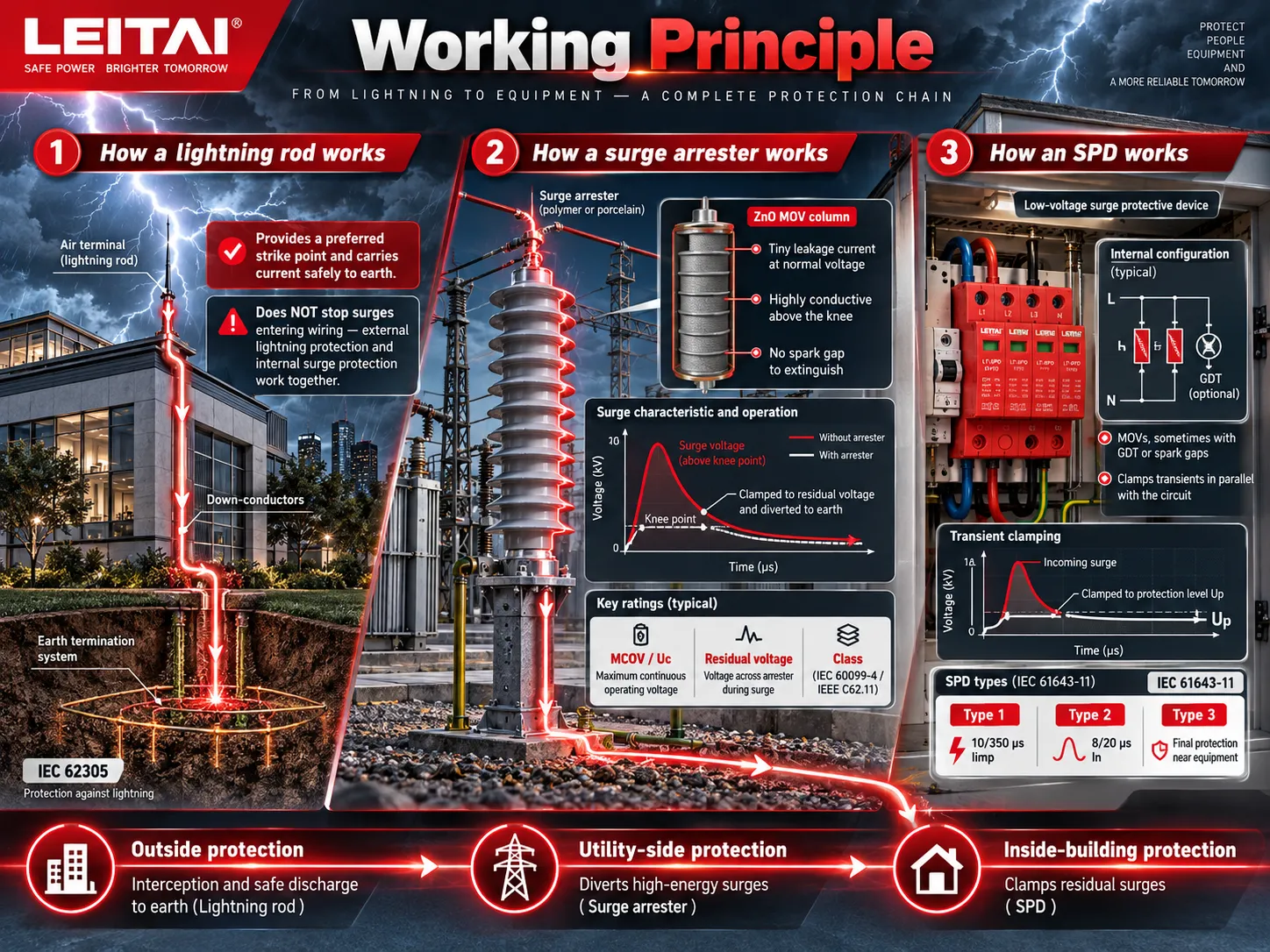
All three of these devices send a potentially hazardous current to the ground; however, they perform their functions at different times and for different reasons. A rod takes a strike before the strike gets to the building, while the surge arrester and SPD are integrated into the circuit and allow current to pass through only when the voltage exceeds a certain limit.
How a lightning rod works
A lightning rod will not invite any form of lightning nor stop it in any kind. Lightning rods give existing strikes the best choice of link-up, then transport the current down through cables leading to probe the ground. Its purpose is to ensure the current does not stay within the structure of the building.
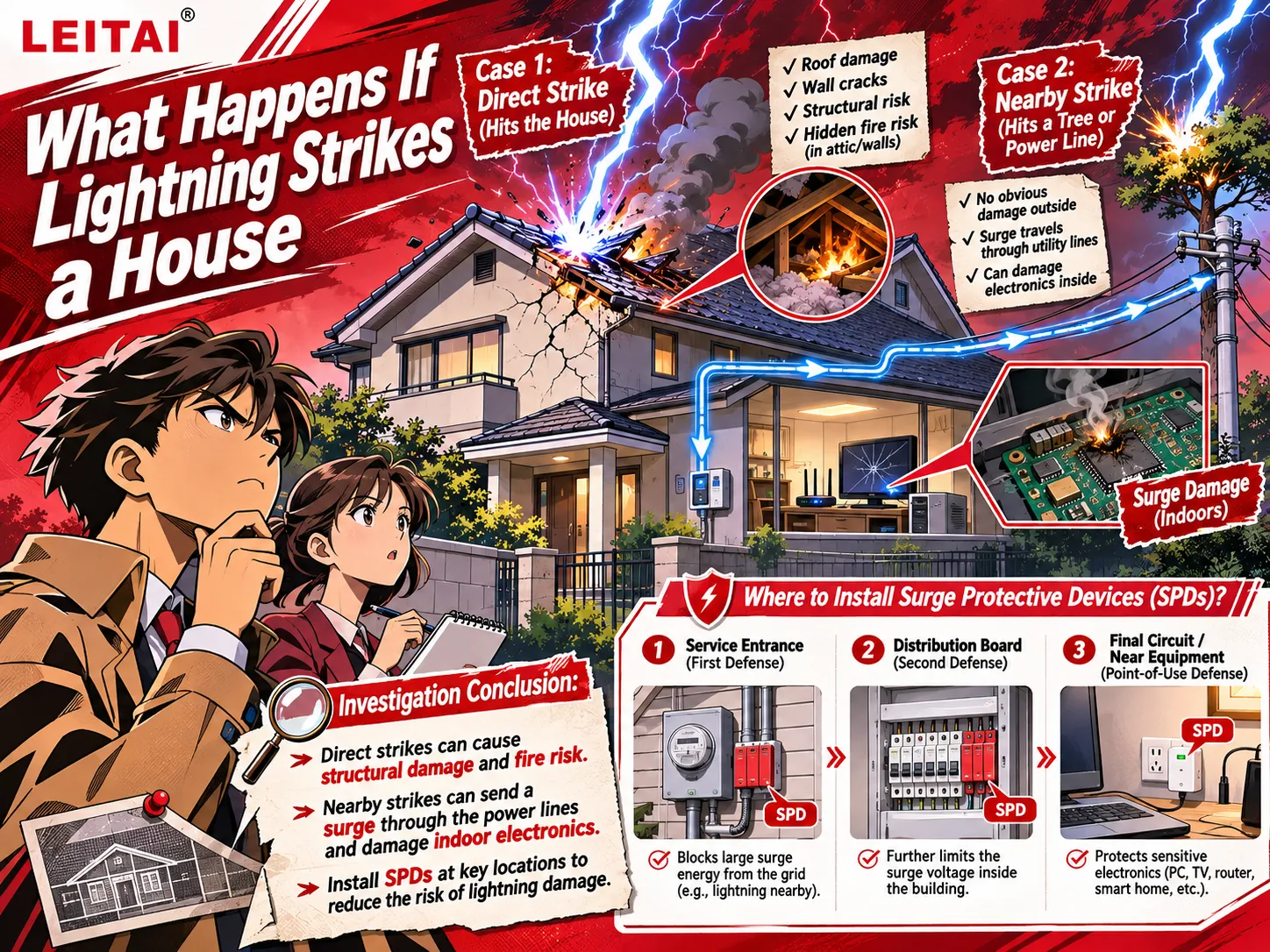
However, it can’t stop the current from entering the electrical system of the building. As lightning strikes travel along the cables downwards to the ground, the cables will find their way into the structure through electrical and data systems, causing voltage surges in these lines. That’s why IEC 62305 includes an external lightning protection system and internal surge protection as two separate halves of one system.
How a surge arrester works
A modern surge arrester consists of a stack of discs made up of zinc oxide, which is approximately made up of 90% zinc oxide with some additions of other metal oxides, in an enclosure of either porcelain or polymer. Under nominal operating voltage, the stack only passes a low leakage current. When the voltage goes above the voltage level known as “knee” voltage, the stack begins to conduct electricity and diverts the surge current to earth. When the surge is over, the discs go back to the non-conductive state and don’t require any spark gap to turn off.
When selecting a surge arrester, there are three ratings to consider:
MCOV: This refers to the maximum continuous operating voltage. It must be equal to or greater than the maximum voltage that the power line can withstand to avoid overheating of the arrester.
Residual voltage: This is the voltage that the arrester has under standard 8/20 μs current.
Class: Distribution classes is defined and covered by IEEE C62.11 and IEC 60099-4 as distribution classes DL, DM and DH and station classes SL, SM and SH.
How an SPD works
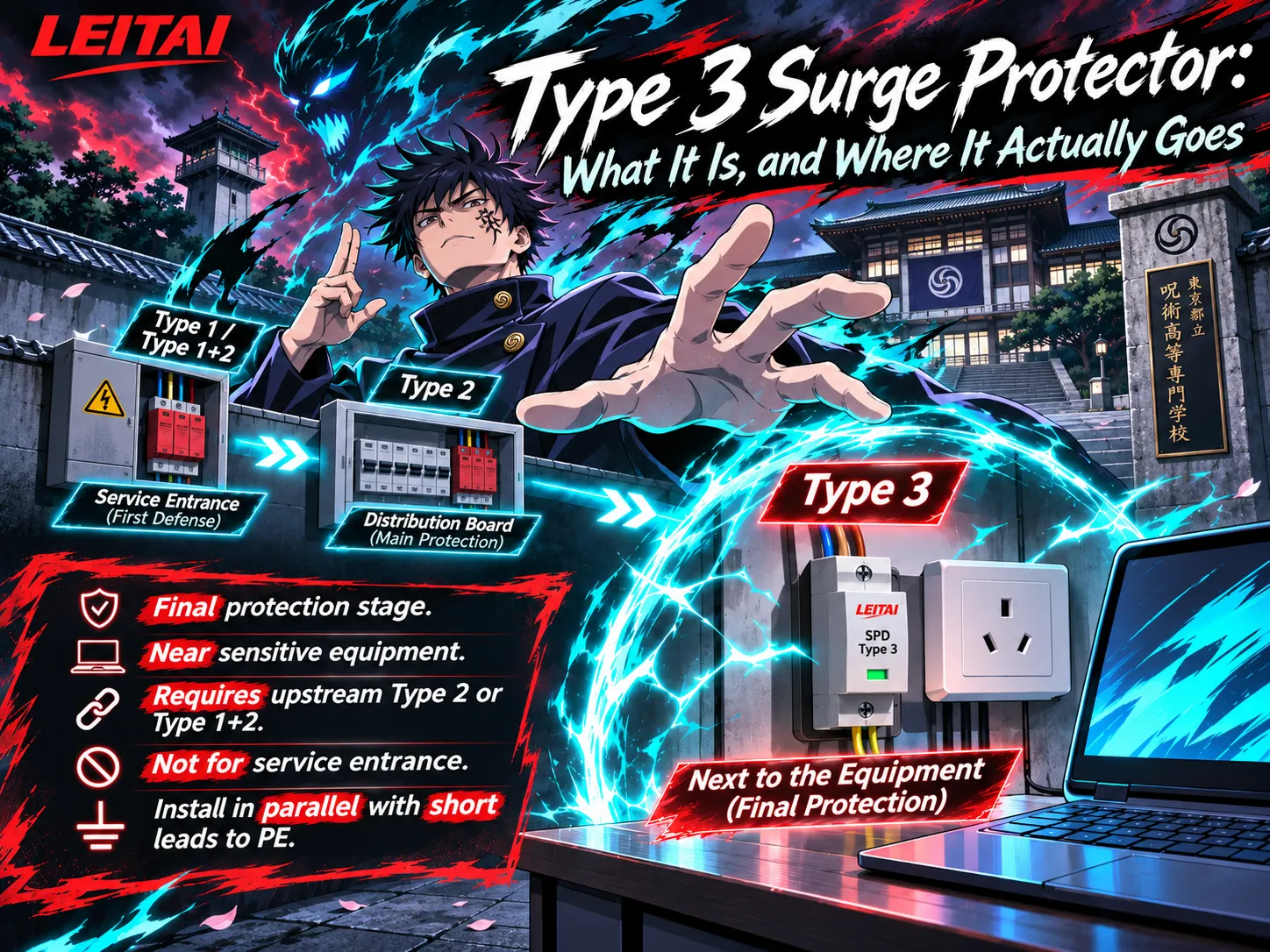
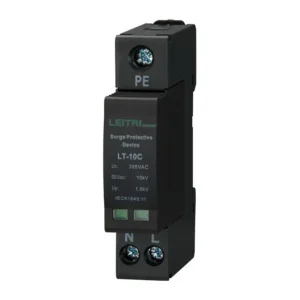
A surge protective device uses the same physics at low voltage. MOVs, which may be used in conjunction with gas discharge tubes or spark gaps, are positioned parallel to the circuit and limit surges to a certain level, Up. IEC 61643-11 classifies them according to the severity of the test. Type 1 devices can cope with a low lightning current known as a 10/350 µs wave (Iimp), while Type 2 devices can handle electrical transients with an 8/20 µs wave. Type 3 devices give final protection close to the equipment. Our guide to Type 1 vs Type 2 SPD covers the difference in detail.
Uses and Application Scenarios
| Scenario | Lightning rod system | Surge arrester | SPD |
|---|---|---|---|
| Ordinary home | Usually optional; depends on exposure and local practice | On the utility’s pole or pad-mount transformer | Type 1 or Type 2 at the panel, Type 3 at sensitive equipment |
| Commercial building with a rod system | Yes | Utility side only | Type 1 or Type 1+2 at the service entrance, Type 2 in sub-panels |
| Factory or process plant | Often required by risk assessment or insurer | At the plant’s own medium-voltage incomer and transformers | Type 1+2 at the main switchboard, Type 2 at MCCs and control panels |
| Substation or overhead line | Shield wires and masts | Station-class and line arresters | In the control building’s low-voltage and signal systems |
| Solar farm | Air terminals or masts where risk assessment calls for them | On the medium-voltage collector side | DC SPDs at combiner boxes and inverters, AC SPDs on the output |
| Telecom tower | Air terminal at the top of the mast | On the utility supply where medium voltage feeds the site | AC SPDs on the supply, plus data and coaxial SPDs |
The pattern is consistent: the rod handles the strike, the surge arrester protects the medium- and high-voltage network, and SPDs protect everything that runs on low voltage.
Price: What Each One Typically Costs
- Home Advisor estimates that the average cost for a lightning protection system is just about $1,556, while costs for each project range from between $443 to $2,670. A simple lightning rod only costs between $60 and $150.
- For whole house surge protection devices (SPDs) the installed cost is about $500 according to the data on Home Advisor. The work in this area has been analyzed in detail in the whole house surge protectors section.
- Price for industrial SPDs is given for each pole and rating. The cost of a Type 2 device is significantly lower than the Type 1 lightning current device which has an Iimp rating that is much higher.
Cost per project is what determines the price of medium and high voltage surge arresters. The voltage class and duty greatly affect the cost, with the distribution arrester of a pole-mounted transformer costing significantly less than that of a high-voltage transmission substation.
How They Work Together During a Strike
Follow a direct strike to a commercial building with full protection:
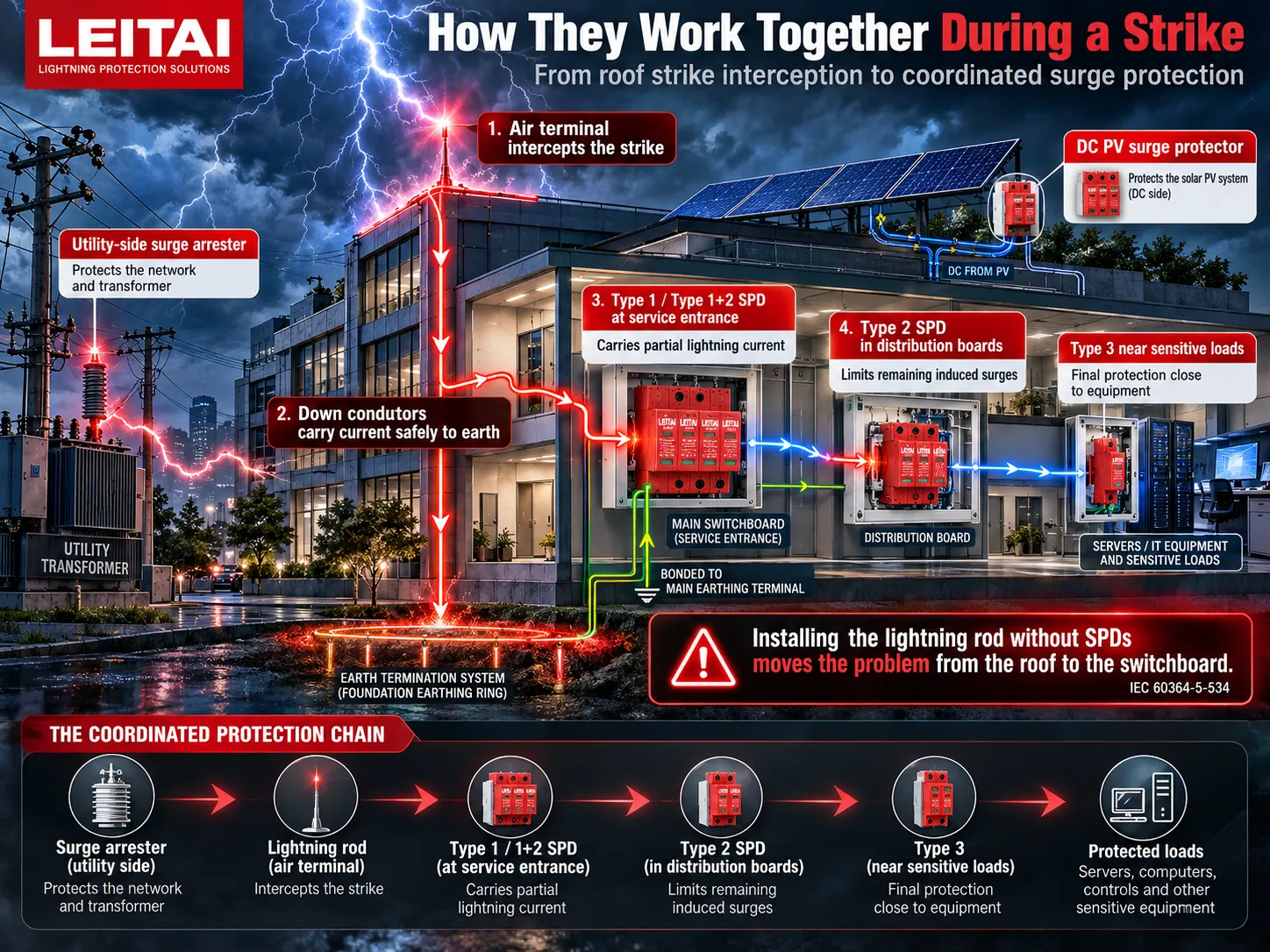
1.The air terminal at the top of the building absorbs the lightning strike.
2.The down conductors take the bulk of the lightning current safely to the ground earthing system.
3.When the earth voltage increases, part of the lightning current seeks to leave the building through the incoming mains. In this case, a Type 1 or Type 1+2 SPD located at the service entrance and connected to the main earthing terminal will divert part of the current safely.
4.The Type 2 SPDs in the distribution boards will then limit the remaining induced currents and Type 3 protect sensitive equipment at the end of long circuits.
5.At the power utility side of the installation surge arresters installed at the transformer will protect the network and the transformer from lightning strikes.
This explains why IEC 60364-5-534 states that SPDs must be fitted at the source of the installation in case there are lightning protection measures installed around the building because installing a rod without an SPD will shift the problem from the roof to the switchboard.
For the service entrance, a lightning current device such as the LT-X series Type 1 SPD, rated up to 50 kA Iimp, or the combined LT-T25 B+C Type 1+2 SPD with Iimp 25 kA, carries the partial lightning current. Downstream, a Type 2 SPD with In 10 kA and Imax 20 kA protects the distribution boards. Solar installations add a DC PV surge protector on the array side.
How to Tell Which One a Specification Is Asking For
When you are purchasing or quoting a lightning arrester, it can refer to one of three devices. Here are the four checks that clarify the matter quickly:
System voltage: if the voltage is higher than 1 kV then it’s a surge arrester; if the voltage is equal or lower than 1 kV then an SPD; and if there is no voltage then it’s a rod.
Standard cited: if the standard used is IEC 60099-4 or IEEE C62.11 then we are dealing with a surge arrester; if it is IEC 61643-11 or UL 1449, then it is an SPD; and if it is IEC 62305, NFPA 780 or UL 96A then we talk about a lightning protection system.
Ratings requested: MCOV, rated voltage Ur and line discharge class belong to surge arresters. Uc, Iimp, In, Imax and Up belong to SPDs, while rod height, material and radius of protection belong to air terminals.
Mounting: a pole bracket, crossarm or substation pedestal means a surge arrester while a DIN rail or a panel enclosure means an SPD.
LEITAI makes low-voltage SPDs and also tests high-voltage arresters rated up to 220 kV on its in-house 500 kV test equipment, so we see both sides of this naming problem every week. See our applications for the sectors we supply.
Frequently Asked Questions
Is a surge arrester the same as a lightning arrester?
Indeed, often this term is used in this manner. In power engineering, lightning arrester refers to the older name of a surge arrester according to the current standards. This device is installed on power lines and their equipment for reducing either overvoltage caused by lightning or due to switching on the equipment. The confusion happens because in addition to this meaning, the term lightning arrester is also used for rooftop lightning rods which represent a totally different device responsible for catching direct strikes (and they have nothing to do with electricity).
What is another name for a surge arrester?
Some frequently used variations include lightning arresters, metal oxide arresters (MOA), surge dividers (older British and Commonwealth terminology), and with gapless designs, metal oxide varistor and surge protective devices (SPD). In the case of lower voltages the equivalent will either be referred to as a surge protective device (SPD), surge protector or simply TVSS which stands for Transient Voltage Surge Suppressor.
Is a lightning arrester required?
It is based on what equipment one refers. Surge protection devices are usually installed by utilities as a part of their normal installation activities. Ordinary houses typically do not need lightning protection systems installed on the roof, but lightning protection could be necessary in accordance with risk assessment (which follows IEC 62305-2) or indicated by the insurance company or local regulations for high buildings. Surge protection devices are becoming more and more obligatory. US National Electrical Code requires SPDs of Types 1 or 2 to be installed on the service of the installation, while IEC 60364-5-534 implies the need for SPDs in case there is any external lightning protection in place for the building.
When not to use a surge protector?
Avoid using a surge protector to safeguard high current heating devices such as heater, kettle, and hair dryer. Avoid chaining power strips one into other, as well as surge strip into the UPS output. Also, do not depend upon surge protectors to protect from the lightning strike, since a separate lightning protection system is required for that purpose. Do not also choose an SPD with the continuous operating voltage Uc lower than the system voltage as well as the short circuit capacity lower than the possible fault current because it will fail prematurely or unsafely. See our guide on plugging a power strip into another power strip for the household rules.
Can a lightning rod protect electronics inside the building?
No, the rod can safeguard the building against a direct hit, though a part of the current and the surge generated by the lightning will still reach the wires connected to the building. That is why it is important to install surge protectors along both power and data communications. Our article on whether a surge protector protects against lightning explains what each layer can and cannot handle.
Can a surge arrester be used on a low-voltage system?
This particular arrestor does not belong to the category of low/high voltage arrester since its level of protection is rather above both the 230- and 400-volts devices. For low voltage systems, SPDs tested according to the standards of IEC 61643-11 or UL 1449 are required for usage, with Up matching the withstand voltage of the equipment. The low voltage surge arresters seem to be especially used for service entrances, but they can be called only SPDs.
References
- Hubbell Power Systems — Metal-oxide surge arresters application guide
- HomeAdvisor — Cost to install a home lightning protection system
- HomeAdvisor — Whole house surge protector cost
- IEC 60099-4 — Surge arresters, Part 4: Metal-oxide surge arresters without gaps for a.c. systems
- IEEE C62.11 — Standard for Metal-Oxide Surge Arresters for AC Power Circuits (>1 kV)
- IEC 61643-11 — Low-voltage surge protective devices connected to power systems
- IEC 62305 — Protection against lightning, Parts 1 to 4
- IEC 60364-5-534 — Low-voltage electrical installations: devices for protection against transient overvoltages
- NFPA 780 — Standard for the Installation of Lightning Protection Systems
- UL 1449 — Surge Protective Devices
Conclusion
Surge arresters and lightning arresters can be said to differ primarily in nomenclature which actually denotes different devices. A lightning rod diverts the discharge from a lightning strike away from the structure. A surge arrester is meant to protect installations and equipment of medium and high voltage from power surges. A surge protective device (SPD) does the same for low-voltage circuits. If the specification states “lightning arrestor”, do make sure you check voltage, standard, and rating since the specification could be aimed at any of the two devices. Also, when providing protection for a building, do provide all three layers of protection since the rod will move the surge to your switchboard.