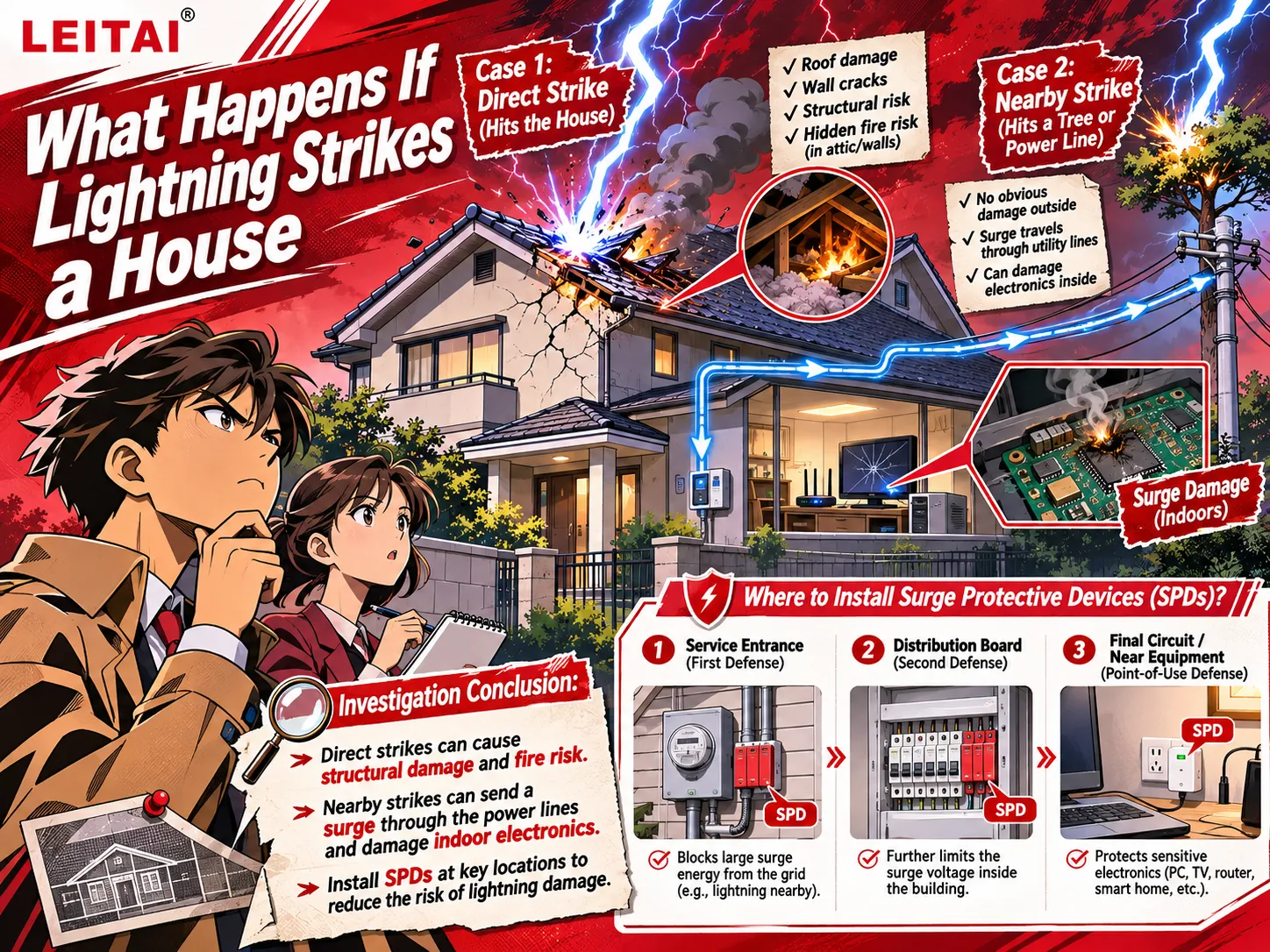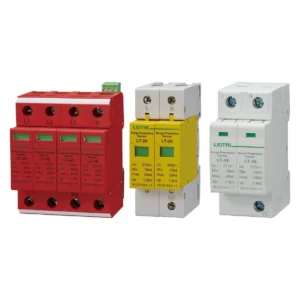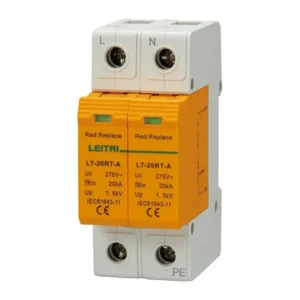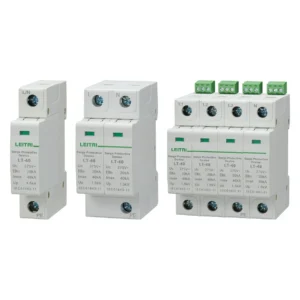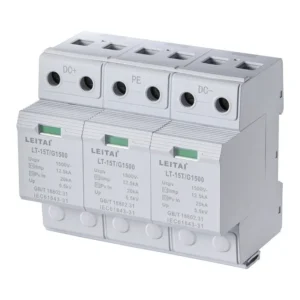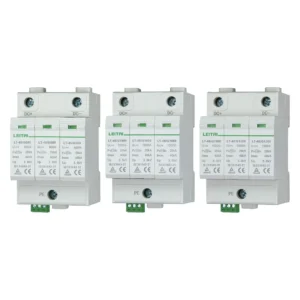

Type 3 surge protectors point towards the last layer of a surge protection system that serves in-line with the equipment they protect. The Type 3 SPD features test processes, which make it an ideal last line of defense against electrical surges. This is because it was developed on the assumption that upstream Type 2 or Type 1+2 devices had done the bulk of the surge energy protection work, in which case the Type 2 device does not replace any incoming surge protective devices.
Simply put, the installation of a Type 3 SPD is recommended in cases where systems already utilize a Type 2 or Type 1+2 SPD. The Type 3 is designed to deal with the minor surge left over after energy protection from Type 2 devices and the surges received from the cables.
The brief explanation
- The application: on areas surrounding sensitive equipment or the extreme side of long branch circuits. Its never to be placed near service entrance.
Required device: at the front of it, a Type 2 or Type 1+2 SPD should be installed at the main or sub distribution box.
Voltage rating: its Uc should be higher than the highest voltage present in the network.
Protection level: the voltage Up should not exceed the impulse withstanding voltage of the appliances being protected.
Installation: to be installed in parallel with the circuit and use the shortest length of the leads to the PE terminal. 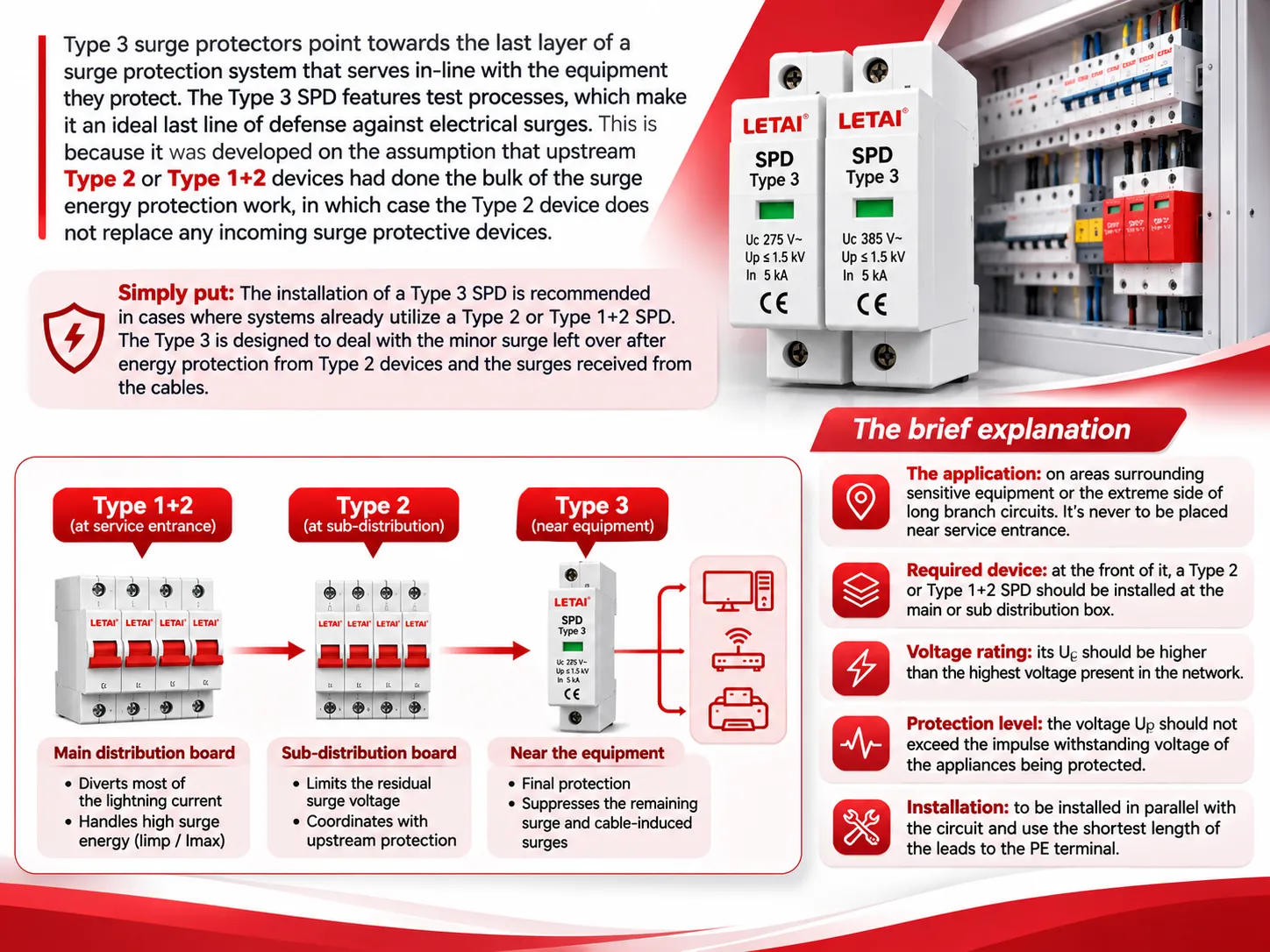
What the Test Is
The three kinds of SPD do not refer to variations of the same item. IEC 61643-11 defines them based on the tests they have passed, as each of the tests is aimed at a specific type of surge experienced at a location.
Type I (Class I testing) involves a current impulse Iimp having the waveform of 10/350 µs. This long high-energy signal represents part of a lightning current that has entered through the service connection point.
Type II (Class II testing) has to do with nominal discharge current In and maximum discharge current Imax with the waveform of 8/20 µs, meaning that lightning and switching surges have taken place within the facility.
Type III (Class III testing) combines a wave produced by a generator giving 1.2/50 µs voltage wave in an open circuit and an 8/20 µs current wave in a short circuit with an imaginary impedance of 2 Ω.
A Type III SPD is distinguished by its Uoc rating, as Uoc indicates the voltage in kV of a high-energy wave generator. Because the impedance is 2 Ω, the maximum peak current the generator can deliver through a short circuit is approximately Uoc/2, which means that a 6kV generator delivers not more than about 3 kA. This represents much less energy than in the Type II test.
This indicates that a Type III rating cannot be compared with Iimp from Type I test or Imax from Type II test in the sense “higher numbers mean more power”. A Type III device having a Uoc of a few kV cannot be considered a weaker Type II device. A Type III device has been designed for a surge lasting until the end of the circuit after some other SPD has acted along the way.
IEC Type III and UL Type III Are Not Comparable
If you check for a Type III surge protector, you will see power strips listed next to the modules. This is explained by the fact that the term has different meanings in both standards.
According to UL 1449 which operates in North America, Type III refers to point-of-use SPDs which are installed not less than 10 meters away from the power panel. These include power strips, plug-in modules, and simplex apparatus.
According to IEC 61643-11 which operates in Europe, the Middle East, most of Asia and several other markets, Type III means Class III test meant for combination wave testing. Many Type III devices appear to be DIN-rail modules for distribution boards and control cabinets.
Though they serve similar purposes, as both SPDs are located near the load, power strip-protected equipment and DIN-rail Type III SPD devices differ greatly in their installation and maintenance methods.
Type 3 and Type 2 Side by Side
The relationship between all three stages is covered in SPD Type 1, 2, 3: Why Three-Stage Protection Matters More Than kA. The table below only compares the two stages that are most often confused.
| Item | Type 2 SPD | Type 3 SPD |
| Location | Main or sub-distribution board | Near the equipment, or at the end of a branch circuit |
| Test class | Class II, 8/20 µs current | Class III, combination wave 1.2/50 µs voltage + 8/20 µs current |
| Main rating | In and Imax, in kA | Uoc, in kV |
| What it handles | Induced lightning and switching surges entering the board | Residual voltage after the upstream stage, and surges coupled into the branch cable |
| Can it be used alone? | Yes, where no direct lightning current is expected | No, it needs a Type 2 or Type 1+2 upstream |
A particular aspect that is not indicated by the table is that the Up of Type 3 may be equal or higher than the Up of Type 2. It matters not how low the number on the label is but where the device is located. The wiring that runs from the circuit board to the appliance adds a voltage due to inductance, can cause oscillation and double the voltage surge at the termination of a long product run, and creates its own induced impulses during operation. A Type 3 device prevents the voltage from exceeding certain level where it matters.
When One Is Worth Fitting
Type 3 makes sense when you have an item needing protection located far away enough from the point of protection, so that the Type 2 device alone is unable to protect it. Typical applications are given in the following examples:
PLC, I/O modules, and other drives installed in a control cabinet powered from a sub-distribution board;
Measuring equipment, meters, sensors, and different testing devices;
Electronics located at the end of a lengthy trunk, or in other words, situated at a distance greater than approx. 10 m from the Type 2 SPD;
Branches running outside, and along the external wall of the building, or close to the lighting protection cables, letting surges induced by lightning enter the line after leaving the protection;
Devices which have low resistance against pulses, such as IEC 60664-1 category I devices rated at 1.5 kV applied at 230/400 V systems.
Using Type 3 for equipment installed on the same board as the Type 2 or a few meters from it does not make sense, since adding one more device into a cabinet, requires known expenses and adds another element to control, but does not actually bring too much benefit from the equipment’s voltage drop.
When It Is the Wrong Device
- Foreign to the services entrance. In case of supply supply, it has to be either Type 2, or Type 1 or Type 1 + 2 if direct lightning current is present.
A building with external lightning protections or an overhead supply line is predisposed to partial lightning current, therefore, only Class I device can be used there. The difference is explained in Type 1 vs Type 2 SPD. - In cases regarding circuits that are located at certain places with no SPD. Type 3 devices only will have to absorb lightning currents above their qualifications and disconnect before it does so.
The Distance That Makes It Work
There are two distances that determine if a Type 3 device is performing its function, and a third distance that determines if the rated value of Up matches what the equipment is actually seeing.
First, the distance from the Type 2 SPD. For the two stages to share the surge correctly, there should be enough cable between them, usually around 10 m, as described in the surge protector wiring diagram article. With less cable, the Type 3 device can try to take the full surge before the Type 2 device has started to conduct. If the two have to be closer together, use a decoupling inductor, or use a pair that the manufacturer has tested for coordination.
Second, the distance from the device to the equipment itself. The Type 3 device should be placed as close to the load as possible. Consequently, we can state that every additional metre of cable will enable the voltage to build up even more before reaching the load.
Third, we have to consider the length of leads of the Type 2 device. Ideally, all lead lengths from the line terminals to the PE bar should be as short as possible, preferably not longer than 0.5 m. Due to the high-speed currents, every additional metre of cable will result in significant voltage settings on the Ups value given in the label.
The modes of protection are installed in parallel with the circuit: line to PE and neutral to PE. In turn, a one-port Type 3 device, such as a DIN-rail module, should not be connected in series. However, some Type 3 appliances have two outlets and load current created in the circuit.
Where the LT-10C Fits
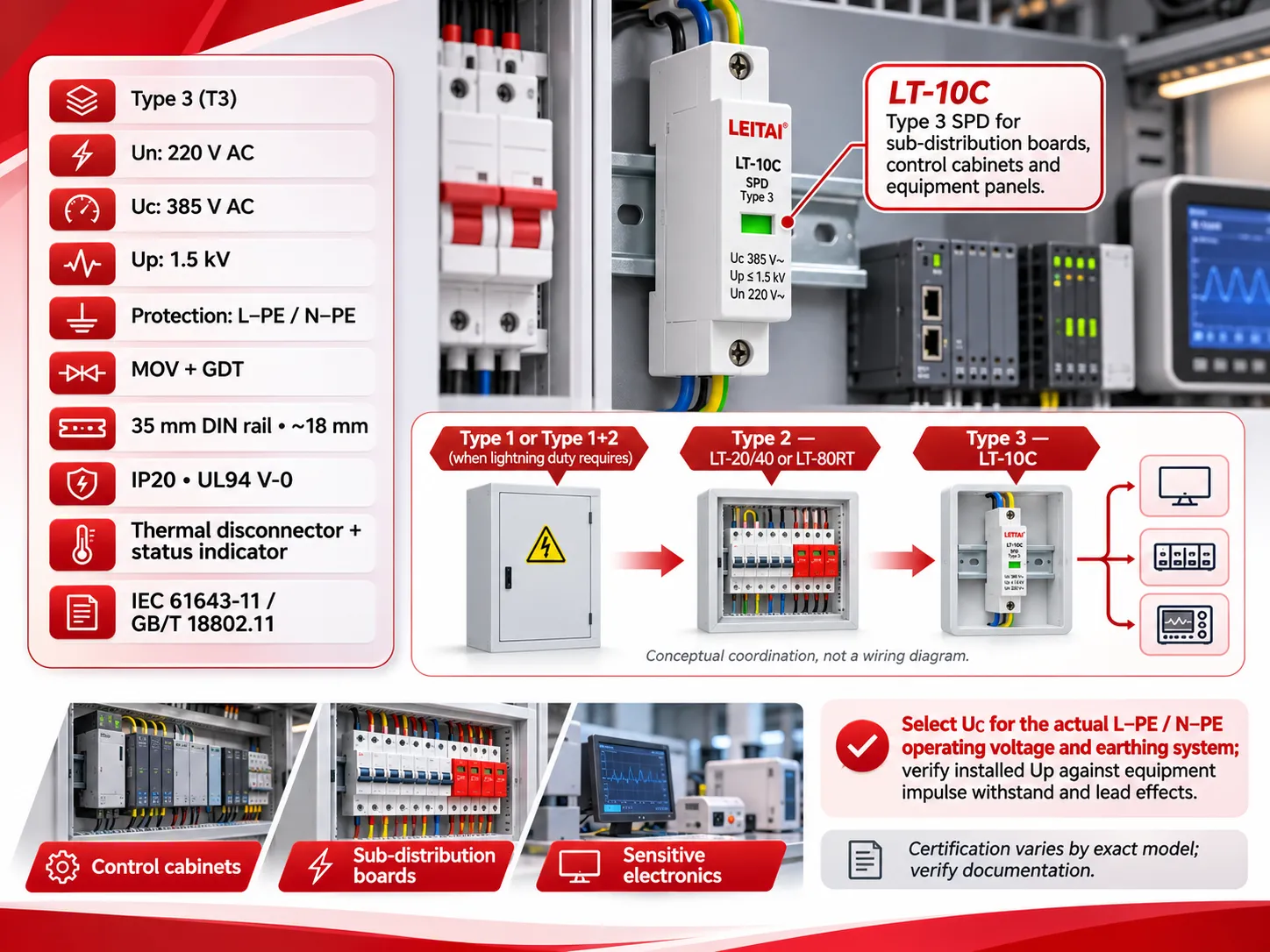
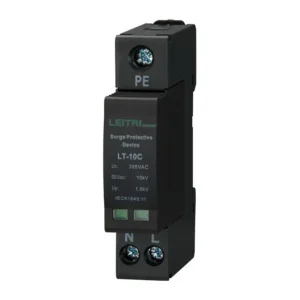
The LT-10C is a DIN-rail Type 3 SPD for sub-distribution boards, control cabinets and equipment panels. It is a modular device, not a power strip.
- Type: Type 3 (T3), tested to IEC 61643-11 / GB/T 18802.11
- Nominal voltage Un: 220 V
- Maximum continuous operating voltage Uc: 385 V
- Voltage protection level Up: 1.5 kV
- Protection modes: L-PE, N-PE
- Protective elements: MOV + GDT
- Thermal disconnector with status indication
- Mounting: 35 mm DIN rail, about 18 mm wide
- Enclosure: IP20, flame-retardant UL94 V0 plastic
- Certifications: TUV, CE, CQC
The Uc specification is good to be discussed. In a 220/380 V network, the voltage between phase and neutral is equal to 220 V. According to IEC 60364-5-53, it’s desirable for a 230 V TN system to have the Uc voltage of at least 1.1 times the voltage between phase and earth, equaling approximately 253 V. Therefore, the common Uc rating that can be found in the market is 275 V. The device with Uc equal to 385 V can provide even more protection from high and temporary overvoltages. It is necessary to use this device for phase to earth and neutral, and do not connect it for two phases, also make sure to check the earthing system if the system is IT, where the phase potential to the earth can reach full value.
The Up of 1.5 kV perfectly corresponds to the impulse withstand of Category I equipment within 230/400 V systems, thus allowing the installation of LT-10C at the end of the branch, right in front of sensitive electronic devices.
Upstream, pair it with a Type 2 device in the board, such as the LT-20/40 or the replaceable LT-80RT. Where the building has an external lightning protection system or an overhead supply, the entrance needs a Class I tested device such as the LT-X series or the LT-T15 B+C.
FAQ
I already have a Type 2 SPD. Do I still need a Type 3?
The type 3 device has no real value unless the electronic equipment is located at a distance of more than 10 meters from the distribution panel. Another requirement is that the length of the branch cable used for connection shouldn’t pick up surge on its own.
Can a Type 3 surge protector replace a Type 2?
No. A type 3 surge protector is tested with a combination wave that carries far less energy than a Type 2 test. Without an upstream Type 2 or Type 1+2 device, it will be overloaded by the first serious surge.
What is the difference between a Type 3 SPD and a surge-protected power strip?
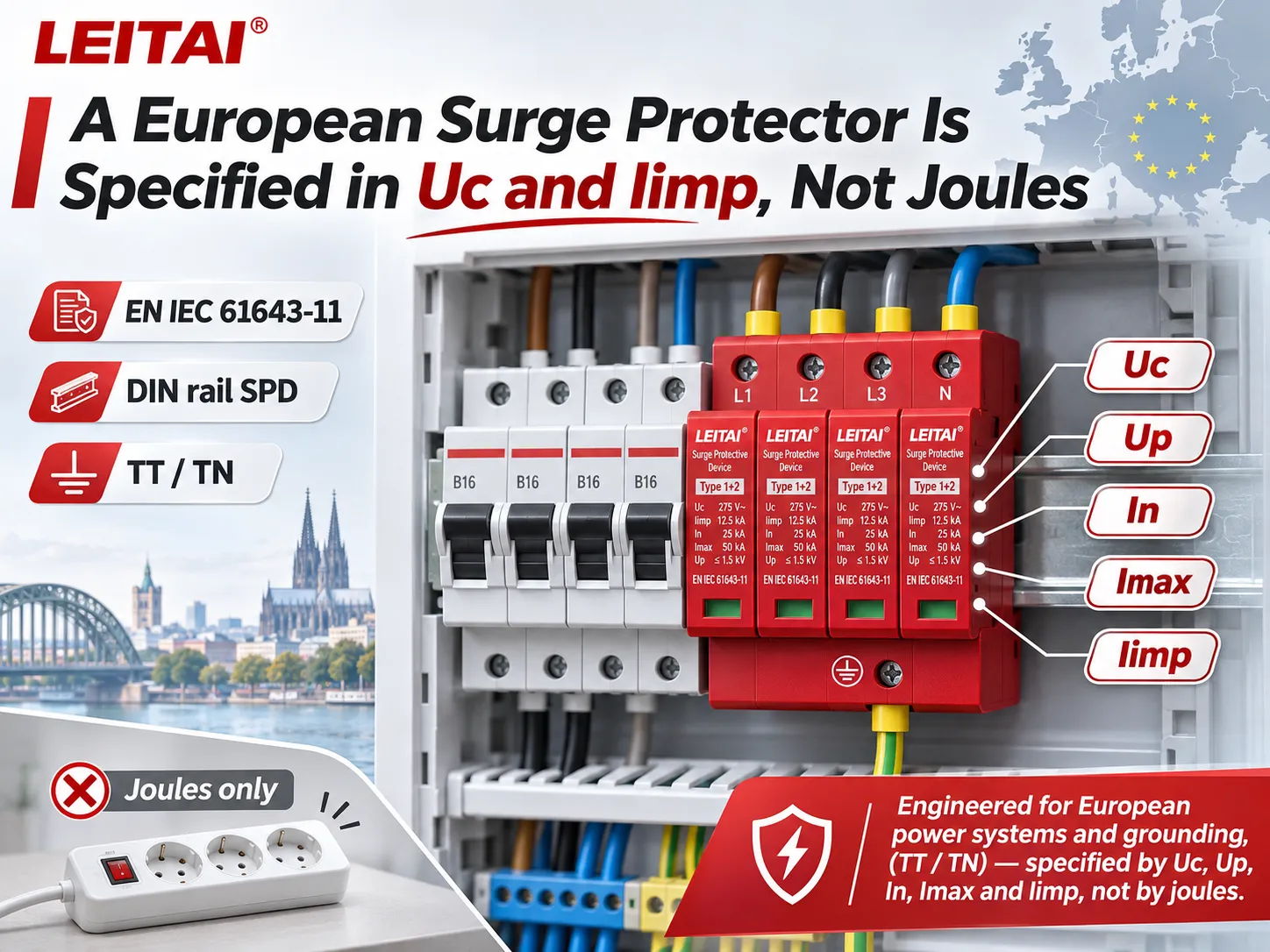
A power strip can conform to Type 3 Device according to UL 1449. Under IEC 61643-11, a Type 3 SPD describes its nature as per Class III testing and can be represented as a DIN-Rail mounted item that is wired into a sub-panel or control cabinet. Both types of devices serve as the final stage but differ in the fact that the DIN-Rail appliance is permanently installed and wired to PE with short leads as well as rated for Uc, Up and Uoc while the strip outlet is a type of consumer device generally rated in joules.
Where is a Uc of 385 V used?
On 220/380 V and 230/400 V networks, connected line-to-PE and neutral-to-PE, where extra margin against high or unstable supply voltage is wanted. It is not meant for line-to-line connection.
How do I know if the Type 3 device has failed?
Check the status window. When the MOV overheats at end of life, the thermal disconnector separates the MOV and the indicator changes from its normal colour to its fault colour (generally from green to red). After this, the equipment is no longer protected and the MOV should be replaced.
References
- IEC 61643-11, Low-voltage surge protective devices, Part 11: Surge protective devices connected to low-voltage power systems, requirements and test methods
- IEC 60364-5-53, Low-voltage electrical installations, selection and erection of electrical equipment, devices for protection for safety, isolation, switching, control and monitoring
- IEC 60664-1, Insulation coordination for equipment within low-voltage supply systems
- UL 1449, Standard for Surge Protective Devices
- What Is SPDs?
- SPD Type 1, 2, 3: Why Three-Stage Protection Matters More Than kA
- Type 1 vs Type 2 SPD: What Actually Changes Between Them
- Surge Protector Wiring Diagram: How an SPD Is Actually Connected
- LT-10C Type 3 Surge Protector
- Surge Protection Device (SPD) Automatic Production Line
Conclusion
A type 3 surge protector is the final stage, never the only one. Put a Type 2 or Type 1+2 device in the board first, place the Type 3 device close to the equipment it protects, and keep its leads short.