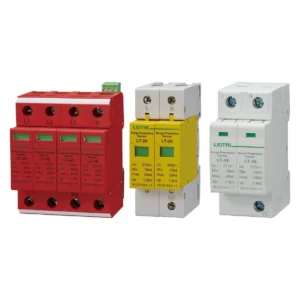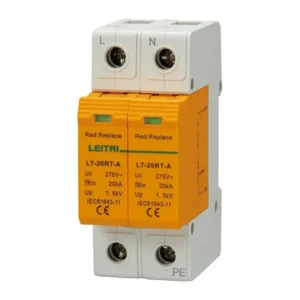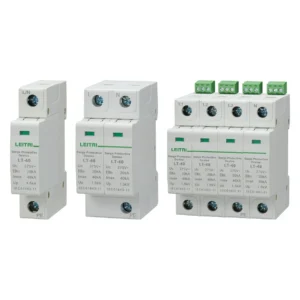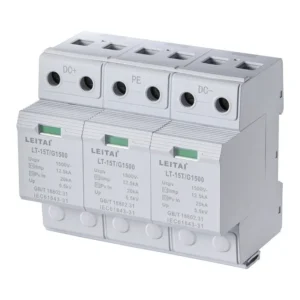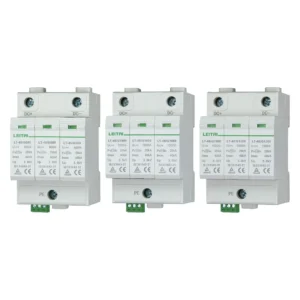

When one searches for a European surge protector, one will find two products. One of them is a power strip with joule ratings indicated on the box, while the second product is called a modular SPD, which is mounted on the distribution board next to circuit breakers. The second product here meets the requirements of the European standard.
The device in question is manufactured in compliance with EN IEC 61643-11, and contains such parameters as Uc, Up, In and Imax. The Type 1 device has one more parameter called Iimp. In order to select the correct device, it is necessary to consider the grounding system, installation position of the apparatus on the board and the necessary conformity documents for the CE mark. In other words, if the product has only joules and no other values, it does not comply with the European requirements.
As it has already been said, the surge protector used for the distribution board must comply with the low-voltage SPD defined by EN IEC 61643-11 standard, which requires Uc, Up, In and Imax as the minimum values. In the case with the Type 1 device, there is the additional Iimp rating. As opposed to the consumer surge protector advertised according to its joule rating, a DIN rail SPD must also meet the supply voltage and TN/TT grounding types.
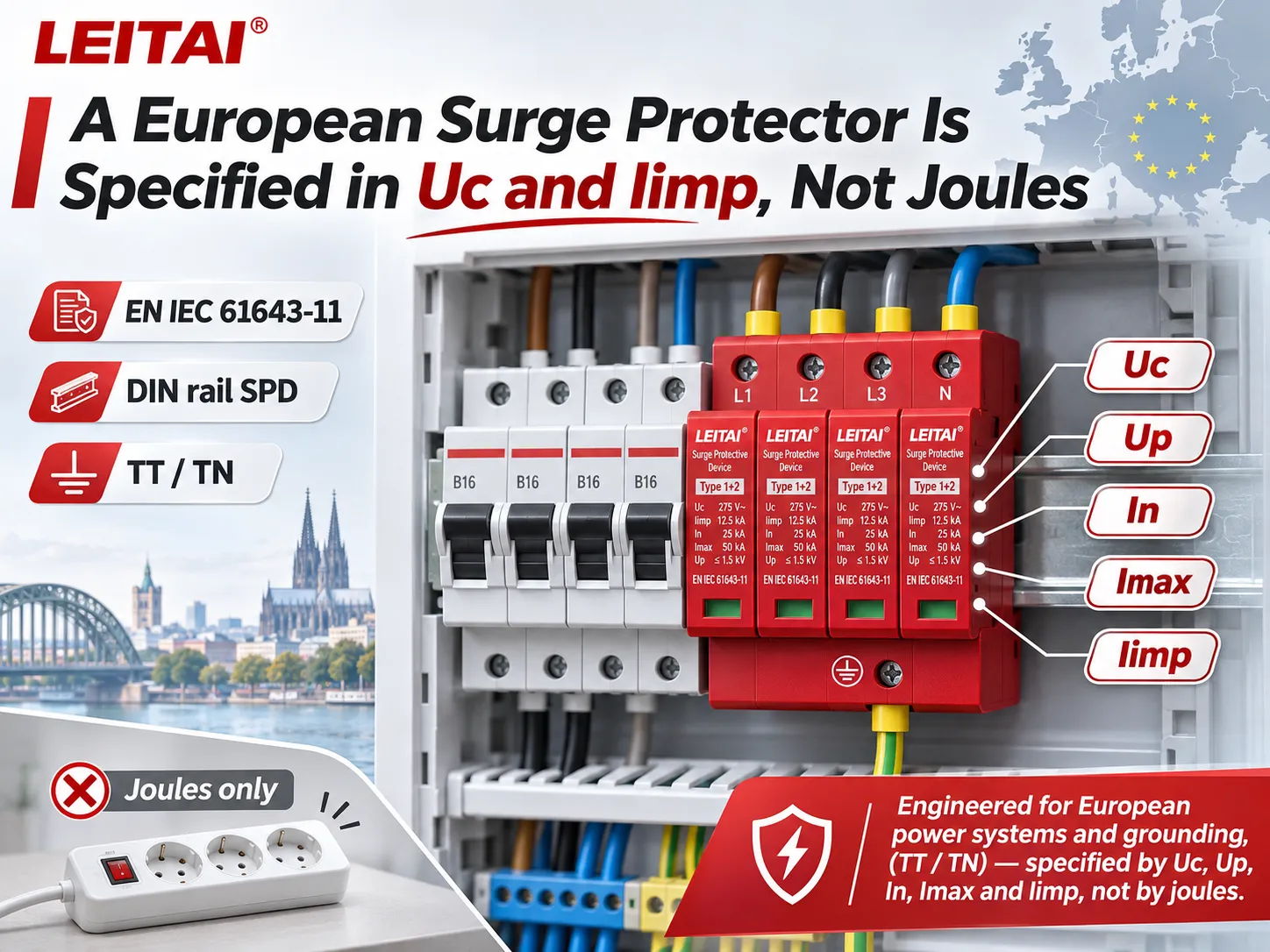
What “European Surge Protector” Actually Means
Power strips with surge protection are of course sold in Europe too. But in low-voltage distribution work, the phrase points to a fixed-installation SPD. The quickest way to recognise one is to look at where it sits and what is printed on it.
| Item | European low-voltage SPD |
|---|---|
| Product standard | EN IEC 61643-11 (low-voltage power systems) |
| Mounting | 35 mm DIN rail, modular width |
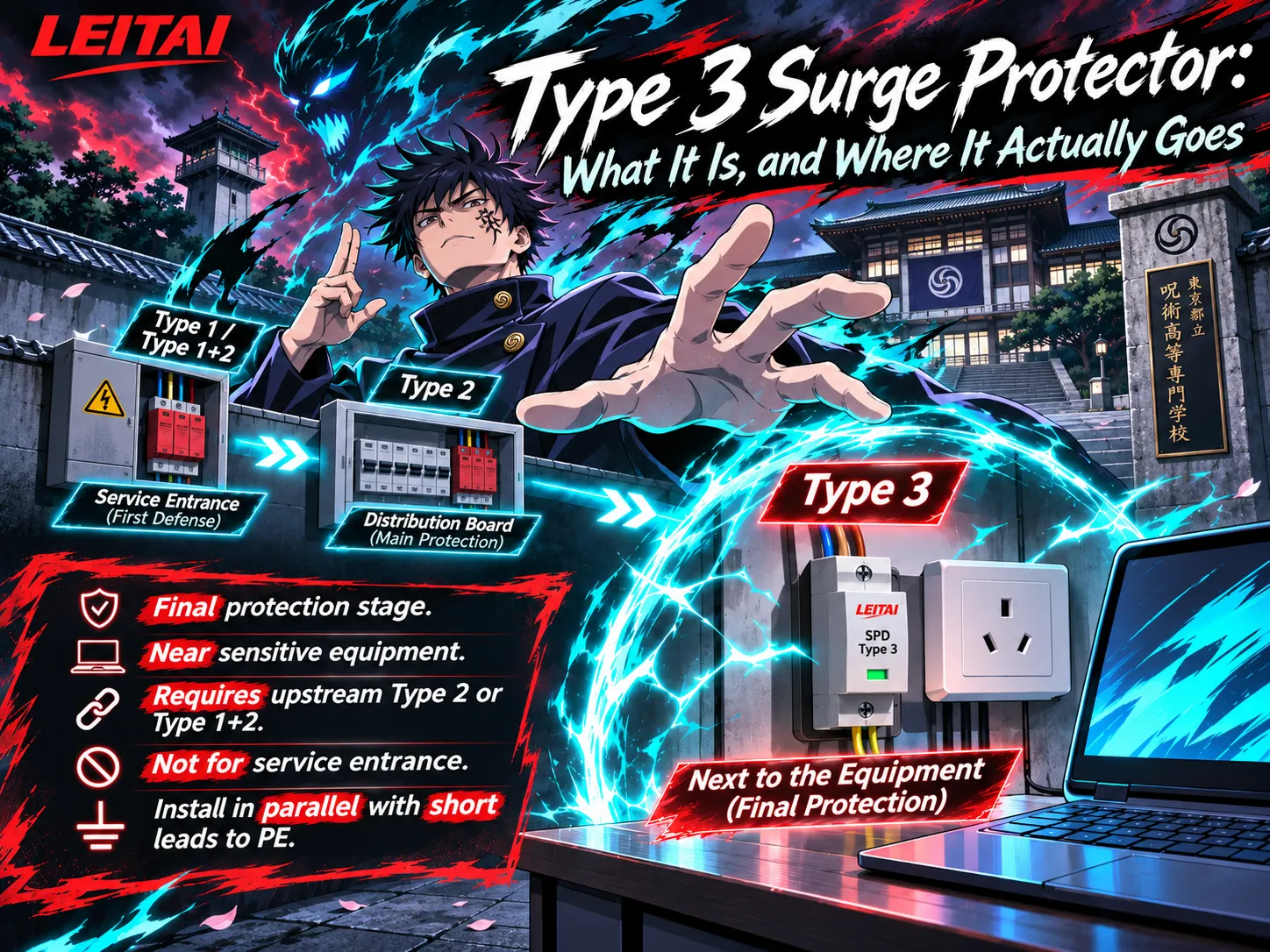
| Main distribution board | Type 1 or Type 1+2 |
| Sub-distribution board | Type 2 |
| Near sensitive equipment | Type 3, coordinated with upstream stages |
| Voltage rating | Uc, maximum continuous operating voltage |
| Protection level | Up, voltage protection level |
| Discharge ratings | In and Imax (8/20 µs); Iimp (10/350 µs) for Type 1 |
| Earthing arrangement | TN-C, TN-S, TN-C-S, TT or IT |
| EU market access | CE marking with an EU Declaration of Conformity |
Datasheets from DEHN, Phoenix Contact, ABB and Schneider Electric are good examples of how these values are presented. They are mentioned here only as reference points for what a complete European SPD datasheet looks like, not as a ranking.
Why a US Surge Protector Specification Cannot Be Used Directly in Europe
The US market works under UL 1449, and several of its terms look similar to IEC terms. The similarity is where most specification mistakes start.
| IEC / EN 61643-11 | UL 1449 | What to watch |
|---|---|---|
| Uc | MCOV | Similar purpose; check each against its own standard |
| Up | VPR | Different test conditions; no direct conversion |
| In | In | Same symbol; confirm the rating and test sequence |
| Iimp (10/350 µs) | No direct equivalent | UL 1449 has no 10/350 µs lightning current test |
| Type 1 / 2 / 3 | Type 1 / 2 / 3 / 4 | IEC classifies by test class; UL by installation location |
| No joule rating | No joule rating | Joules are a marketing figure on consumer strips |
The Type number can lead to a large number of misunderstandings. The IEC Type 1 is characterized by its ability to provide 10/350 µs lightning current as Iimp. The IEC Type 2 is tested using 8/20 µs waveforms and receives tests for In and Imax. In contrast, the UL Type 1 device is classified by the place of installation, which is on the line side of the service disconnect without using any external over-current protection system. While the labels may be matching, they mean two different types.
The same applies to the clamping performance. Up figures are referred to the tests issued by IEC, while VPR is obtained by using a UL combination wave. The same value of 1.5 kV indicated on one document may mean a total opposite value on the other.
A unit can be constructed and undergo tests according to both standards. However, it should not be certified with only one of the documents. For how the three IEC stages work together, see SPD Type 1, 2, 3: Why Three-Stage Protection Matters More Than kA.
TT vs TN Earthing: The Importance of the SPD Connection Arrangement
In selecting SPDs in Europe, the earthing system must be taken into account before the kA ratings. Even for the same voltage power supply, a different installation situation will require a specific module, depending on the arrangement of neutral ground connection.
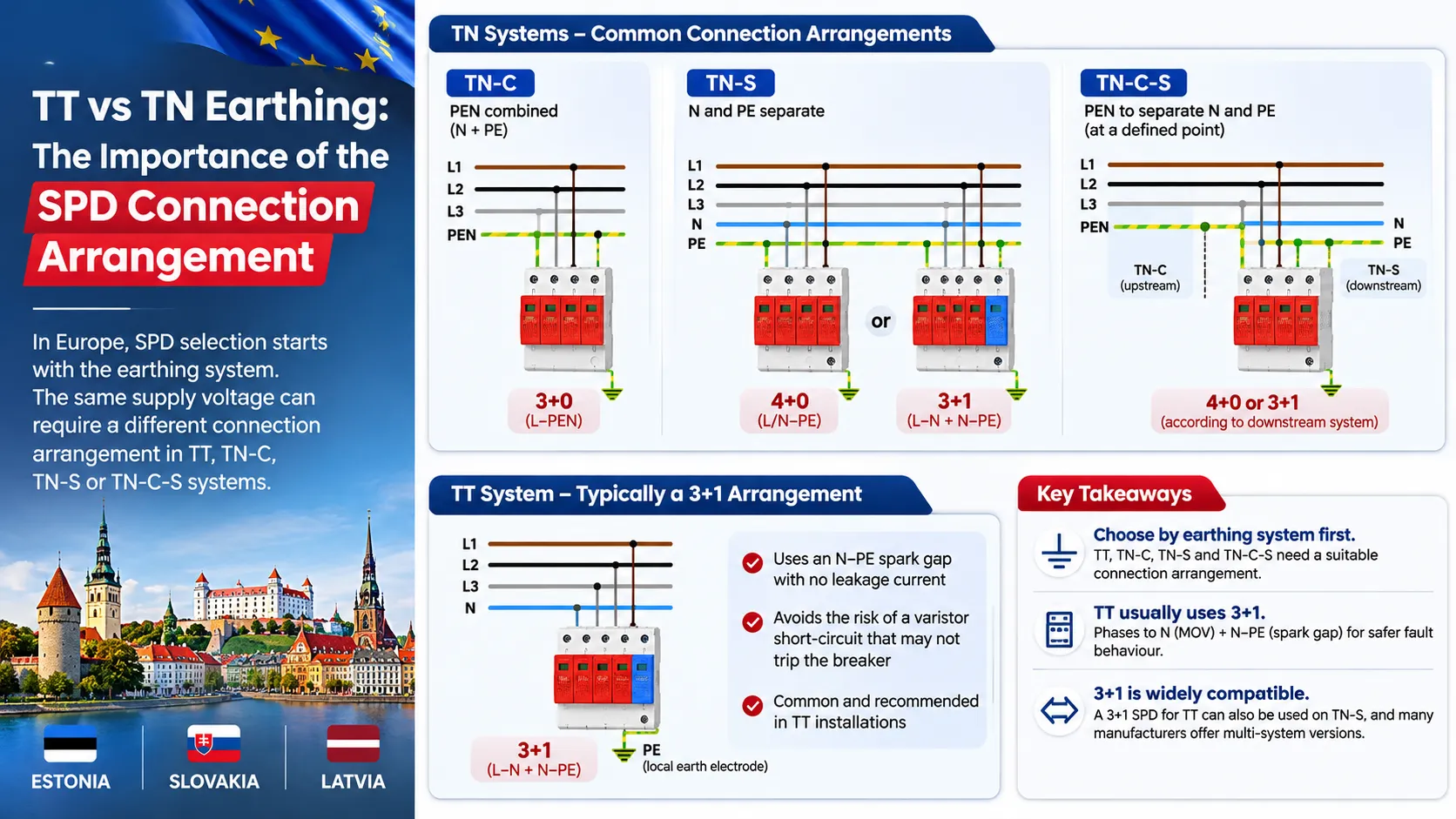
TN-C, TN-S and TN-C-S
In TN-C earthing, neutral ground and protective earthing are connected and work together in the form of PEN. In TN-S, there is a separation of neutral ground and protective earthing, and the configuration may involve either the negative mode (4+0, where every phase is connected to PE) or the positive mode (3+1). In the setup of TN-C-S systems, the transition from one scheme to another is provided for connecting PEN and neutral ground to separately.
Why Most TT Earthing Connections Employ the 3+1 Configuration
TT systems imply that the installation utilizes an independent earth electrode with a potential for very high earth-fault loop resistance. Hence if there is a short circuit of a varistor that is connected to phase and PE, the fault current may be insufficient to operate the upstream circuit breaker.
The common practice is that in case of fault, 3+1 connections are used, which means that besides linking to each phase, one spark gap is connected with respect to N-PE. The malfunction of the connection through L-N will create a short circuit, which can be eliminated with backup protection of the circuit. The N-PE spark gap connection has no leakage currents and can only pass the power surge. In many cases this is a common mistake in Europe to use a 4+0 module on a TT board.
Do All Types of the SPD Arrangement Function for Various Earthing Systems?
Yes, as a rule, the 3+1 arrangement that is suitable for TT will also work for TN-S systems. The reverse is also typically true because many manufacturers, including DEHN, may produce the adapted SPD lines.
CE Marking, EN IEC 61643-11, and UL 1449: Understanding What It Implies
Several documents may be bundled together but refer to separate issues. CE marking represents an affirmation by the manufacturer that the product complies with the relevant legislation of the European Union. For surge protective devices (SPDs), this legislative act is generally the Low Voltage Directive.
EN IEC 61643-11 is the standard applicable to the product. Note that a specific edition is referred to here. IEC 61643-11:2025 should be taken into account, even though a number of documentations still mention EN 61643-11:2012+A11:2018 during the time of transition.
A test report serves as a proof document. It must specify the model, configuration, and the standard.
European Declaration of Conformity serves as the document establishing a relationship between the product and the directives and standards used.
The UL listing by a certified testing laboratory is a valid requirement for inspections and projects in the USA.
Where Installation is Prohibited
SPDs tested only according to the IEC61643-11 standard will not be applicable for projects in the United States requiring the compliance with UL 1449. For the inclusion into the list of devices approved by NEC, an SPD should have a UL 1449 marking; a certification is necessary for passing an inspection.
The opposite is valid as well. If a plug-in strip only measures the protection in joules, such a device cannot play a part in an EN61643-11 invitation for a distribution board. There are noted products with both IEC and UL certificates, and if such a case occurs, the documents must be examined separately.
What to Include in a European SPD Enquiry or Specification
A clear enquiry saves several rounds of clarification. The following format can be used directly. It is an example of structure, not a claim that any product meets every value.
| Field | Example entry |
|---|---|
| Supply voltage | 230/400 V AC, 50 Hz |
| Earthing system | TT / TN-S / TN-C-S / TN-C / IT |
| Installation position | Main board / sub-board / near equipment |
| SPD type | Type 1 / Type 1+2 / Type 2 / Type 3 |
| Uc | Specify per protection mode, e.g. 275 V L-N, 255 V N-PE |
| Up | Specify the maximum allowed |
| Discharge rating | Iimp per pole and total for Type 1; In and Imax for Type 2 |
| Connection | 3+1 / 4+0 / 3+0 / 1+1 |
| Backup protection | Maximum fuse or breaker rating, short-circuit current rating |
| Accessories | Pluggable modules, remote signalling contact, status indicator |
| Documents | Test report, EU Declaration of Conformity, standard edition |
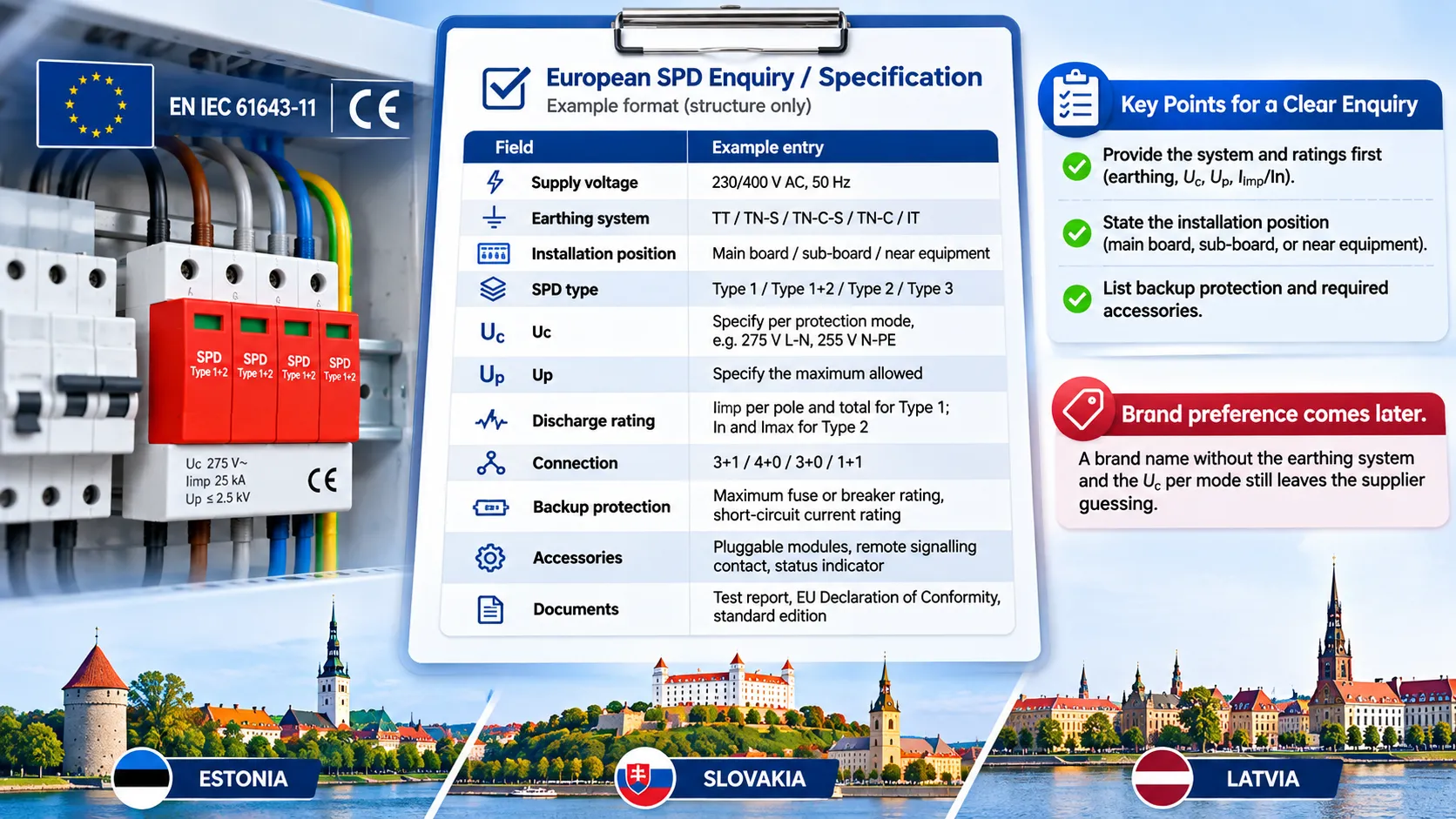
Put brand preferences after these fields, not before them. A brand name without the earthing system and the Uc per mode still leaves the supplier guessing.
Where Leitai Fits in European Low-Voltage Surge Protection
Leitai manufactures low-voltage DIN-rail SPDs of the kind described in this article. Leitai is not a European installer, and it does not deal in line or transformer surge arresters for medium- and high-voltage networks.
The LT-X15 / LT-X30 / LT-X50 Type 1 SPD page is a simple example of how European-style ratings are presented, with Uc 275 V, Iimp of 15, 30 or 50 kA and Up 2.5 kV. Selection for a specific board still depends on the fields listed above.
Where a project requires SPDs to an EN 61643-11 specification, or under the customer’s own label, the details are on the LEITAI OEM & ODM Services page.
FAQ
What is a European surge protector?
In projects for low voltage distribution in Europe, people usually refer to a surge protector as a DIN-rail type surge protective device according to the standard EN IEC 61643-11. The choice of a surge protector is based on specifications like Uc, Up, In, Imax or Iimp ratings, grounding type, installation location, and related documents rather than the joule rating.
Is IEC 61643 the same as UL 1449?
No. Both the standards consider surge protective devices, however, they use totally different approaches in testing and they use different definitions of types. While Type 1 according to the IEC is defined with the use of the 10/350 ms Iimp test, UL Type 1 defines the device based on its location of installation. Also, Up and VPR are defined differently.
Can a CE-marked SPD be used on a US panel?
Not on the strength of the CE mark alone. US installations generally require an SPD listed to UL 1449, and inspectors check for that listing. A product approved under both systems can be used in both markets.
Do I need a different unit for TT and TN systems?
Often, yes. TT systems normally use a 3+1 arrangement with an N-PE spark gap. A 3+1 unit can usually also serve TN-S, but a 4+0 unit made for TN-S should not be used in TT unless the manufacturer declares it suitable.
References
- IEC 61643-11:2025 – Low-voltage surge protective devices, Part 11
- Schneider Electric – Common characteristics of SPDs according to the installation characteristics
- DEHN – DEHNshield product family
- European Commission – CE marking
- Bourns – Surge protective device classification parameters
- Benlong – Surge protection device (SPD) automatic production line