
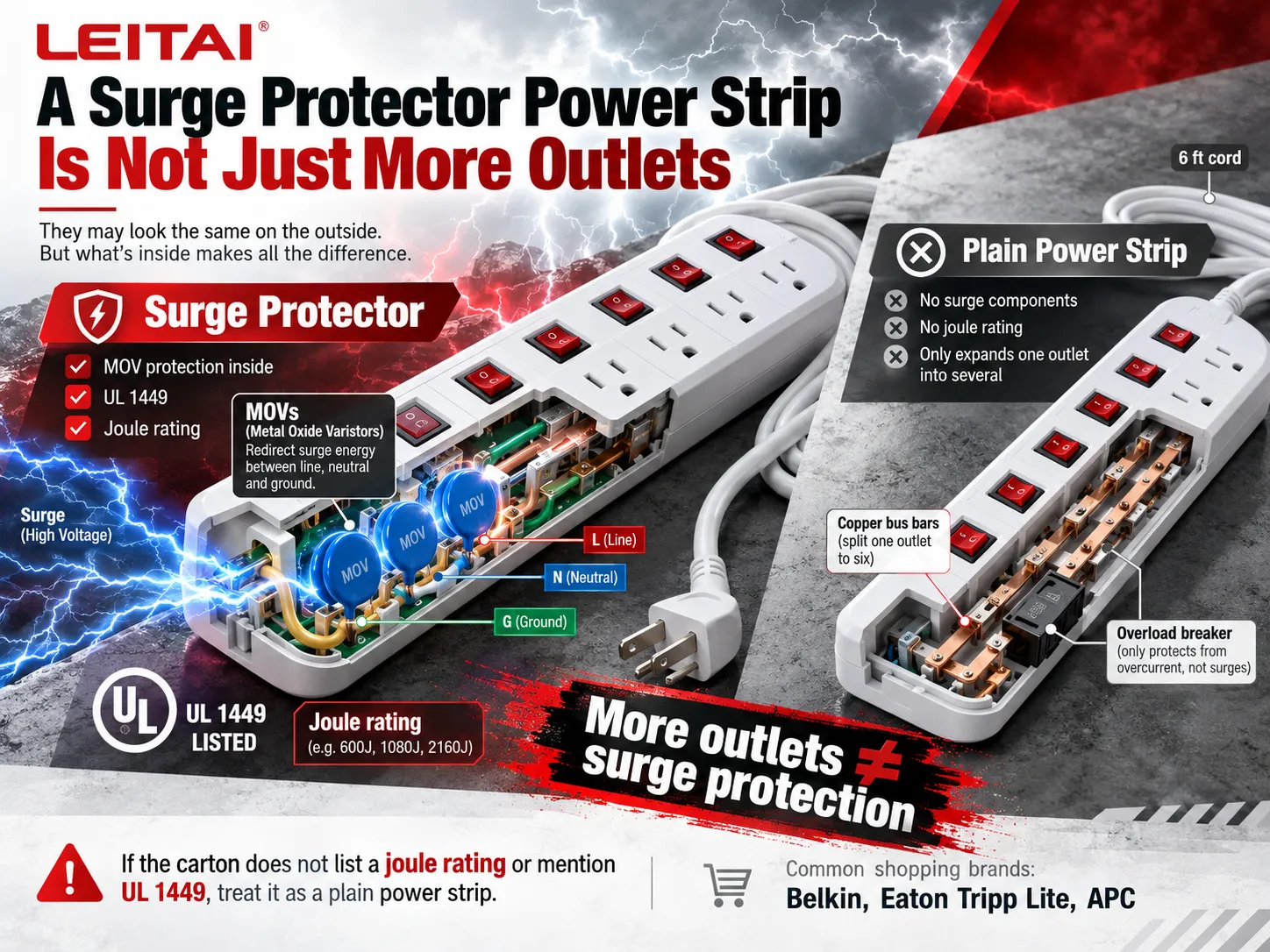
You can see two strips that look the same, are six outlets with a rocker switch, and a six-foot cord. One cost eight dollars, and another twenty-five. One of them is a surge protector power strip. The other simply turns one wall outlet into several.
The difference is inside the housing and on the label. Surge protector power strips carry a small bank of metal oxide varistors between the line, neutral, and ground. A plain power strip has copper bus bars and has no more than an overload breaker. If the carton does not carry a joule rating or mention UL 1449, treat it as a plain power strip, whatever the front of the box says.
This guide uses the brands most people are shopping for: Belkin, Eaton Tripp Lite, and APC. This information is intended to help you understand what these numbers mean and how they rate a surge protection device mounted inside a panel.
How to tell a power strip from a surge protector on the carton
In North America, UL 1363 recognizes a standard multi-outlet power strip as a “Relocatable Power Tap.” This listing attests the wiring and outlet to be safe from fire hazards and electric shocks, but has nothing to do with surge protection. In other words, it has to comply with UL 1436 and UL 1449 if a power strip has more than two receptacles and comes with surge suppression.
For this reason, “UL Listed” is not enough information to verify surge protection. Always check which standard is cited, or seek the product category that appears on the device; “Relocatable Power Tap” represents plain power strips, whereas “Surge Protective Device” indicates surge protection.
| What to look for | Plain power strip | Surge protector power strip |
|---|---|---|
| Extra outlets | Yes | Yes |
| Overload breaker / reset switch | Usually | Yes |
| Joule rating printed | No | Yes |
| Safety listing | UL 1363 only | UL 1363 and UL 1449 Type 3 |
| Voltage Protection Rating (VPR) | None | Typically 330, 400 or 500 V |
| “Protected” indicator light | No | Yes |
| Connected-equipment warranty | No | Often |
Each of these details is found on printed boxes from Belkin, Eaton Tripp Lite, or APC, among other companies. On unbranded products, the word “surge” may be seen prominently printed but without mentioning voltage protection rating as well as the joule count.
Although the same method applies to business in the rest of the world, the standards are different. Plug-in protectors are classified as type III (T3) and are tested to IEC61643-11, meaning that the label indicates a nominal discharge current (In) as well as a voltage protection level (Up), instead of joules.
What the joule number actually buys
Joules show how much energy surge protective devices (MOVs) can endure before they stop protecting devices. It does not indicate protection, but rather what surge protection devices have in reserve. MOVs continue to degrade due to power surges, including the little ones from motors and compressors running in the household. Therefore, there is never an indication on the surge circuit that energy has been used up, but it is bound to happen eventually.
This is why “Protected” is on the power strip: when this light is off, it means that the strip is no longer a surge protector. Belkin recommends replacing it and warns that continued use will automatically void the warranty. Meanwhile, APC allows its SurgeArrest series of devices to stop power supply to the outlets when its protection is gone. Traditionally, cheaper variants do neither: they keep supplying power without protection.
Two main things about joules ratings are often misunderstood.
First of all, it should be emphasized that UL does not test joules. Number of joules presented by manufacturers are calculated differently and mean different things. Therefore, it is possible to confuse joules presented by different manufacturers and get wrong information. Voltage protection rating (VPR) is a number given by UL after testing.
Secondly, it should be noted that joules do not equal lightning protection rating. Lightning carries several thousand joules more than even the most powerful power surges capable of being absorbed by a power strip.
It can be concluded that if it comes to household TVs, computers, PS consoles or routers, it is recommended to use surge protectors with at least 1000 joules rating. If one uses a home theater and/or desktop computer for work, it is recommended to use power strips rated 2000 joules and more. At the same time, it is not necessary to buy power strips with high joules rating for other devices like fans, phone chargers or lamps.
Where Belkin, Tripp Lite and APC actually different
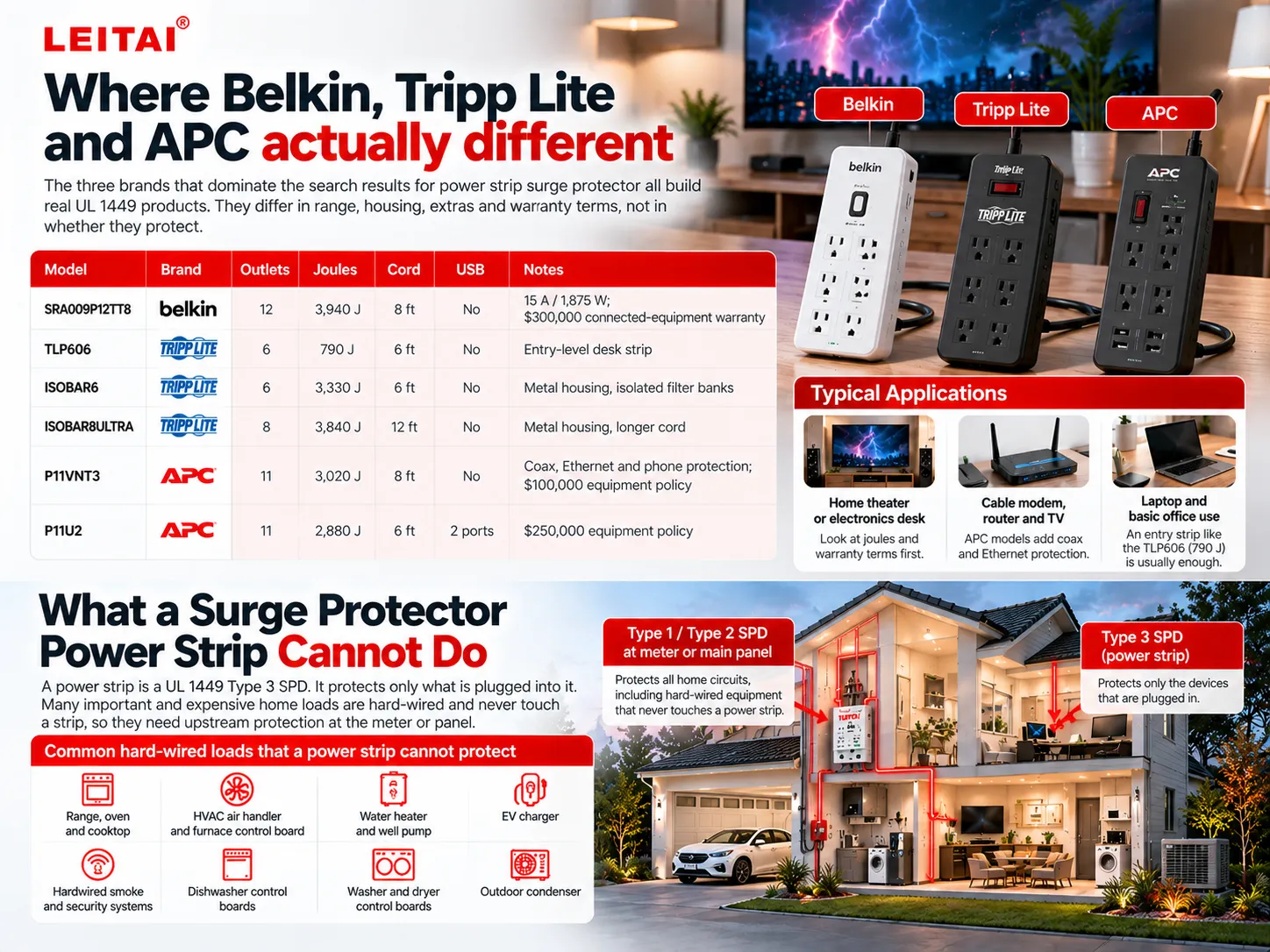
All of the top three companies that show up in power strip surge protector results have authentic UL 1449 products. They vary in terms of the number of units offered, box design and important extras, as well as warranty provisions, but not in terms of reliability. Below is a table showing different models available in the US as reported by their manufacturers, as well as prominent stores. Since the models change over time, please look at their most recent packaging before buying them.
| Model | Outlets | Joules | Cord | USB | Notes |
|---|---|---|---|---|---|
| Belkin SRA009P12TT8 | 12 | 3,940 J | 8 ft | No | 15 A / 1,875 W; $300,000 connected-equipment warranty |
| Eaton Tripp Lite Protect It! TLP606 | 6 | 790 J | 6 ft | No | Entry-level desk strip |
| Eaton Tripp Lite Isobar ISOBAR6 | 6 | 3,330 J | 6 ft | No | Metal housing, isolated filter banks |
| Eaton Tripp Lite Isobar ISOBAR8ULTRA | 8 | 3,840 J | 12 ft | No | Metal housing, longer cord |
| APC SurgeArrest P11VNT3 | 11 | 3,020 J | 8 ft | No | Coax, Ethernet and phone protection; $100,000 equipment policy |
| APC SurgeArrest P11U2 | 11 | 2,880 J | 6 ft | 2 ports | $250,000 equipment policy |
How to read it by scenarios rather than by watts:
Home theatre setup or a table with appliances: start by measuring joules and warranty guidelines. The 12-socket power strips from Belkin and the Isobar power strips from Tripp Lite are rated approximately 3,300 – 3,900 J. The metal case and separate filter banks of the Isobar provide perfect solutions for cabinets and workshops.
If the modem, router, and TV share the socket: the APC Performance SurgeArrest series, which has the additional coaxial signal protection and the Ethernet protection, can be very helpful, as surges can occur not only through power cords.
Lamp/light and charger: any entry-level power strip like the Protect It! 790 J or a general power strip will do.
Two important notes. The coverage for the connected devices by Belkin varies from 25,000 to 400,000 depending on the model, and in order to be compensated, one has to provide the proof of purchase, the surge suppressor, and not to link it to another one. It is essential to remember that some models of Tripp Lite Isobar are suitable for 12 A and 1,440 W and not for 15 A.
If the goal is to keep your computer running even when the power goes off, then this is not even a surge suppressor. We cover that split in surge protector vs UPS.
What a surge protector power strip cannot do
A surge protector power strip protects only the equipment that it is connected to and nothing more. It is classified as a Type 3 SPD under UL 1449, meaning it is a point-of-use device which means that it is installed 10 meters away from the service panel. The distance of the wiring goes into designing the device. It helps in reducing the speed of the current coming in.
There are various expensive appliances across a house but they are not connected to this strip.
The equipment that is not connected to a power strip are:
Oven, cooktop, and range
Air conditioner, HVAC control board, and outdoor condenser
Water heater and well pump
Electric car charger
Hard-wired fire alarm and security systems
Dishwasher, washing machine, and dryer control boards which run on separate circuits
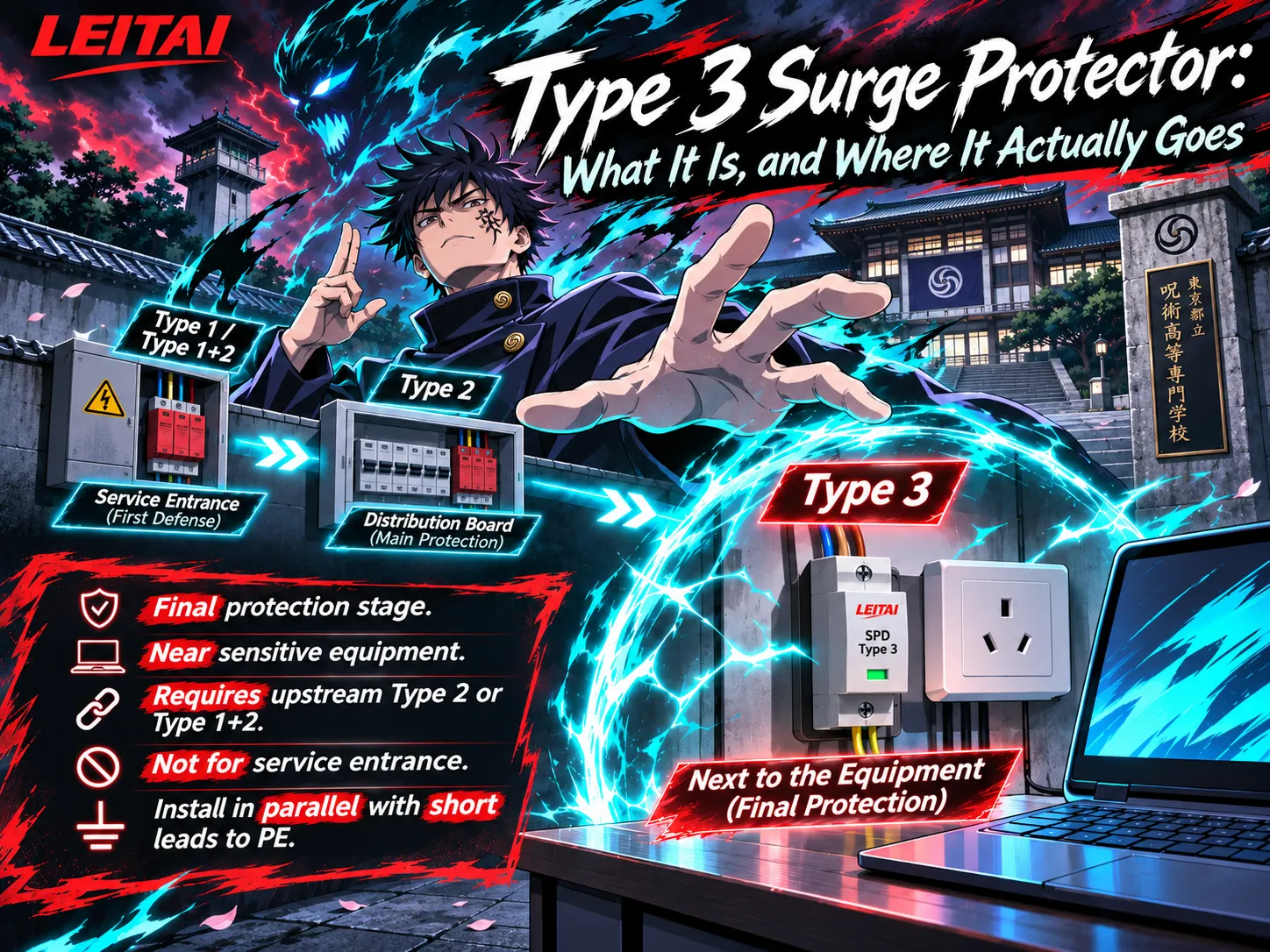
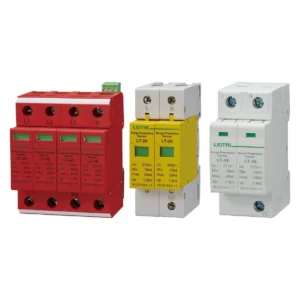
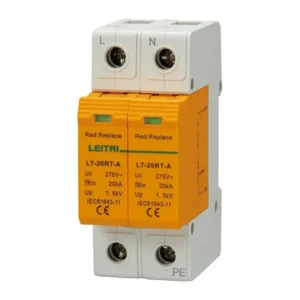
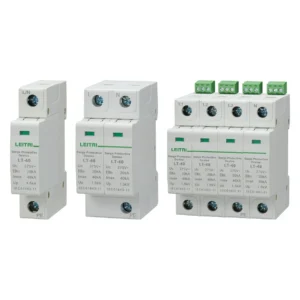
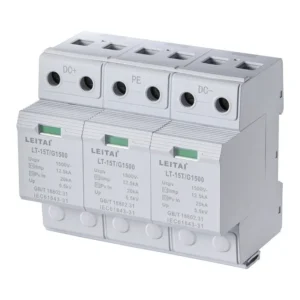
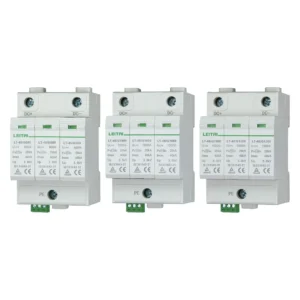
Those loads can only be protected upstream, by a Type 1 or Type 2 device at the meter or panel. If you are weighing that, our breakdown of whole-house surge protector cost covers the device and installation numbers. For sub-panels and distribution boards feeding sensitive circuits, a DIN-rail Type 3 surge protector does the same last-stage job as a strip, but for a whole circuit instead of one outlet.
Daisy-chaining and high-load appliances
Do not connect one strip to another, and do not connect a strip to an extension cord. UL 1363 says that a relocatable power tap is not meant to connect one to another, Belkin voids its warranty if one does, and all connecting adds up in resistance and heat at a place that is not supervised. If one runs out of sockets, one has to buy a strip with more or install another wall socket.
Keep high-demand appliances connected to the wall outlet:
Space heaters (a 1500 W heater consumes around 12.5 A from a 120 V electricity source)
Window and movable air conditioners
Refrigerators and freezers
Microwaves, toasters, kittles, and air fryers
Hairdryers and curling irons
An Uninterruptable Power Supply (the majority tell it not to put in the surge strip)
Medical tools, if their manufacturer permits it.
The overload circuit on the strip does not change it. It is a thermal device that goes off at excessive current during several seconds or even minutes. A surge lasts for microseconds. The overload circuit and MOVs protect from different things.
Panel first, strip second
Surge protection works in stages. A Type 1 or Type 2 SPD at the breaker box contains the major outside surges that can be caused by utility switching or nearby lightning before they flow into the house. The power strip surge protection device at the television or work station handles what gets past the breaker box protection device as well as the minor surges created within the home by motors, compressors, and switched-mode power supply units.
If you already have whole-house protection, make sure your Type 3 power strip is connected to your TV, computer, and all network devices in your house. The breaker box already does the job of limiting the voltages but does not ensure that the voltages come down to the level that will be safe for electronic devices. Any kind of internal surge will occur between the device and the outlet where your electronic device is connected.
If you are renting a property and do not have access to the breaker panel, buying a good quality strip is the only option left for you. Invest in one good power strip to protect your expensive equipment rather than buying several cheap ones.
What to check before you buy
①. Governmental Product Safety certification indicated clearly as Type 3 SPD and not just “surge suppression” in the promotional materials.
②. Presence of a printed joule rating suitable for the type of appliance used along with either VPR of 330 or 400 V.
③. Available indicator for protection status, preferably the type that cuts off power supply after use of protection up to its limit.
④. Rated 15 A / 1,875 W with a 14 AWG cord since thinner cords, such as 16 AWG, imply a lower rated current.
⑤. Sockets placed far apart or movable so that transformer plugs will not block their neighbors.
⑥. Ground-fault or “Grounded” light. Metal-Oxide Varistors that provide grounding can handle only grounded outlets.
⑦. Protection for coax and Ethernet in case modem and TV will be connected to the same strip.
⑧. Brand and connected equipment warranty explained together with the testing procedure in case of malfunction.
Brand is the last element in the list for certain reasons. Belkin/Tripp Lite/APC strip will pass all the previous tests. However, falling on the name in the box will not help the strip which will not pass these tests.
Where Leitai fits
Leitai does not sell retail power strips. We manufacture surge protective devices, including Type 3 units such as the 10 kA LT-10C for distribution boards, and strip-level SPD modules for manufacturers that build power strips and PDUs under their own name.
If you are buying one strip for your home, go by the checks above. If you are a brand or distributor planning a surge strip line and need the protection module, testing support or private-label production, see our OEM/ODM page.
FAQ
Is a power strip a surge protector?
In normal cases, a simple power strip is made to add sockets, and is carried under UL 1363 standard. A surge protector power strip, on the other hand, has added MOVs and is carried in UL 1449 standard. Each surge protector is actually a power strip, but not vice versa. There is a joule rating available on the label which states whether it is a surge protector or not.
How many joules do I need?
Around 1,000 J or more for a computer, TV, router or console, and 2,000 J or more for a home theater or full workstation. Lamps and phone chargers do not need a high rating. Compare VPR as well, since that is the number UL actually tests.
Can I plug a surge protector into a power strip?
No. Connecting a surge protector to a power strip, or the other way around, is referred to as daisy chaining. UL 1363 prohibits this action because it increases the heat and resistance at the junctions, and companies like Belkin will invalidate their warranties if it is done. Plug a surge protector directly into an electrical outlet.
Do I still need one if I have a whole-house SPD?
Yes, for sensitive electronics. The panel device handles large external surges; a Type 3 strip handles the remaining let-through voltage and the surges created inside the home. The two are designed to work together.
Surge protector vs power strip: which one should I buy?
Acquisition of a surge protector power strip is to be considered for any appliance containing a circuit board that you would not wish to replace – for instance the television, computer, monitor, modem, router, gaming console or sound systems. But a simple power strip would do just fine for such appliances as lamps, chargers, fans and fairy lights.
What should you never plug into a surge protector?
Some electrical devices are prohibitedfrom connecting to a power strip or an extension cord. There are many other devices that are also not allowed from being used or plugged in. The following are some of the devices that cannot be used or connected to the power strip.
Is it okay to leave the power strip on all the time?
Yes. A surge strip may be rated for continuous use, yet its protection will only work while plugged in. The user should check from time to time that the “Protected” light is active, that the plug and cord are not hot, and that the surge strip is not hidden under a carpet or bed.
When not to use a surge protector?
Avoid using one for heavy-draw appliances, outdoors, or in wet areas unless it is designed to serve that purpose, with an ungrounded two-prong outlet (using the appropriate adapter), as an alternative for installed wiring or after the “Protected” light has turned off. In those cases, the correct choice would be a wall plug or a new outlet or a replacement power strip.