
The 200 A service rating refers to how much continuous load the panel has the ability to carry. It does not tell you anything about how much surge energy should be dissipated and there is no formula available to convert 200 amperes into kA. The choice depends on the rated voltage and design, the location of the installation, available fault current, and the conditions of the site, with the panel amperage only determining the type of the panel used.
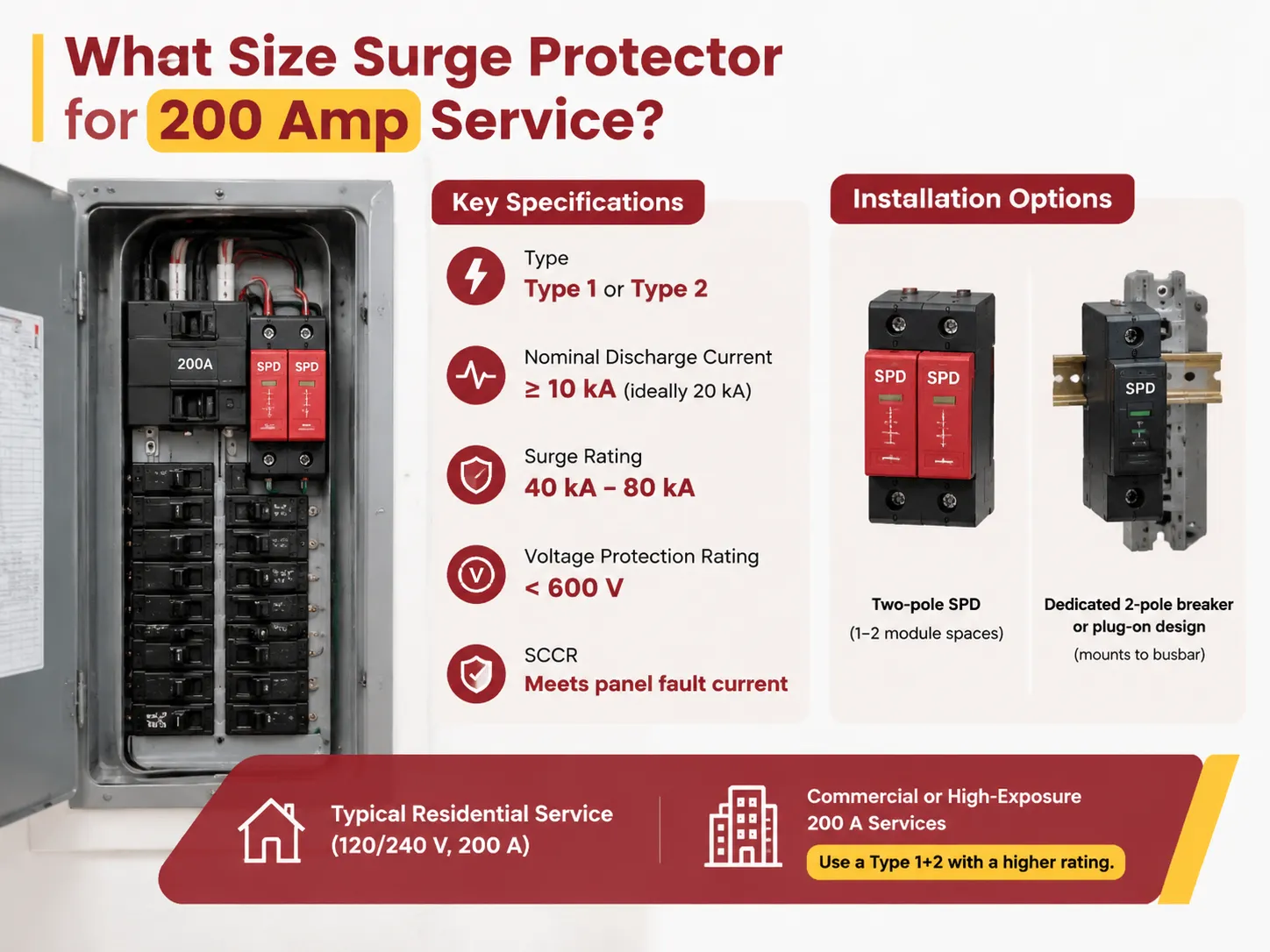
Straight answer: For a normal residential service of 200 A at 120/240 V in North America, a Type 1 SPD or a Type 2 SPD can be used with the discharge current of 10 kA, although better to use 20 kA. Also, the surge rating of the device needs to be in the range between 40 kA-80 kA, while the voltage rating of the SPD must be below 600 V. It is worth mentioning that in a real-life setting one can install 2 poles with an appropriate sized SPD powered from a single 2-pole breaker or the SPD unit which can be installed directly on the main busbar. If we talk about commercial services and those with a high level of exposure, 200A services will require a SPD rated as Type 1+2.
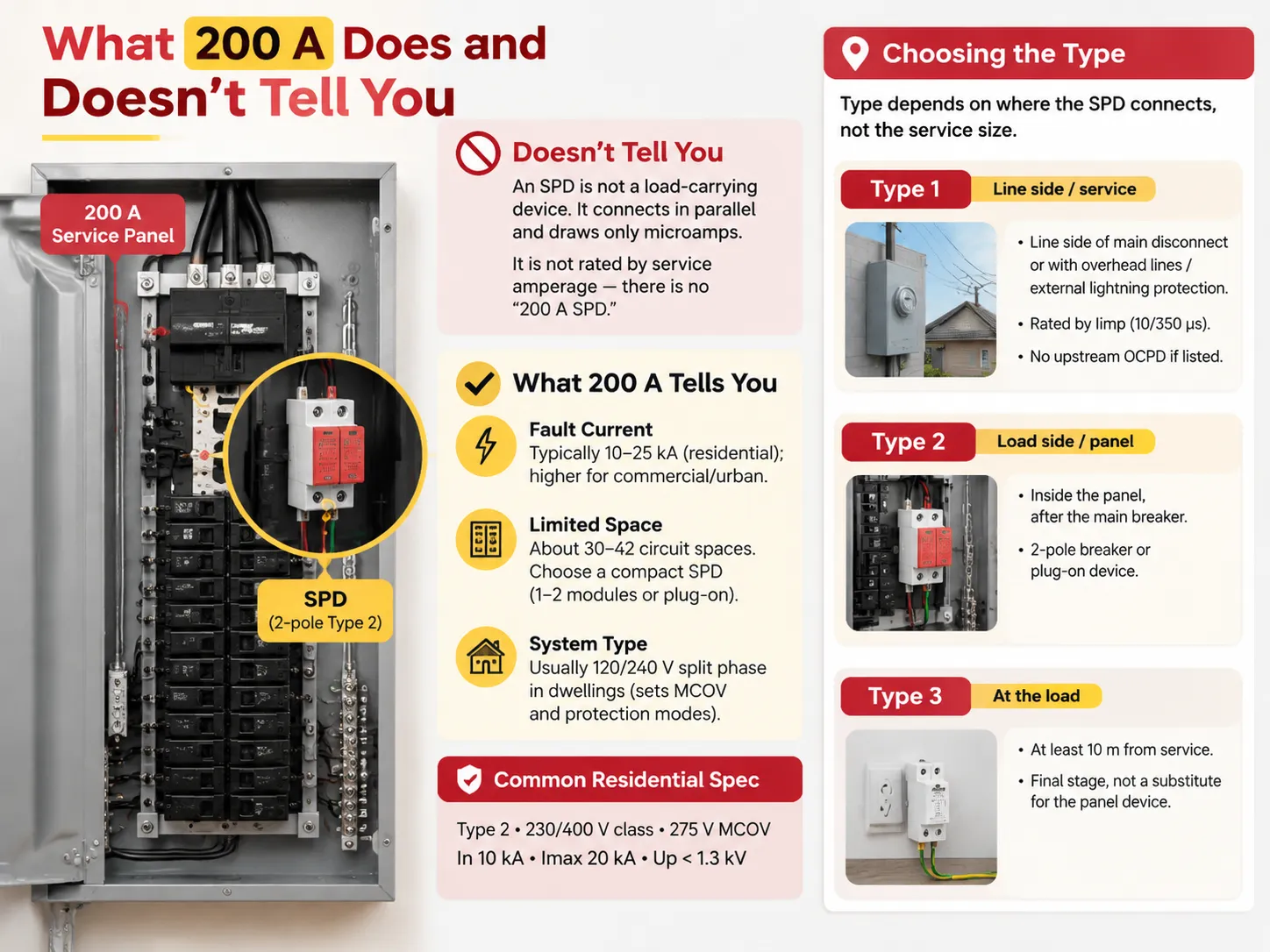
What 200 A Does and Doesn’t Tell You
The most prevalent mistake in the entire process of installation is misinterpreting the SPD as a load-bearing component. The SPD is not a load carrier. It is connected in parallel with the power supply and thus does not carry any current at all but instead draws microamps in normal operation. This means that the existence of a 200 A SPD for a service of the same rating is pointless, and no manufacturer will ever create an SPD rated for the same amperage as the service.The 200 A rating gives information in relation to the installation.
- Large size panels are usually employed in systems with significant fault current. A residential installation will have the fault current in the range of 10-25 kA while in a commercial network it is likely to be much more than that. The SPD needs to have a rating equal to or greater than this value.
- It is important to note that there is a lot of competition for the available physical space. A panel rated 200A is likely to have some 30 to 42 big circuit slots. A module with a simple design takes very little space.
- Most installations are going to operate in a 120/240 V split phase, which determines the modes of connection. In other words, if a device operates in an entirely different voltage, it will have to be re-designed and rated for those operating conditions.
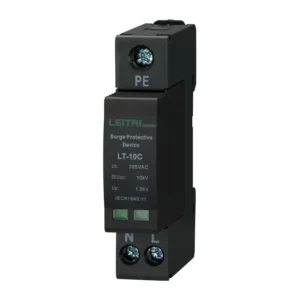
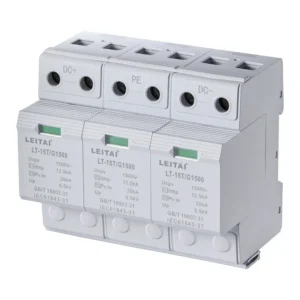
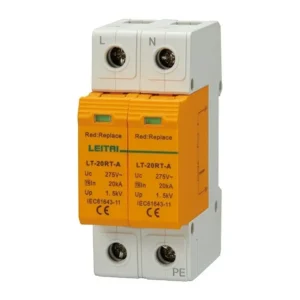
For the common residential case, the device that ends up in the panel is a two-pole Type 2 unit sized for a 230/400 V-class system with a 275 V MCOV, offering something in the region of a Type 2 SPD rated In 10 kA with a 20 kA maximum discharge and protection levels from under 1.3 kV. That spec fits a 200 A residential panel comfortably and leaves room for the next breaker someone wants to add.
Choosing the Type by Location
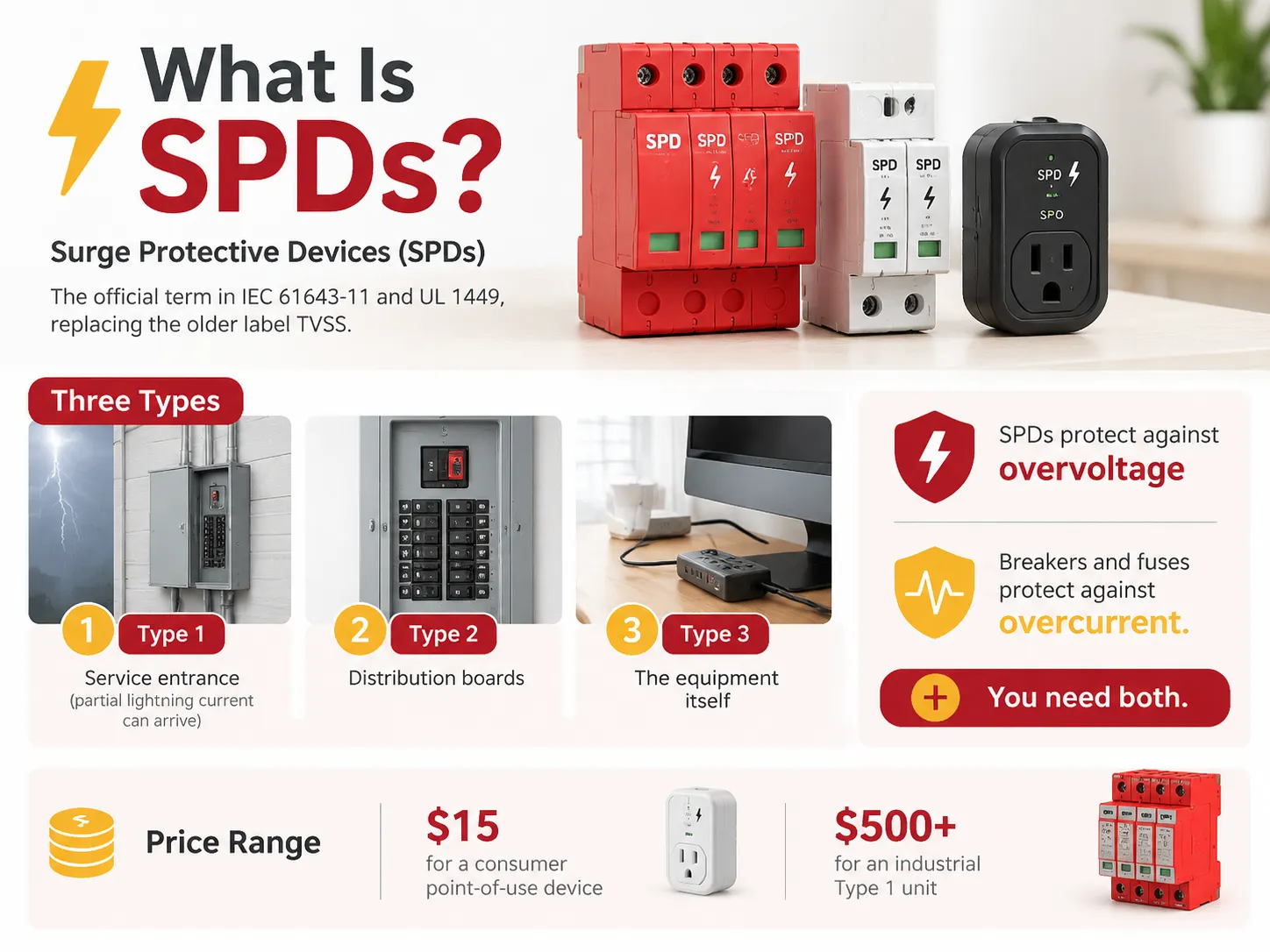
The type is determined by the location of the connection with respect to the main overcurrent device, not by the service level.
- Line side of the service disconnect or service with overhead conductors or external lightning protection system: Type 1. Rated by Iimp at 10/350 µs and does not require overcurrent protection upstream if approved.
- Load side of the main overcurrent device at the panel: Type 2. Most residential 200 A installations fall here, either wired through a dedicated 2-pole breaker or a plug-on device connected to the busbar.
- At the load which is at least ten meters away from the service: Type 3. It is the last option but should never replace the device in the panel.
Since a 200 A service with a lightning protection system on the roof is different from one with a totally underground supply, the type issue must be resolved prior to making any rating comparisons.The differences between Type 1 and Type 2 SPDs come down to placement and test waveform, and getting that wrong is the one mistake that cannot be compensated for by buying a bigger number.
Picking the kA Rating
After determining the type, you evaluate the discharge rating in relation to its exposure and durability, not the characteristics of the panel.
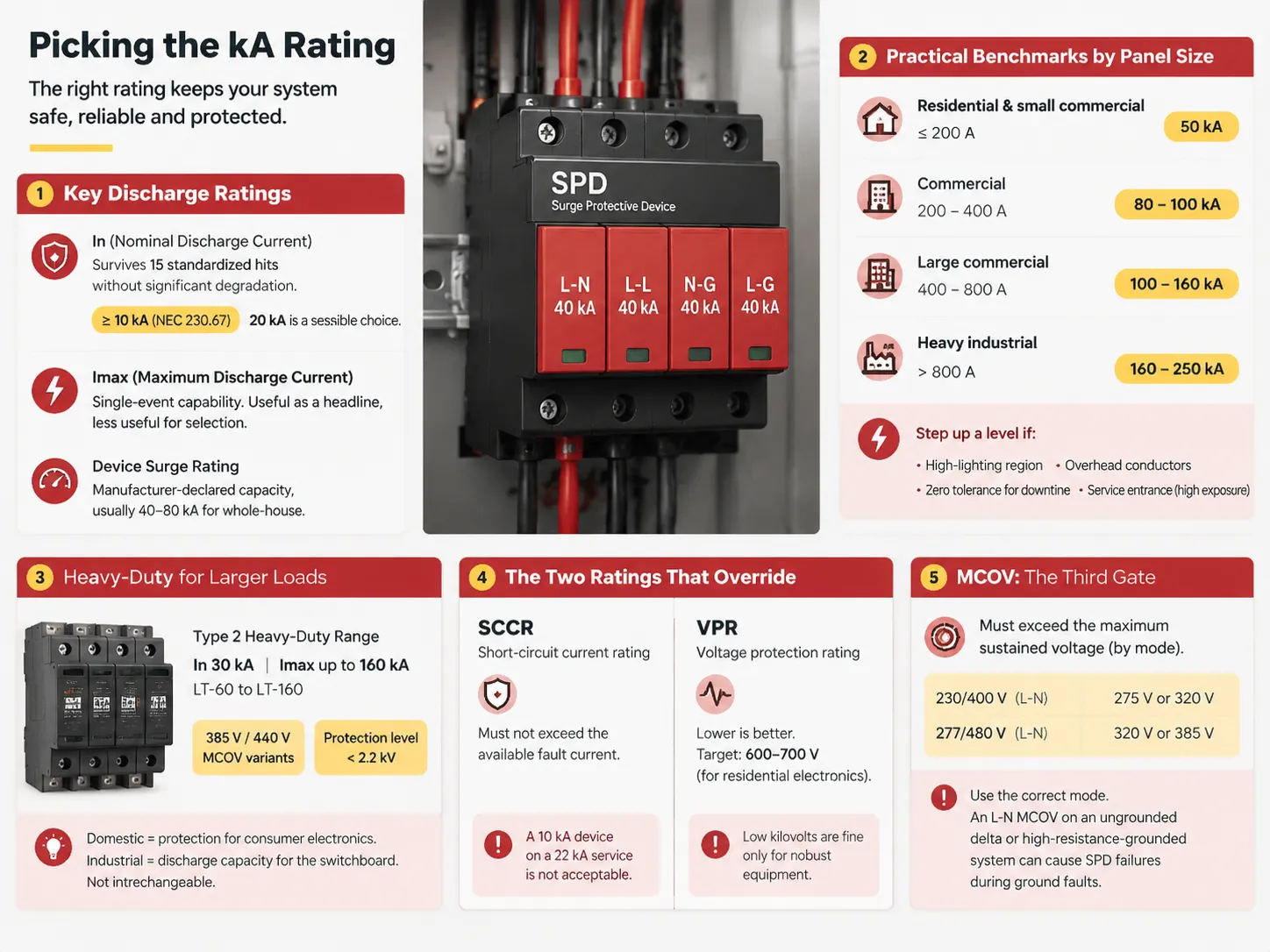
- In relation to the nominal discharge current: This indicates the amount of current that an SPD can withstand without damage, being exposed to the current 15 times as standardized. Knowing this allows you to determine how durable the device is, which is the measure you should be paying for. According to NEC 230.67, the minimum value for dwelling unit service is 10 kA, and 20 kA is standard for residential applications.
- Imax or maximum discharge current represents the one-time surge capacity. It serves to provide a reference point, but it’s of limited significance when deciding which device is needed because the device with a high Imax and low In is likely to be created for the manufacturer’s specifications.
- The device surge rating, being either 40 kA or 80 kA, is a recommended rating for the entire house according to the manufacturer and has no connection with the code.
- As for the practical benchmarks according to the size of the panel: up to 200 amperes for residential and small commercial applications, 50 kA rating is commonly acknowledged as a minimum; for 200-400 amperes of commercial applications the figures are 80-100 kA; 400-800 amperes – 100-160 kA rated devices; and for heavy industrial purposes 160-250 kA rated devices.
- Another recommendation is to increase the rating in the case when the building is situated in the area with frequent lightning strikes, it is supplied with the overhead power lines, loads do not tolerate any downtime, or it is placed at the service entrance on the side that is prone to facing natural forces.
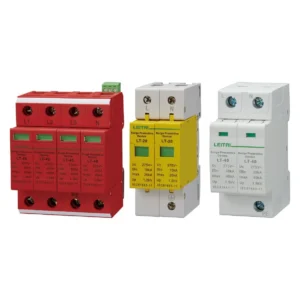
Where the load is heavier than a dwelling, the rating rises quickly and the physical device changes shape. Large switchboards and industrial incoming panels move to heavy-duty frames, where a Type 2 heavy-duty range rated In 30 kA with Imax up to 160 kA across the LT-60 to LT-160 models covers the top of that band, with 385 V and 440 V MCOV variants and protection levels under 2.2 kV. Pay attention to the different stress; a home appliance has a protective grade suitable for electronic devices while an industrial one is selected due to the capacity required for the operational switchboard functions, thus the two devices cannot be replaced with one another even if values are similar in both cases.
The Two Ratings That Override Everything Else
Two parameters can eliminate a device regardless of how high it discharges.
- SCCR — The short-circuit current rating. An SPD should not be mounted where the broken-down electrical current surpasses the branded SCCR of that SPD. This is a matter of safety because a non-rated SPD can break down generating an electrical discharge that stays within its enclosure. You should get the maximum fault current value from the label provided by NEC 110.24 or from the electrical study report. For instance, it is acceptable if a device is rated for 200kA and a supply line is rated for 22kA, however, it is unacceptable if a device rated for 10kA is used instead.
- VPR — Voltage protection rating. The voltage you let-through voltage when measured under UL 1449 conditions with a 6kV/3kA. The smaller is the better. The goal is at least to survive with the impulse withstand rate of the equipment you have. Usually for residential use it is acceptable to have VPR in the range from 600V to 700V.
MCOV is mentioned as a third gate while referring to this point. The value of the MCOV should be higher than the maximum sustained voltage measured in each operation mode — 275V or 320V in an L-N arrangement for the 230/400V system, 320V or 385V in 277/480V.
How Many Breakers, and Installation Details That Decide the Result
The breaker question is not as closely related to the SPD as one might think. However, it does play a role in the final choice.
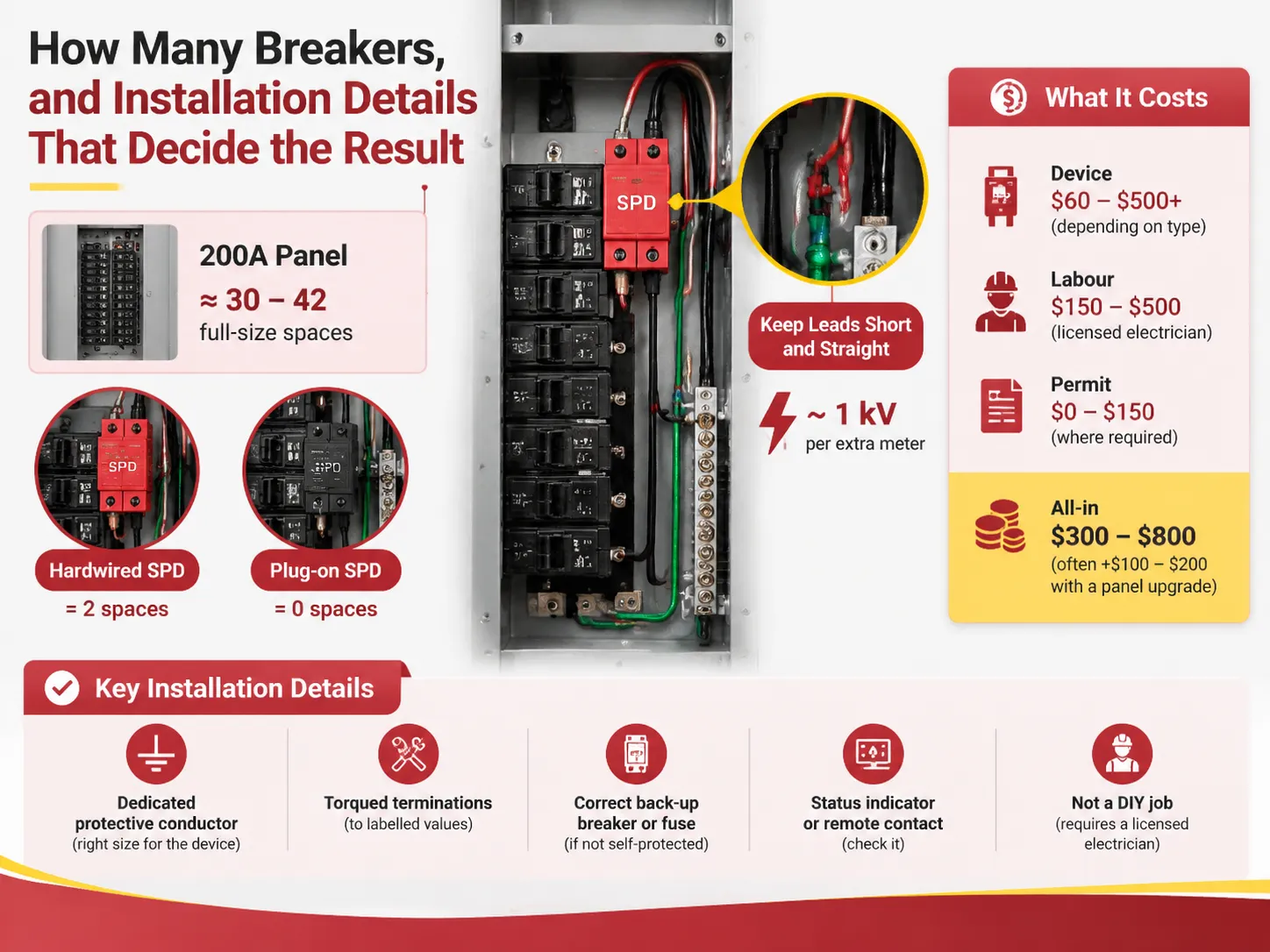
- A 200 A residential panel has a capacity of nearly 30-42 full-size spaces. The number of spaces accessible will be related to a load calculation, not to the arbitrary number of spaces. A hardwired SPD takes up 2 spaces, as it requires a separate 2-pole breaker. On the other hand, a plug-on SPD occupies no spaces. If a panel is full already, then this difference will influence the decision that needs to be taken — either there will be a purchase of a sub-panel or the tandem-breaker issue is going to be solved.
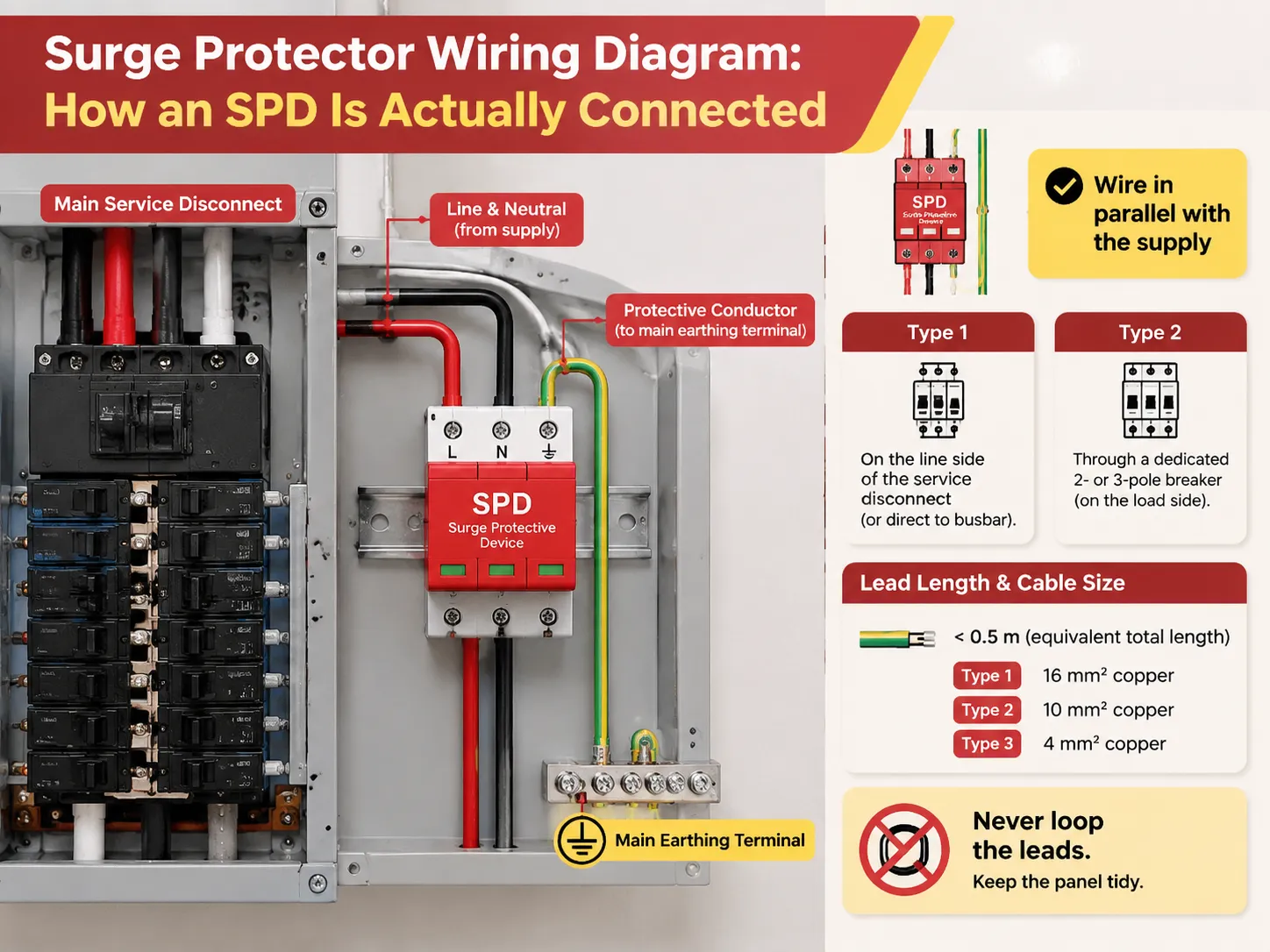
- However, what is really important about the numbers provided above is the overall length of the conductors. The total length from the busbar through the SPD to the ground terminal should be as straight and short as it is possible — up to 0.5 m in length. Otherwise, each additional meter of connecting cable will add around 1 µH that will create approximately 1 kV of extra let-through voltage levels during surges. A well-installed mid-range device will beat a premium device with looped leads every time, which is why the physical wiring layout inside the panel deserves as much attention as the specification sheet.
The remaining items do not hold any importance or room for negotiation. It is necessary to have a protective conductor of suitable size according to the type of device, terminations correctly torqued to their values, backup breaker or fuse installed if the particular device is not self-protecting, and a status indicator or remote contact that is checked regularly.
What It Costs and Who Should Fit It
The cost for a full installation is known before the work begins.
- Equipment: $60-300 for a Type 2 installation (40-80kA) or $100-500 or more for a Type 1 or high-power installation.
- Labour: $150-500 for a certified electrician doing a relatively easy installation that can still take under an hour, in addition to paperwork and inspection coordination.
- Permit: $0-150, if necessary.
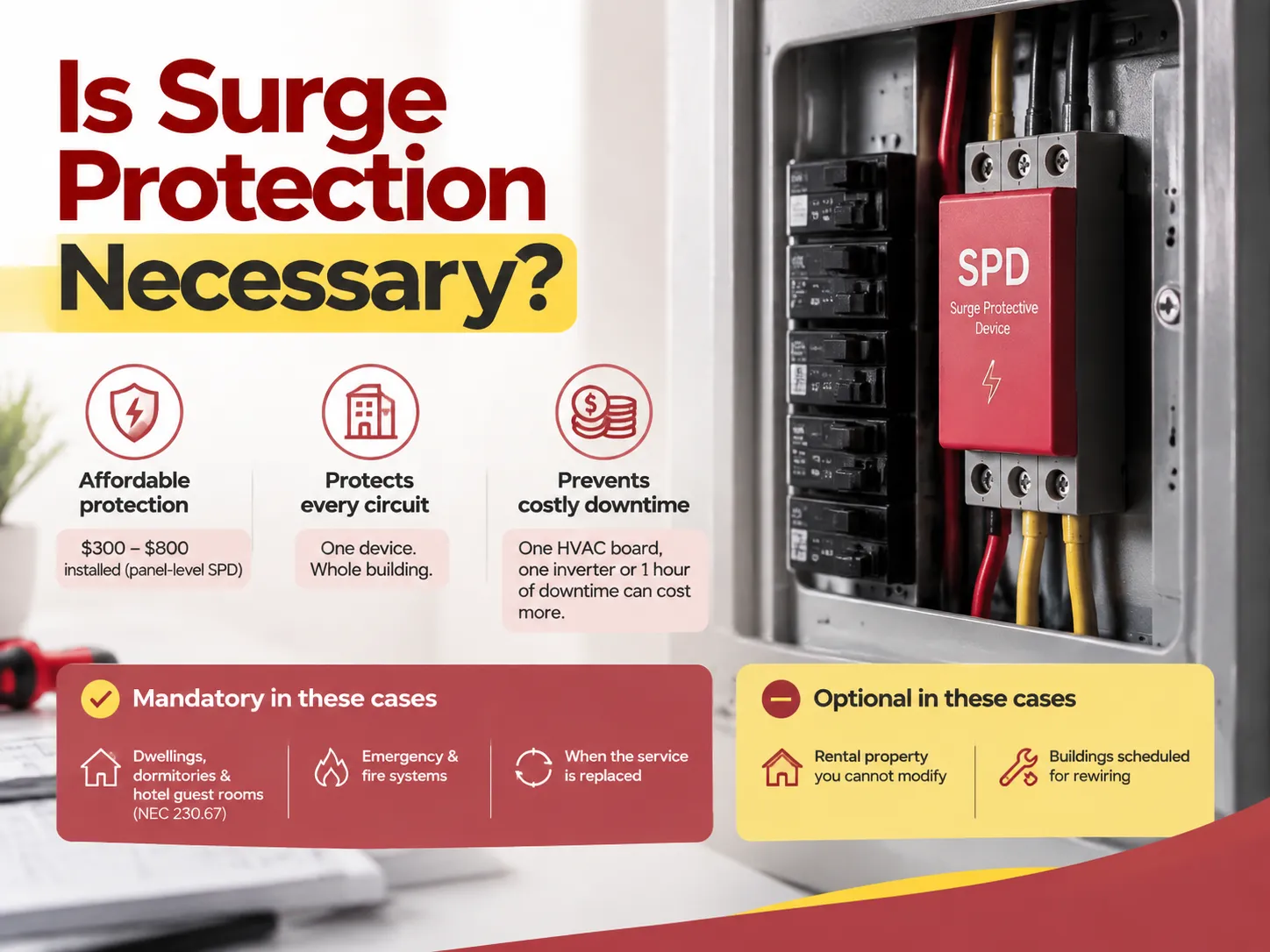
- Total: $300-800, with an average increase of $100-200 if done in combination with a panel upgrade.
This is not a DIY job. This is true even for a plug-on product as it requires access to service devices with live busbars, while the decision on whether to use a plug-on or hardwired device depends on the manufacturer’s requirements in terms of panel. The process of getting it done well — permits, panel compatibility, short leads, correct breaker sizing and a recorded installation — is set out in the practical walkthrough of whole house surge suppressor installation, including what to ask a contractor before you sign.
Frequently Asked Questions
What size surge protector for a 200 amp panel?
Select a Type 1 or Type 2 SPD with an advertised nominal discharge current of a minimum of 10 kA while 20 kA would be an even better option and a surge rating specified by the manufacturer of about 40 kA to 80 kA and a voltage protection rating lower than 600 V. Check the short-circuit current rating against the fault current present at the panel. This typically would require two modules of a residential 120/240 V service feeding directly from a two-pole breaker or mounted onto a bus bar using only a single space if such is the case.
What are the surge protection requirements for 2026 NEC codes?
Be sure that you verify which edition has been adopted by your authority having jurisdiction prior to proceeding with the assumption that the latest version is applicable — there may be years’ worth of time between adoption and publication. According to the 2023 edition, Article 230.67 mandates that a Type 1 or Type 2 SPD having a minimum discharge current of 10 kA be provided for service equipment providing power to dwelling, dormitory, hotel and nursing home patient units, and this applies when such equipment has been replaced. In Article 215.18, the same requirement for SPDs applies to travellers providing power to the service tenants, with the SPD being present in close proximity to the equipment housing the branch-circuit protective devices, while in Article 225.42 the requirements for SPDs broaden to exterior service equipment. It must be mentioned that Article 700.8 states that SPDs be fitted in emergency switchboards and fire alarms.
How many breakers can I have on a 200 amp service?
There is no predetermined limitation with respect to the 200 A rating; it is the load calculation which determines the installation limits, as opposed to a given number of breakers. In practical terms, a typical 200 A residential panel provides approximately 30 to 42 full-size spaces, although selected types may also use tandem breakers in some places to increase the number of circuits. However, what matter in practice is the load calculated; this is done by adding the general lighting load, the fixed appliances load, including the load of the stove, dryer, water heater, air conditioner or heat pump, and charging station for electric vehicles, along with the corresponding demand factors to ensure that the calculated total fits the service rating with a margin. An SPD does not alter this calculation, since it does not take any load current; however, if it features a hardwired design, it consumes two spaces due to its dedicated breaker.
What should never be plugged into a surge protector?
Equipment that uses a lot of heat: heaters, irons, dryers, toasters, kettles, microwave ovens, and mobile air conditioners. The 15 A strip is not suitable for any of these devices and its internal protection does not act as a replacement for a properly rated circuit. These are not the only recommendations regarding this issue. Never connect one strip to another; do not forget that operating any medical device that serves life support requires following the manufacturer’s recommendations; do not use the strip if it is damaged or discolored; a melted or cracked casing is a sign that something must be replaced and not just looked at.
References
- NFPA 70, National Electrical Code — Sections 230.67, 215.18, 225.42 and Article 242
- UL Standards & Engagement — UL 1449, Surge Protective Devices, VPR and SCCR requirements
- Mersen — National Electrical Code 2023 edition: SPD requirements and definitions
- DITEK — Understanding the 2023 NEC rules for surge protection
- International Electrotechnical Commission — IEC 61643-11, SPD requirements and test methods
Conclusion
The 200 A label mentioned on the board is a context and not something to be construed as a specification. Match the type with where it is to be installed, select the power surge which represents the frequency with which your area is affected, rather than how impressive the figure appears to be, check the short circuit rating against the actual fault current that can occur in practice, and verify the voltage protection rating against what is downstream. After this concentrate on the installation, because short leads and proper earthing will be more helpful than going for the next size in the catalogue.