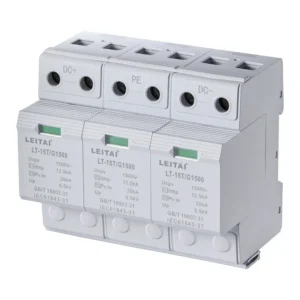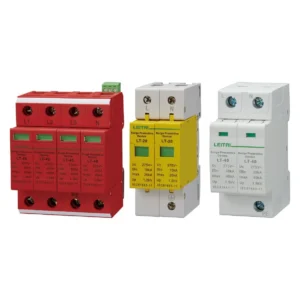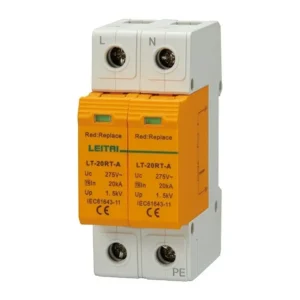

Surge protection is affected by too much voltage only for a few microseconds while overload protection is affected by too much current for several seconds or minutes. Unlike surge protection that acts as a parallel-connected clamping device that never stops supplying electricity, overload protection is a device that interrupts the power supply. Comparing surge and overload protection as alternatives is wrong because a circuit needs both means of protection and only one cannot do the job of another.
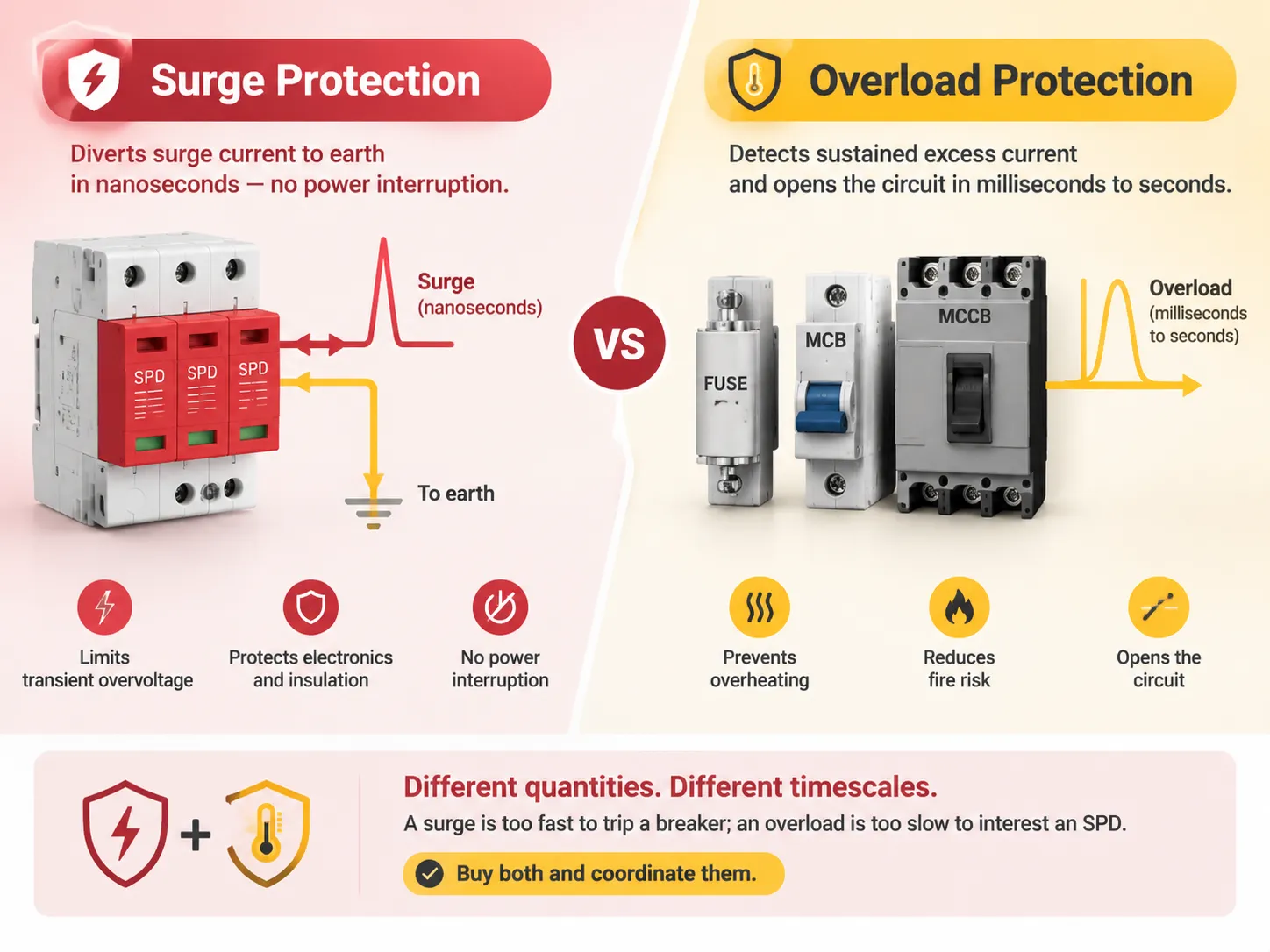
In a few words, a surge protection system employs a surge protector to send an electrical surge to ground in nanoseconds while still allowing power to flow so that sensitive circuitry is protected against damage. On the other hand, an overload protective device will be a fuse, MCB, or MCCB that will identify extended currents and interrupt the circuit within milliseconds or seconds, thus ensuring conductor protection against overheating or fire. They act upon different parameters in different time ranges.
Two Different Problems
The physics lasts only thirty seconds, as everything else happens after it.
- An overcurrent event occurs when a motor uses three times the current it’s rated to use for a certain number of seconds, a short circuit delivers several tens of kA to the fault or a circuit is loaded beyond the capacity of its cable — all of these cause the heating of conductors, insulations and terminations until something goes wrong. The problem with protection is to interrupt the process before the event has occurred, and the means used are electro-mechanical or thermal, and it takes minimum milliseconds.
- In a surge event, there is no time for anything to happen before the event takes place. A nearby lightning strike or a switching transient raises the voltage to several kV and returns to its former condition in several microseconds. Although a great current may pass through the wire, the time of its flowing is too short to influence the circuit breaker mechanism and to heat the wires considerably.
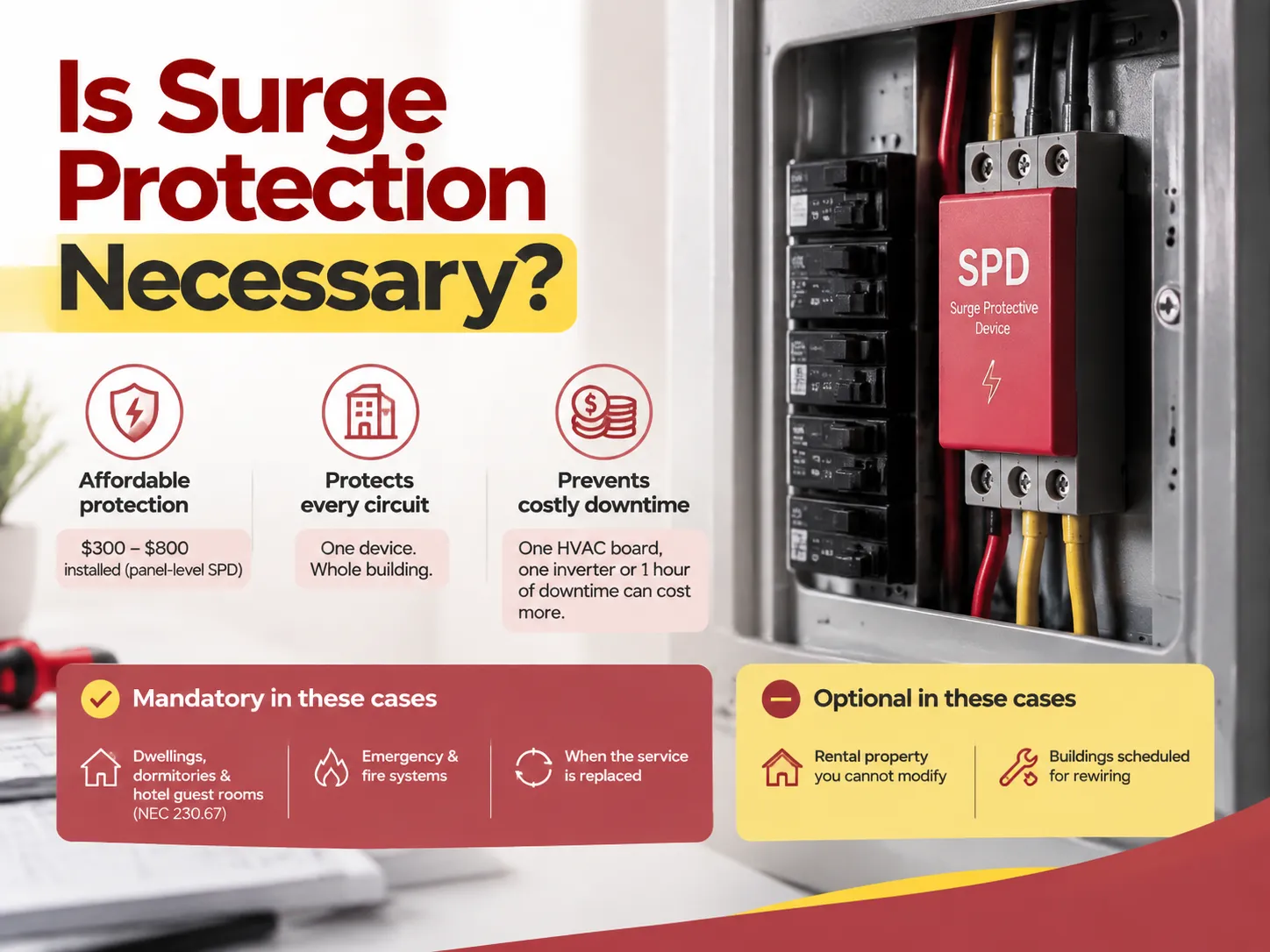
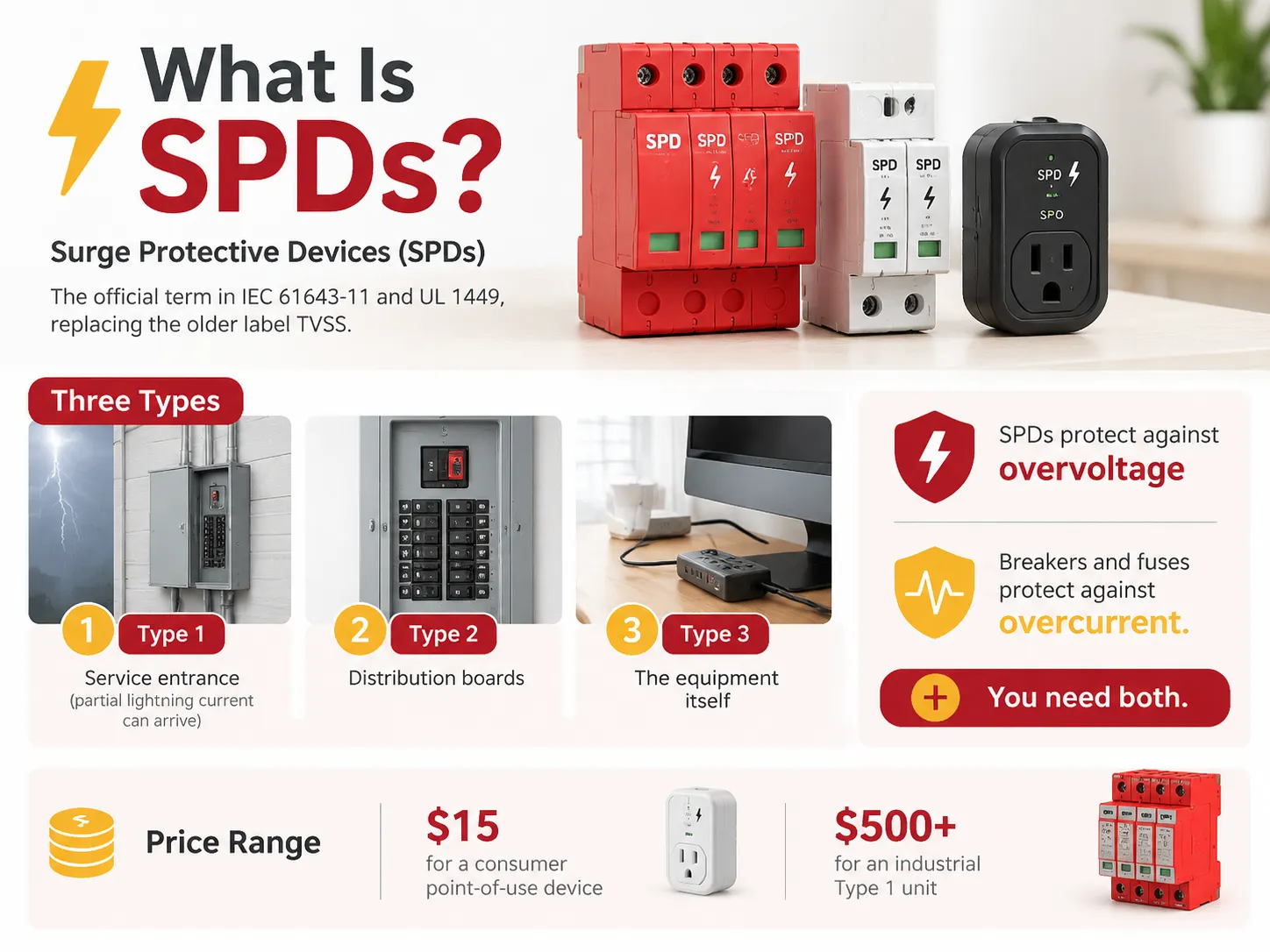
Two different amounts, two different times, two different modes of failure. Hence, this is why a circuit breaker cannot stop surge damage and a surge protective device cannot stop overload; therefore, the panel contains really two separate pieces of equipment and not a single piece that is available in two forms. For the wider picture of what the surge-side device is and where each type belongs, what an SPD is and how the Type 1, 2 and 3 classes differ is the right reference point.
How Each One Responds
The distinction cannot be missed when you consider the outcome of a situation.
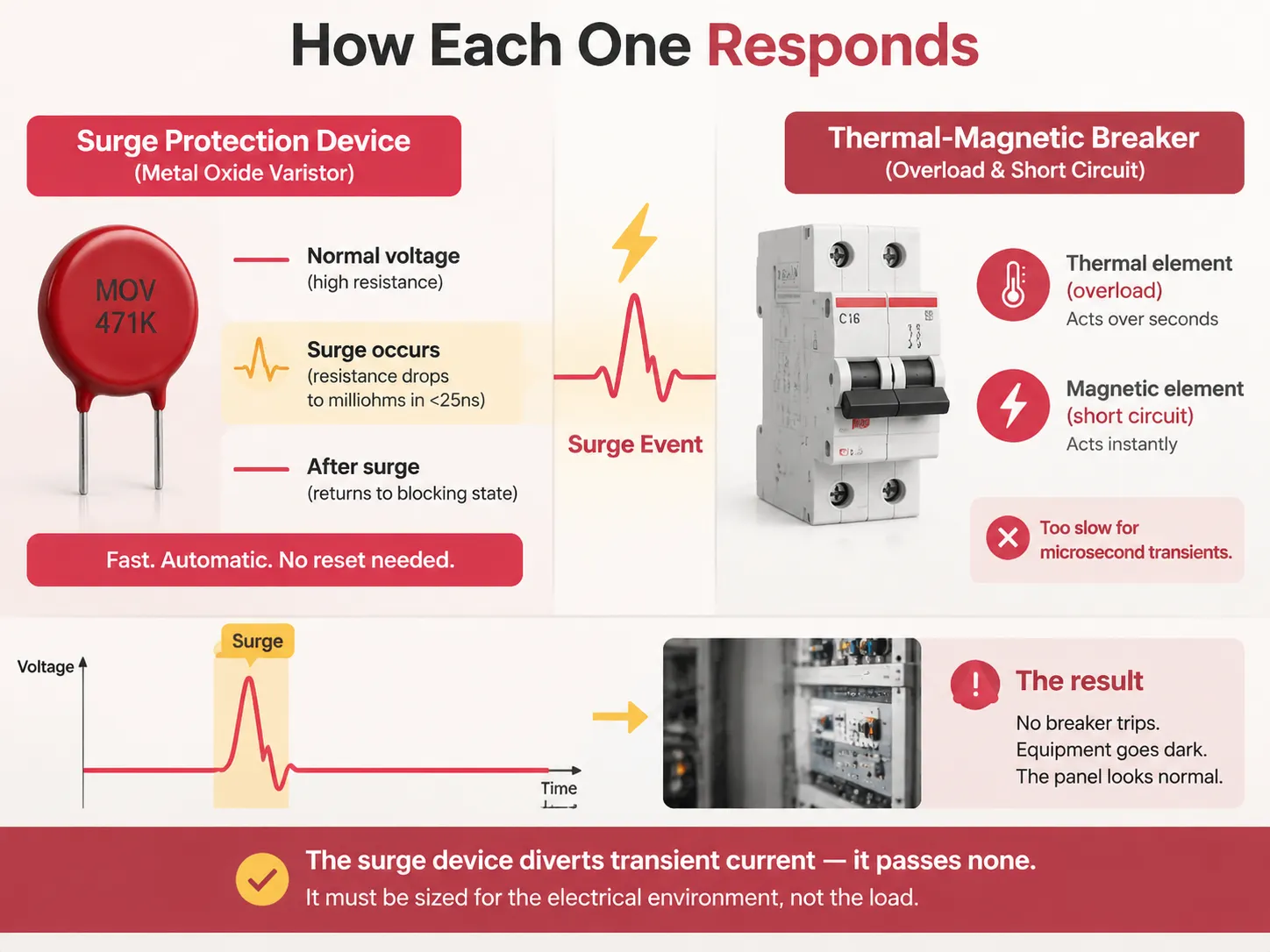
- A metal oxide varistor has a virtually infinite level of resistance at normal voltage levels. If the voltage exceeds the defined threshold level, the resistance drops down to just a few milliohms in less than a quarter of a microsecond. At the same time, it provides a low-impedance path to the ground and goes back to its blocking state after the disturbance disappears. There is no need for any re-setting, interruption or help from an end-user.
- A thermal-magnetic circuit breaker employs two principles. The thermal element makes a bimetallic strip bend depending on the level of sustained current that lasts seconds, which prevents burning from getting too high. The magnetic component acts instantly at the time of extremely high current passing through the wire. Neither of those methods can work fast enough to react to microsecond transient voltages — a circuit breaker will never notice anything.
Let’s put it in a clear way: there is no breaker tripping in most rushes. The devices lose power and a control board fails, but afterwards everything seems perfectly alright. This is a common source of misunderstanding in fault-finding, as the intuition is to search for a tripped breaker that simply is absent.
A surge device needs to be appropriately sized for the electrical environment, not for the load. Its discharge rating shows how much of the surge current can be diverted, not how much of the load current can be passed, which is none of course.A Type 2 distribution SPD rated In 20 kA and Imax 40 kA with 1.5 kV L-N protection is selected for the fault level and the exposure of the board it sits in, and it would be equally at home in a 63 A panel or a 200 A one.
Where They Cross Over in a Real Panel
Though the two types of devices perform very diverse functions, they ought to interact correctly, which is the point where failure in functioning of many systems begins.
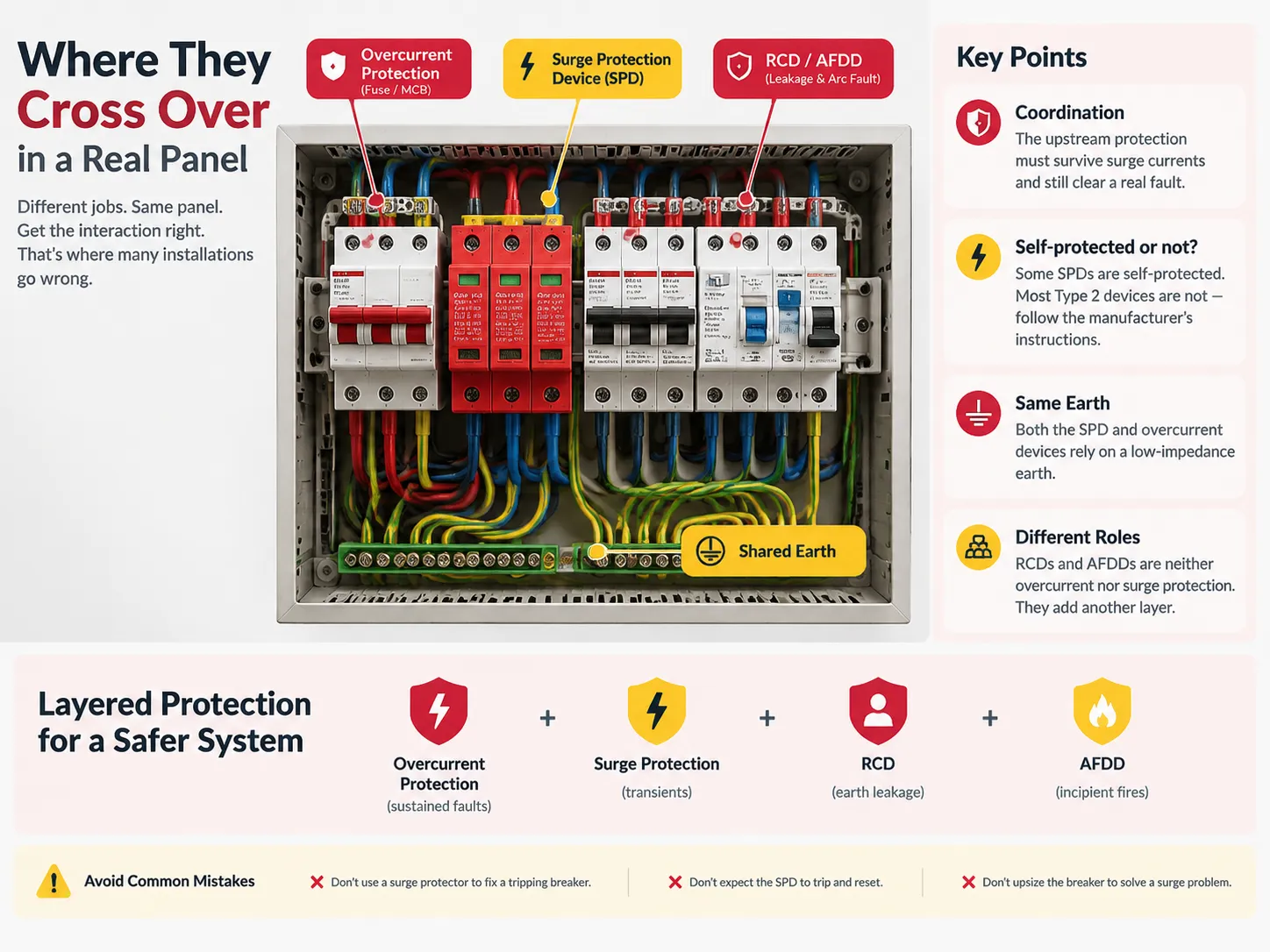
- The SPD may require overcurrent protection. Where the SPD does not have its own protection, it requires another device upstream to remove the short-circuit current in case the SPD has failed to short circuit. If a varistor fails, it may conduct continuously if its failure is not limited by an interruption mechanism, which results in failure of the SPD and great heating of the piece of equipment. Normally, coordination is done by means of a gG fuse of the range from 63 A up to 125 A or an MCB like C32-C63, with the manufacturer’s coordination data for a specified device prevailing over any general explanation.
- The required overcurrent protection does not have to be opened at the time of normal surge diversion. It makes the meaning of coordination clear – the upstream device must survive the currents passed by SPD and clear any real fault. Selecting them separately can lead to either loss of overcurrent protection during the storms or to the situation when SPD is unable to work.
- Certain SPDs have the capacity to self-protect. This is not the case for the majority of Type 1 devices that must operate with external overcurrent protection. Most Type 2 devices fail the self-protection test and must use an external fuse or breaker as specified in the installation instructions. Where a purpose-made disconnecting device is specified, it is designed for this exact duty — a back-up disconnector rated 30 kA Iimp with a 3 A trip current clears the follow current of a failed SPD without opening during normal surge activity, which a general-purpose breaker of similar rating may not do as cleanly.
- Both require the same earth connection. The surge device relies on low-impedance earthing to operate, while the behavior of the overcurrent devices relies on the earth fault loop impedance. Typically, an inadequate earth diminishes the functionality of both devices, as it happens imperceptibly.
- RCDs and AFDDs make a third category of devices. Residual current devices are useful in earth leakage detection, while arc fault detection devices are good for finding series and parallel arcing. In general, neither of these devices operates like the overcurrent or surge devices, nor can they replace them.
- The term layered protection is used to describe the result achieved in terms of protection: overcurrent devices serve as protection against permanent faults, while surge devices are responsible for protection against transients, residual current devices are used for earth leakage, and arc fault devices help to detect incipient fires. The removal of any protective layer leaves an unprotected hazard.
Why the Confusion Costs Money
There are three patterns that repeat constantly, and each of them costs money in its own way.
- Purchasing a surge strip in order to solve the problem of a tripping breaker. When the breaker is tripped, either too much current is being consumed for too long, or there is some kind of fault in the circuit. In such cases, a surge protector will not change the situation, because the particular solution will involve a load calculation, and the redistribution of some of loads on the circuit or creating a new one. Chasing the symptom with surge hardware also tends to produce the next problem, because the workaround is often more devices on the same overloaded circuit — which is exactly how daisy-chained power strips and overloaded receptacles happen, and why plugging a power strip into another power strip is prohibited outright.
- Assuming the SPD is able to trip and reset. SPD is not able to trip and therefore doesn’t reset. All it can do is work or fail and its failure is noted on the device, not on the panel schedule.
- Presuming that having a larger breaker would help with surge problems. It does not help and makes these problems worse. The available fault current at the SPD terminals is the amount of available short-circuit current and simply having a larger breaker upstream would increase this number beyond the SPD’s rating.
A wrong specification practice exists that needs to be corrected: sometimes in the project documentation surge protection is listed together with breaker schedules as if surge protection and breaker is the same thing. But these are two completely different devices requiring different selection criteria: charge rate, protection class and short circuit current rating versus tripping curve, break ability and coordination.
Getting Both Right
Here is a series of steps to follow:
- Calculate the load. The overcurrent protection can only match the load and cable after that. Nothing else in the panel can be calculated until this point.
- Establish the fault current. This determines the level of the capacity of the overcurrent device and the minimum short circuit current for SPD. This is a safety requirement; it’s not a choice.
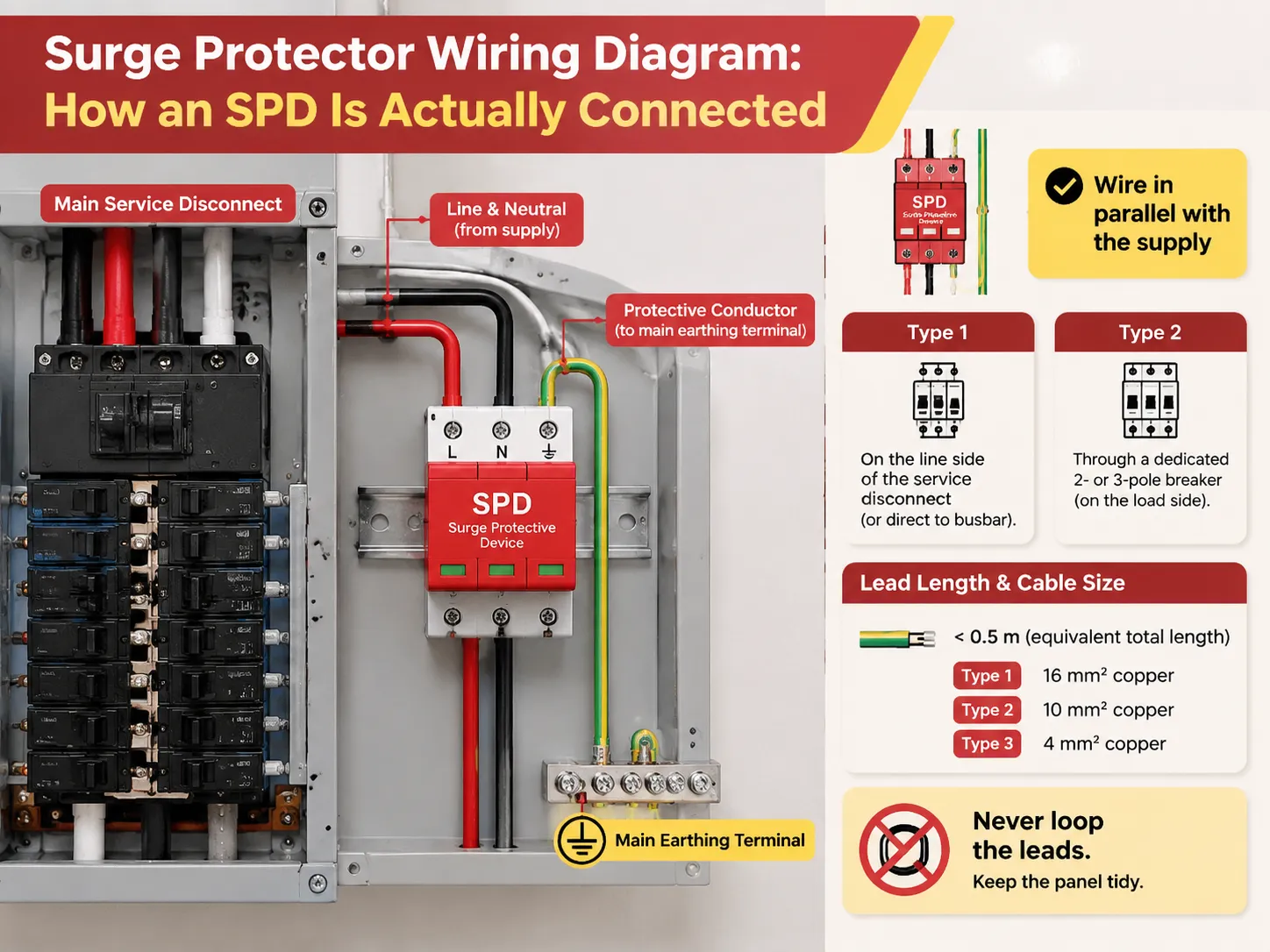
- Pick the type of SPD depending on its location. If it is on the line side of the service disconnect, it means that it is a Type I SPD; in case it is positioned on the load side of the main overcurrent device, it is Type II; being placed at the equipment shows that it is a Type III.
- Determine the discharge rating depending on the level of exposure which is a nominal discharge current value for sturdiness, maximum discharge level for one time, and the protective level depending on the equipment that follows it.
- Coordinate both things. Follow the SPD manufacturer’s table of coordination with upstream device; do not make improvisations here.
- Make sure that there are short and straight leads between SPD and the earth conductor. One can get the length of lead about 0.5 meters for Types I and II, as every additional meter requires 1 kV more.
Frequently Asked Questions
Which is better, overload protection or surge protection?
Neither is true, as they serve different functions and a compliant installation requires both. Overload protection stops prolonged currents from traveling through conductors, which is what prevents overheating and consequently fires from happening — every circuit has to employ this. Surge protection helps to control instantaneous overvoltage events which couldn’t be detected by overcurrent protection devices — that’s why sensitive electronic components, and the insulation surrounding them, do not suffer because of transients. The only case when the question may have a right answer is if one’s budget is limited and you have to solve one problem only: if the circuits have overloads or faults making the breakers trip, buying surge protection equipment is not a good idea; however, if one piece of equipment fails without breakers tripping, surge protection should be bought.
Is overload protection worth it?
It is compulsory that all circuits must provide overcurrent protection in accordance to their cables, since overload protection and short circuit protection is a subject that lies at the very foundation of electrical installation codes. One must ask themselves whether this protection that has been implemented is relevant today: circuits with added loads may be operating under higher limits than was thought of initially, and that means that a circuit breaker with a trip curve is not an upgrade. Where loads are increasing over time, the only way out is to calculate the loads and provide the capacity needed.
When not to use a surge protector?
when the danger is not in the form of an overvolt. Never consider an SPD as a replacement for an overcurrent device, do not install it to resolve the problem of circuits tripping constantly, and do not put a panel device in a spot where the fault current is very much greater than the short-circuit current rating. From the point-of-use, heat-producing devices should not be connected to the consumer strip, you must not connect the strips together, and do not use the strip to work for a medical device if there are no specifications from the manufacturer for that. Finally, if the requirement is a route of the surge current to the ground, then the lightning system is the device of choice and not an SPD.
Should I use overload protection?
Definitely, it should have been already included, and the key task is to verify that it is indeed all correct. Make sure that each circuit’s protective device is suitable for the cable size that has been utilized and the trip curve meets the requirements imposed by the type of load (the characteristics of the motor circuit are different from those of the lighting circuit), make sure that the breaking capacity matches the available fault current, and provide that the coordinated devices are working properly (the closest devices have to disconnect a fault but not the principal one). In case the SPD is introduced into the panel, please, check that the upstream device works perfectly with the new device. Also, confirm that the SPD is self-protected or protected with the requested protection means.
References
- NFPA 70, National Electrical Code — Article 240 overcurrent protection and Article 242 overvoltage protection
- UL Standards & Engagement — UL 1449, Surge Protective Devices
- International Electrotechnical Commission — IEC 61643-11 SPDs, IEC 60898-1 MCBs and IEC 60947-2 circuit breakers
- Mersen — National Electrical Code 2023 edition: overvoltage and overcurrent protection requirements
- Phoenix Contact — coordination of surge and overcurrent protective devices, technical documentation
Conclusion
Overload protection prevents the overheating of conductors and stops a fault from turning into a fire. Surge protection prevents short-time overvoltage events from ruining electronics and insulation, which makes equipment capable of surviving occurrences that do not leave a trace in the switchboard. The two protection mechanisms do not overlap in terms of their purposes and are chosen based on completely different criteria, yet they are related by the need for coordination—the upstream device has to allow for the occurrence of normal surge diversion events while eliminating real faults.