
EV charging equipment consists of a defined final circuit that comprises a control unit, a contactor, and a wire that can run outside the premises. While this association of components would not necessarily suggest the need for a second surge protector, surge protection for equipment installed in an EV charger is typically classified as type 2 on the AC feed. This raises the question as to whether the type 2 protection already fitted at the main panel will still safeguard the charger, or whether the charging circuit requires a separate risk management device.
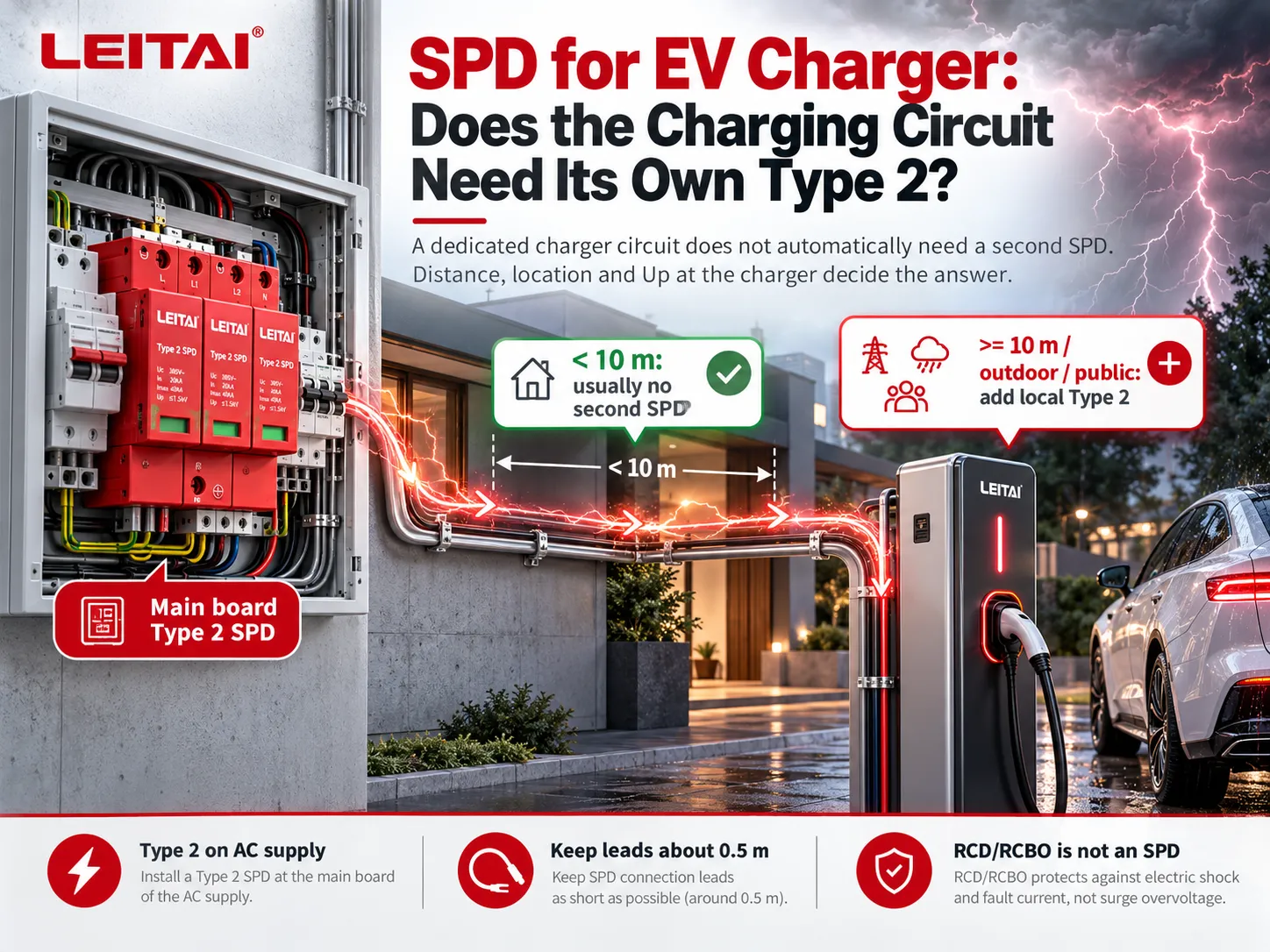
To summarize, there is no need for a dedicated charging circuit to have its own Type 2 SPD. When there is a short cable length involved between the Type 2 installed at the distribution board and the charger which is generally considered to be less than 10 metres long while the protection level at the charger is 2.5 kV or less, Type 2 at the distribution board is sufficient. After that second Type 2 is installed at the charging station on the pedestal, at the EVSE depending on the length of cable needed or outdoor setting or where mandatory stated by the manufacturer. A power board cannot be used. DC fast charging is a different challenge altogether.
The Installer’s Guide to the Charging Circuit
The source of the installation must be secured before anything else. The home or place of business should be equipped with a Type 2 SPD on the mains board, or a Type 1 + 2 in case of possible lightning surge current, including the outlet feeding the EV charger. It is then necessary to measure the distance of the cable rather than rely on the catalog description.
If it is only a couple of meters away or is located on the other side of the same wall, don’t rush to buy a second device only because the circuit is destined for charging. If the EV charger is located in the detached garage, or оn the one side of the carport, or at the very end of the parking lot, install one last Type 2 device there. Make sure that the leads connecting the devices are no more than half a meter long. The voltage must also be appropriate: Uc is 275 V for 230 V charger, for instance. Uc value will be a bit larger (385 V) if the charging station is on a three-phase board. Photovoltaic DC SPDs must never be used with AC charging systems.
What Makes the Charging Station Special
A mode 3 charging point is a unique device connected to the mains as long as the EV is plugged. The electronics must also remain connected to the circuit constantly. If there is an electrical surge, a surge protection devices found in the mains will not be sufficient; the charger can still get damaged via an outdoor cable.
The three factors distinguishing this system from a regular socket are:
1. The circuit is dedicated; the charger does not share it with anything or anyone else. Wherever a charger fails, it will be the fault of this specific charger.
2. Cables are often long, hanging outside. This aspect creates ideal conditions for re-generated voltage surge, since the SPD operates at the mains level.
3. The protective devices installed are not surge protectors. An RCD or RCBO will remove any residual currents if there are any, and an MCB will disconnect a piece of equipment in case of any excess current; however, neither would affect a surge.
It is possible to use either the Type A or Type B RCDs, along with the 6 mA DC fault detection devices where the charger fails to do so.
What the rules actually demand
Not one single sentence that states every home charger or such simply needs an extra Type 2 has been written down. All the requirements got split. IEC 60364-4-44, Clause 443 that discusses whether the installation needs any protection against transient overvoltage at all, against the aspects emerging from a failure, and impulse withstand of the equipment. Then Clause 534 from IEC 60364-5-53 describes how the SPD should then be chosen and connected. IEC 60364-7-722 attends to the supply of electric vehicles. The latter, with respect to public access charging points, reads as requiring a Type 1 or Type 2 SPD to IEC 61643-11 in the switchboard feeding the vehicle or within the EVSE, with a maximum Up of 2.5 kV.
A more practical test of this applies in the following way: provision of an additional Type 2 withstand at each charging point, provided the distance is less than 10m from where the upstream SPD to the EVSE is located. The Type 1 or Type 1+2 device at the origin when there is an external lightning protection system cannot maintain separation; otherwise, for long runs, a Type 2 device is employed locally.
A private domestic charger is not automatically in that public-access case. A lot of countries still expect a Type 2, or a Type 1, at the service or the main consumer unit. In the US, NEC 230.67 requires a Type 1 or Type 2 SPD for dwelling services. That regulation hangs at the service point, not on every branch. It does not prohibit a secondary protection device, nor does it render a long garage run inherently safe. The permit will depend on local adoption and the charger manufacturer’s work. If instructions indicate the installation of a local SPD, one should comply.
Type 2 on the Charger Circuit, in Plain Terms
Type is the test duty. On an AC charging circuit the usual device is Type 2, tested with the 8/20 µs wave and stated by In and Imax. It is installed in parallel, on the load side of the main disconnect, at the board that actually feeds the charger.
| Situation | SPD at the origin | Extra device on the charging circuit |
|---|---|---|
| Home charger a few metres from the main board, no external lightning protection system | Type 2 | Usually no |
| Same house, charger in a detached garage or on a run of about 10 m or more | Type 2 | Type 2 at the garage board or charger |
| Public or commercial charge points | Type 2, Up at or below 2.5 kV | Type 2 at each EVSE unless the upstream SPD is under 10 m away |
| Site with an external lightning protection system bonded to the structure | Type 1 or Type 1+2 | Type 2 locally when the cable run is long |
| DC fast charger | Type 1 or Type 2 on the AC input, by the same exposure rules | A separate DC SPD on the DC output, rated for that DC voltage |
A higher kA number does not replace a short lead or the right Uc. A 40 kA device installed with a two-metre earth loop can let through more voltage than a 20 kA device mounted against the terminals.
When One Type 2 at the Main Board Is Enough
The length of the cable and position of the charger, rather than the dedicated circuit determine the split. As outlined below, for charging devices under 10 m away and located within the same structure, the charging source suffices; however, for longer distances, outdoor locations, or public charging bay applications, a charging circuit must be equipped with its own Type 2.
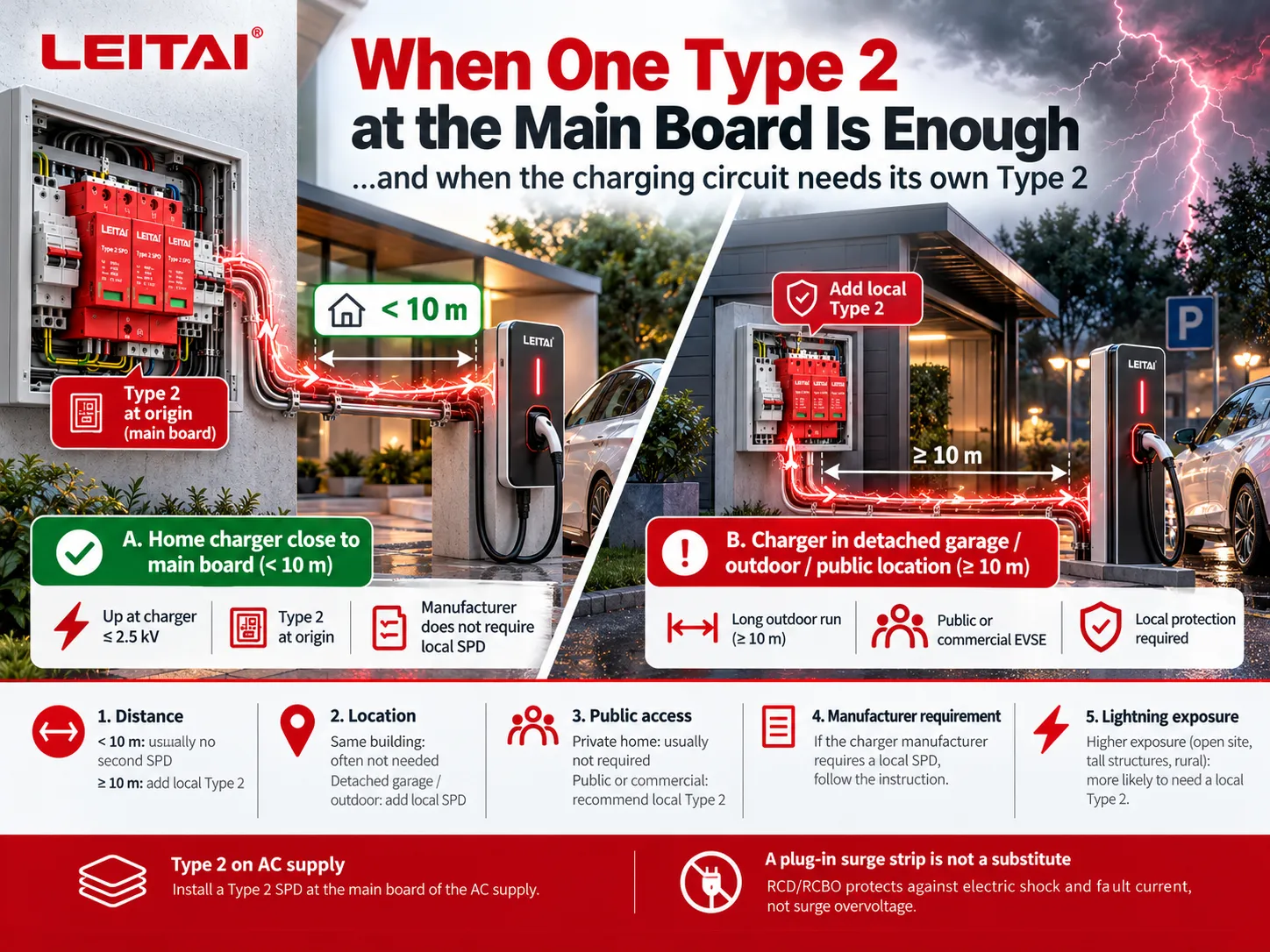
Exceptions are made when you should not fit the upstream Type 2 charging circuit with the following requirements met:
– The SPD is within the same switchboard as the charger breaker or the distance between the SPD and the charger is less than 10 m.
– The installed published Up remains within 2.5 kV under the short-circuited condition.
– Uc exceeds the normal supply voltage including tolerances. In cases of a single-phase charger with a voltage range of 230 V Uc must also comply with 275 V instead of 230 V.
– The charger manufacturer did not require the local installation of the SPD.
– There is no public charging bay requiring the installation of a protection device according to the supply rules.
When the circuit requires a separate Type 2
The right side of the figure shows another situation. A separate Type 2 must be placed on the charging circuit under any of the following circumstances.
The charger is powered from a garage distribution board, a public box, or a street cabinet, with supply cables from the SPD upstream being at least 10 meters long.
The charging stations are public and the upstream device is insufficiently close to be eligible for the protection of the resulting installation type.
The only protection device is a plug-in tape or there is no protection device altogether.
Lightning systems are installed in the installation in question. Therefore, the upstream has to be either Type 1 or Type 1 + 2, while the charging point still needs a separate Type 2.
The operating instruction for the charging point includes the installation of the local surge protection.
The surge protection device must be placed near the charging point or in the charging point cabinet if there is a position in DIN rails available. Connect it parallelly. Protect the connection wires according to the recommendations made by the manufacturer. Never connect the surge protection device in series with the charging point.
The Half Metre That Decides Performance
Where the Type 2 sits is only half of the result. The leads that connect it decide the voltage the EV charger still sees. Short and straight keeps the let-through down. A loop of a metre or two adds voltage the datasheet never showed.
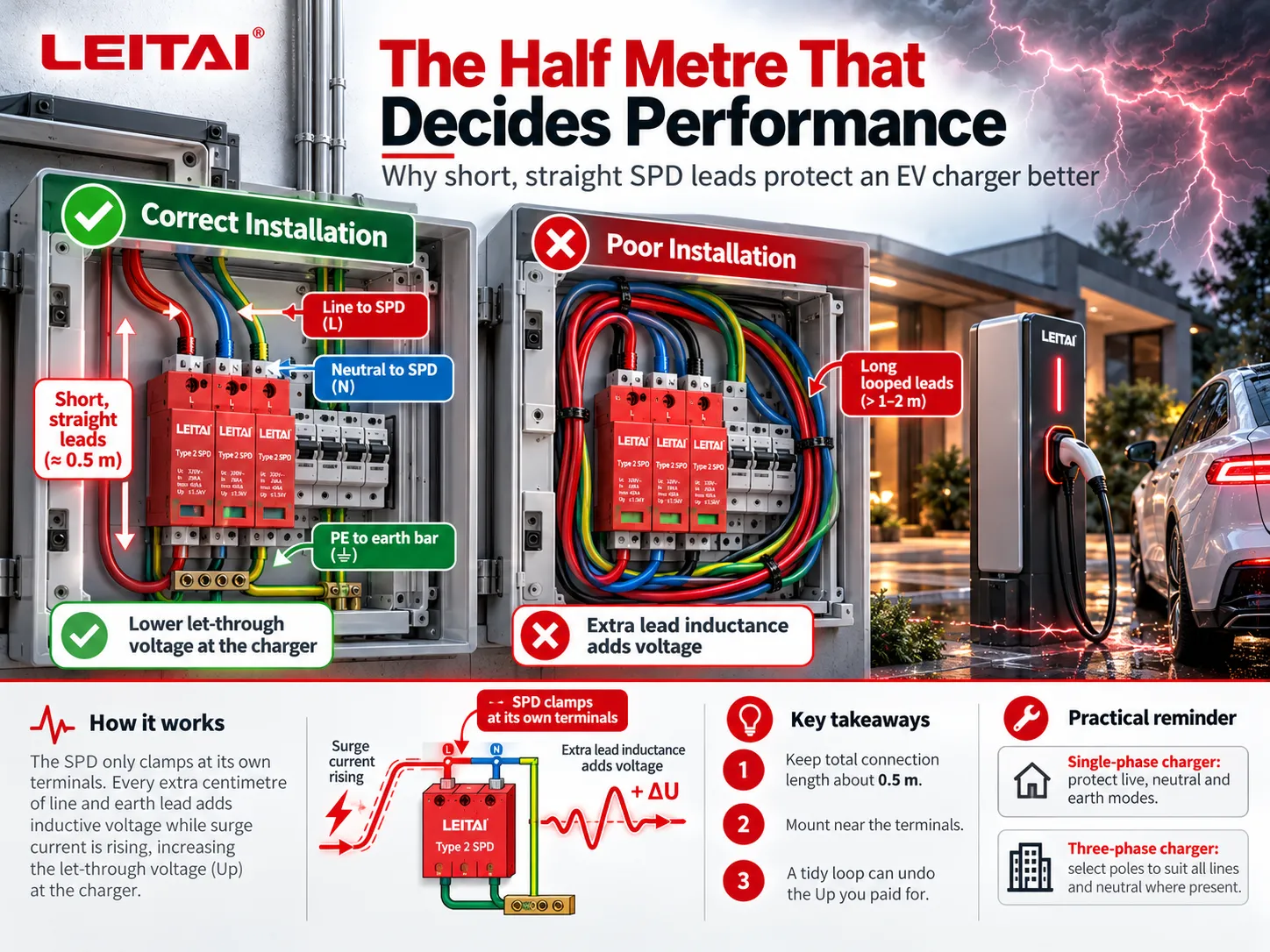
The SPD restricts only the voltage at the terminals of the device installed. Any additional distance covered by the line or earth lead increases the voltage with the rise of surge current. In the charging circuit, there is a live phase with respect to the SPD, neutral to the SPD, and a ground wire connected back to the ground bar.
One must keep the total distance of their connection wires or conductors to around half a meter and keep them straight. A small turning loop inside the enclosure could do away with your investment in SPD. The earth conducting wire must be of the size that the manufacturer specifies and not borrowed from a long wandering protective wire if the enclosure is small enough.
Electric pole identification is vital to ensure its correspondence with the power supply. The single-phase charger requires the earth and neutral modes of the SPD in almost all configurations being used. The three-phase charger needs three lines plus neutral, where there is neutral wire present. The SPD, which is specified as single-phase, would remain a single-phase unit regardless of the size of the charger.
The Function of AC Charger and DC Fast Charger Is Not Identical
An AC appliance is a wall-mounted device installed in a home or office that supplies AC power to the vehicle. The SPD used for the EV charger should be AC Type 2 according to IEC 61643-11. From that point, the onboard converter built into the car can be connected, ensuring that the supply equipment, as well as the cable, is fully protected.
A DC charger performs the rectification process inside the charging station and delivers the resulting DC power to the vehicle. Despite this exciting development, the AC power input has to adhere to the rules mentioned before. The DC output will have to be equipped with a dedicated DC SPD designed according to the parameters of the DC voltage and the relevant testing standard, but not a 275 V AC module and not a solar string device used in the solar combiner. If there is a solar DC device and EV AC device at the site, there will have to be two separate SPDs. Selecting the appropriate SPD is a Ucpv challenge.
Where Leitai Fits
Leitai produces the SPD. It does not do the charging circuit design, RCD choice, or earthing arrangement sign-off for an outdoor installation. These are the responsibility of the installer and local regulations. After the distance test indicates that the Type 2 SPD is needed, the relevant hardware is now the AC distribution series.
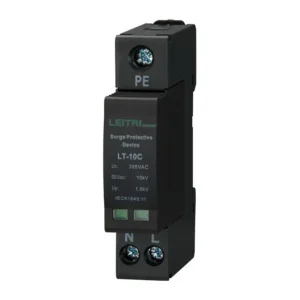
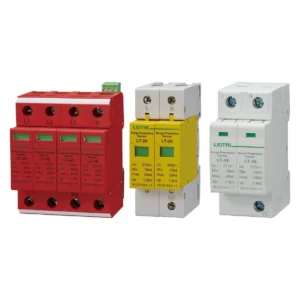
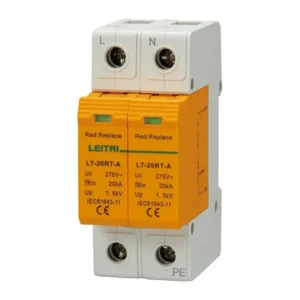
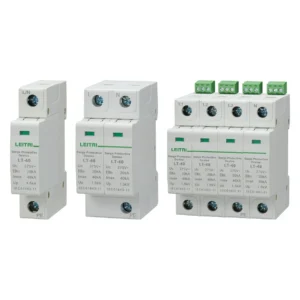
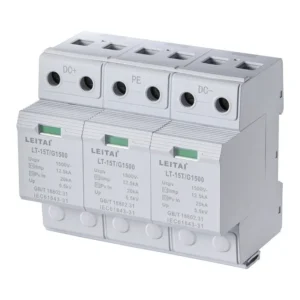
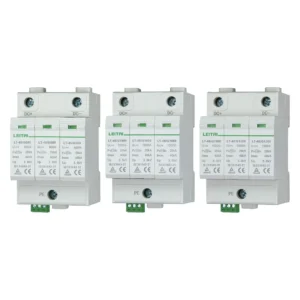
The LT-20/40 is a Type 2 SPD for AC distribution boards according to IEC 61643-11, with Uc values of 275 V, 320 V, 385 V and 440 V and Up value published at below 1.8 kV. You would use a 275 V Uc with a standard 230 V single-phase charger and a 385 V Uc on a board with 230/400 V three-phase power. Remember to check In, Imax, Up and number of poles for the given variant before installing it on an EV board as this is a unit for the main board and possibly for the local board, if cable run is long. How those two duties differ is set out in the Type 1 versus Type 2 SPD note. What the three types are for, in general, is covered in what an SPD is.
FAQ
Does an EV charger need its own Type 2 SPD?
Various other cases exist against the general consideration of this device as sufficient in most cases. If the Type 2 device at the board is less than about 10 m from the charger and if the Up at the charger is still at or below 2.5 kV, that device is usually enough. Now, if the run is longer, if the point is public, or if a manufacturer provides local protection, then, by all means, implement a Type 2 on the charging circuit.
Is a whole-house surge protector enough for a home EV charger?
It is enough when the charger is close to that protector. A wall unit beside the main panel is the easy case. A unit in a detached garage on a long feeder is not. Add a Type 2 at the garage board rather than relying on the service device alone.
Can I use a plug-in surge strip on an EV charger?
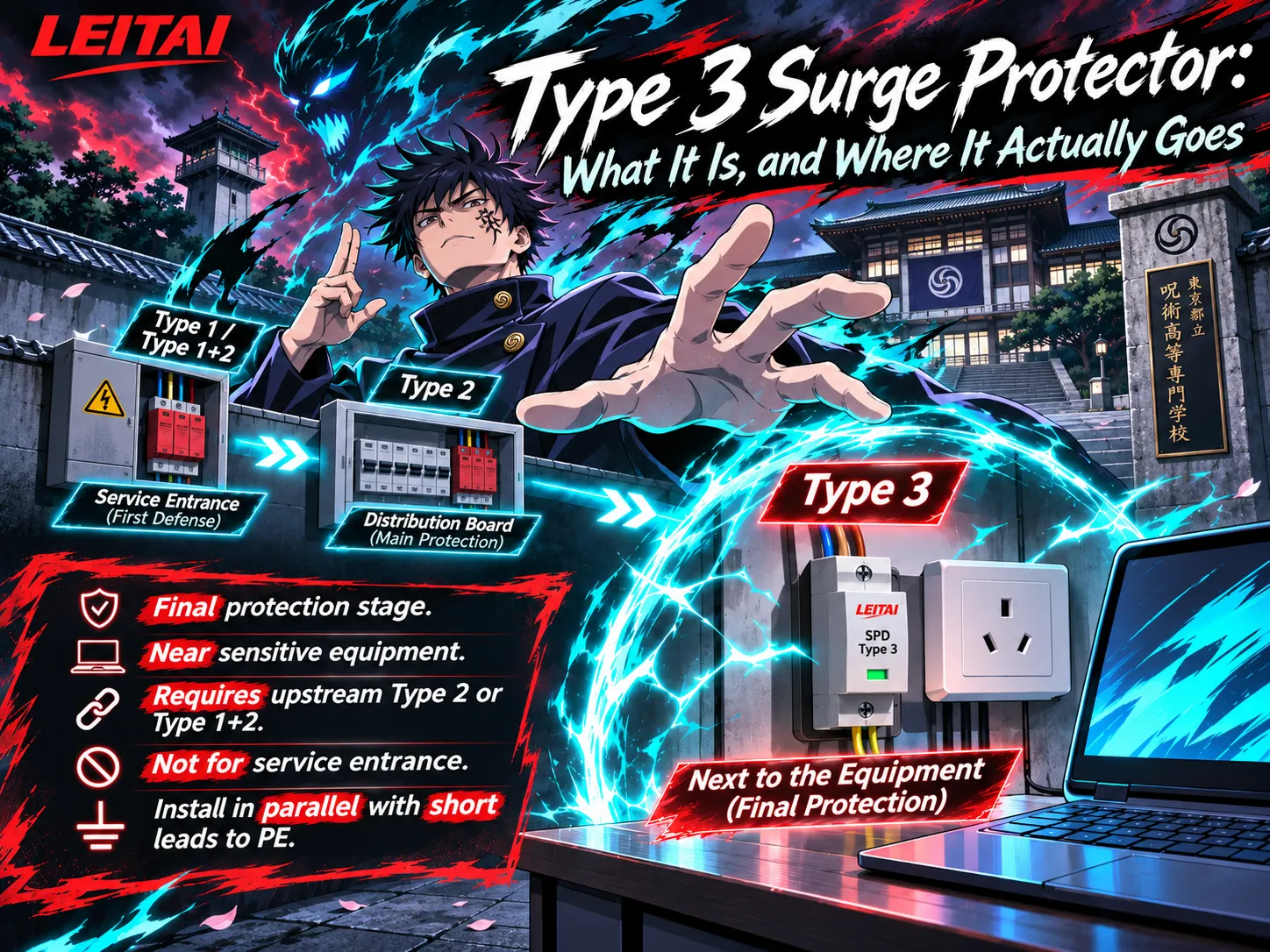
No. A fixed charging point is not a movable device, and a Type 3 module is not suitable for a 32 A or 40 A dedicated circuit, where it would be the only SPD. A fixed Type 2 device has to be installed. A Type 3 device is only the last level in a multi-step staircase of an upstream SPD serving low-power devices.
What Uc should I order for a 7 kW single-phase charger?
The 7 kW number is actually the load, not the voltage of the SPD. For a single-phase 230 V supply, you will need to request AC Type 2 with a Uc of 275 V, poles matching the live and neutral, and Up less than or equal to 2.5 kV. For a three-phase 400 V supply, the normal value for Uc is 385 V. Do not request a DC photovoltaic SPD for this circuit.
Does a DC fast charger use the same SPD?
Only on the AC input, and only after the same distance and lightning-current check. The DC output needs a separate DC SPD rated for the charger voltage. An AC Type 2 does not protect that DC bus.
References
- International Electrotechnical Commission — IEC 60364-7-722, supplies for electric vehicles
- International Electrotechnical Commission — IEC 60364-4-44, clause 443, and IEC 60364-5-53, clause 534
- International Electrotechnical Commission — IEC 61643-11, low-voltage surge protective devices
- Schneider Electric Electrical Installation Guide — EV charging, surge protection and the 10 m distance
- NFPA 70, National Electrical Code — Section 230.67, surge protection at dwelling services
- Leitai — LT-20/40 Type 2 SPD for AC distribution
Conclusion
An SPD designed for use with an electric vehicle charger is classified as Type 2 within the AC supply and activated in the charging circuit when the upstream device cannot keep voltage at levels suitable for operation of the charger due to its distance. Within about 10 meters of the upstream device and ensuring that the voltage is not higher than 2.5kV, the main board Type 2 serves the purpose. However, a specific Type 2 is needed in situations where the distance in excess of 10 meters is recorded – that is, where the vehicle chargers are installed in public places or insisted upon by the manufacturer. RCD occurs in the circuit so that residual current remains functioning but cannot operate for the purposes of SPD.