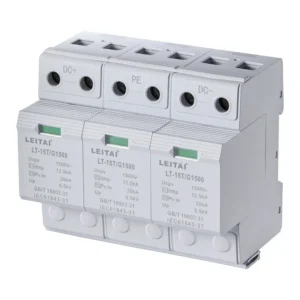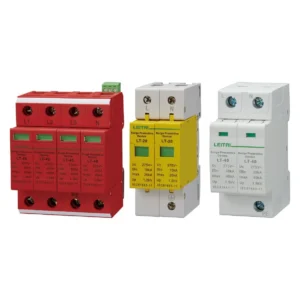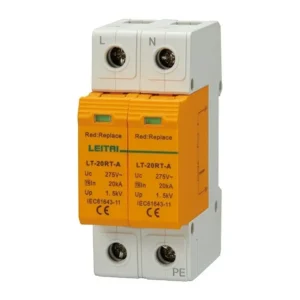

Surge arresters and lightning arresters are often used interchangeably and get confused in technical specifications. A surge arrester is a protective device against overvoltage transients for systems with voltage levels over 1 kV. Hence, a surge arrester is a medium- or high-voltage component characterized by its voltage rating, nominal discharge rate, and residual voltage. A lightning arrester, on the other hand, is frequently understood (rather loosely) as a rod placed on top of a house that prevents direct lightning strikes. Thus, one can see that, while the terms share the same root meaning, they refer to different concepts with different criteria.
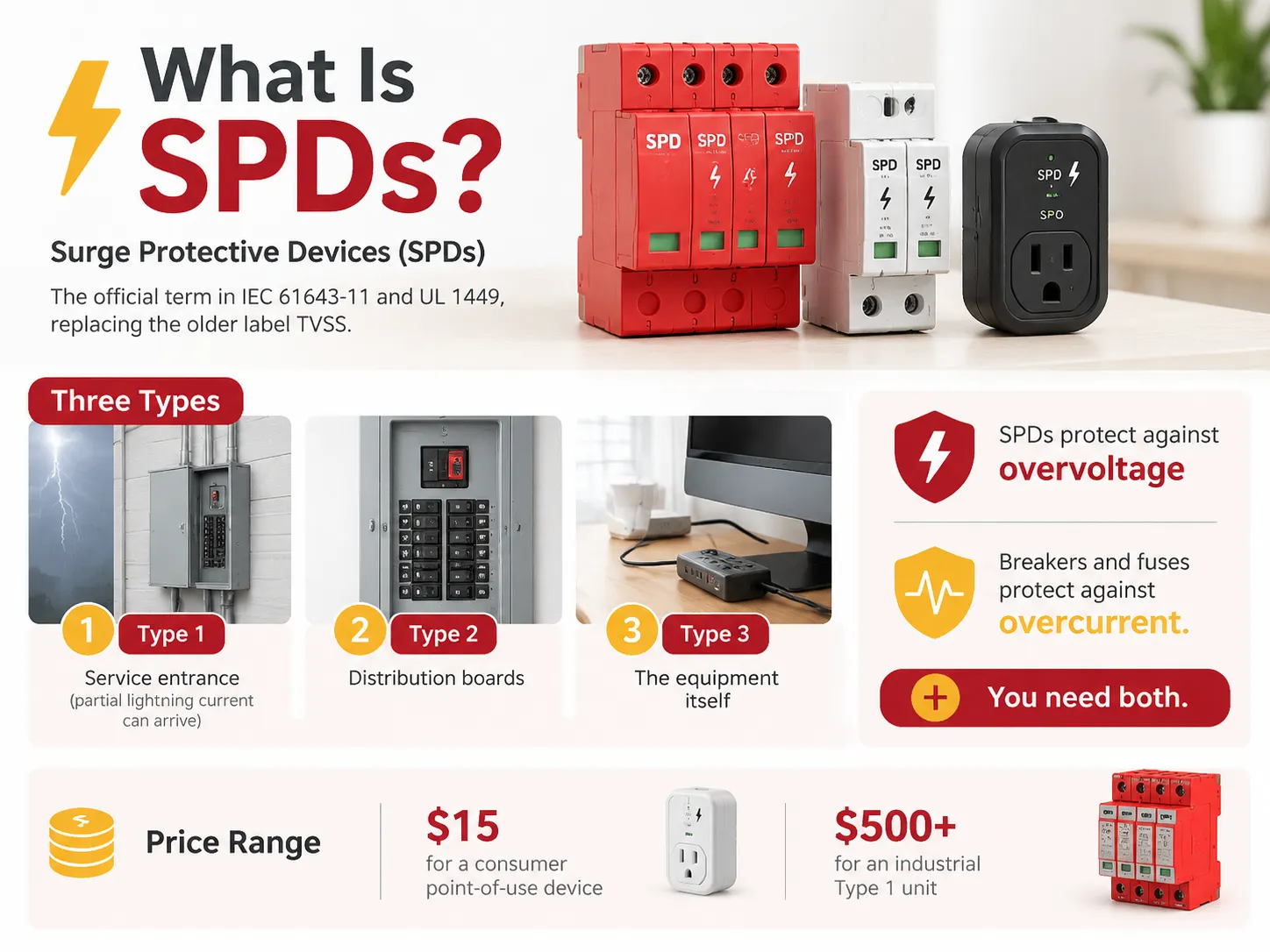
Definition: Surge Arresters are electrical protection devices like metal-oxide varistors or spark gaps designed to convey surge electricity on medium and high voltage systems per IEEE C62.11 and IEC 60099 standards. While lightning arresters refer to the air terminal of lightning protection systems, which includes lightning rods, it’s classified as structural and covered by NFPA 780 and UL 96A. In low voltage facilities, neither term applies since it is known as surge protective device and classified under IEC 61643-11 and UL 1449.
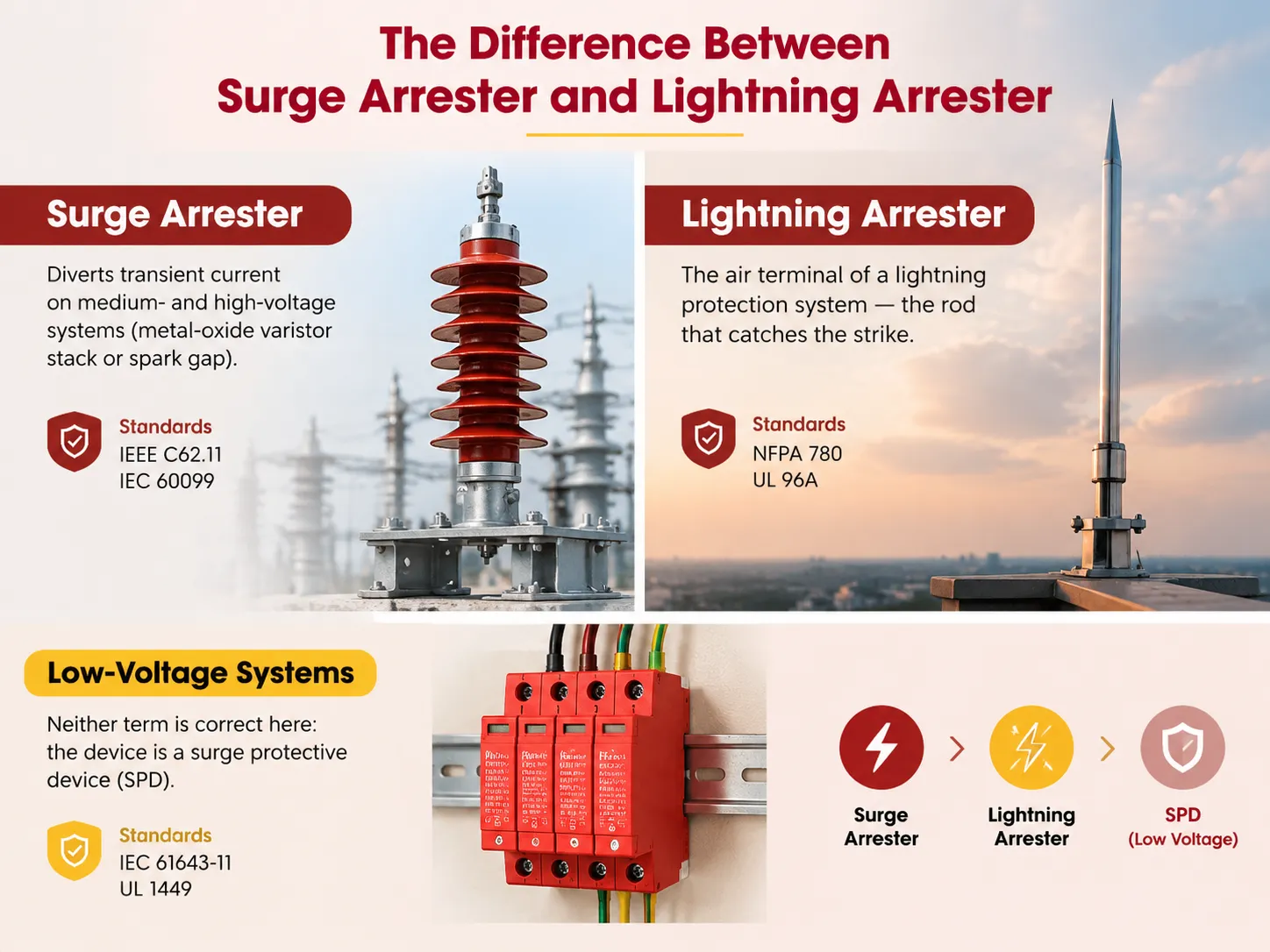
Two Words, Two Different Jobs
Let’s clarify what each term means physically as the terminology is where the confusion actually lies.
Surge arrester: it is the equipment installed to the conductor, with the impedance dropping once it reaches high values, and the device shunts the impulse current to the ground. It is located parallel to the physical object that needs protection and can be used at switchgears, transformer derivatives, on the overhead wire and at the input of the substation. The product is made of porcelain or polymer with the possibility of being mounted on an insulator. A device rated for 220 kV is one meter tall.
Lightning arrester, in layman’s terms: this is the metallic pointed electrode on the roof. Its purpose is to give a known point for the lightning strike. After a strike, conductors will take the lightning to the ground.
The terms got confused due to the history of the terminology. In the past, lightning arresters were used as a comprehensive term used for all protection systems against lightning, and manufacturers used this term both for the devices mounted on the roof and on the lines. However, officials managed to differentiate between the terms and this differentiation is hardly seen in the catalogs.
These terms should not be used in the design of low voltage installations.The correct term is surge protective device, and what an SPD is and where the three types install is the right starting frame for anything under 1 kV.
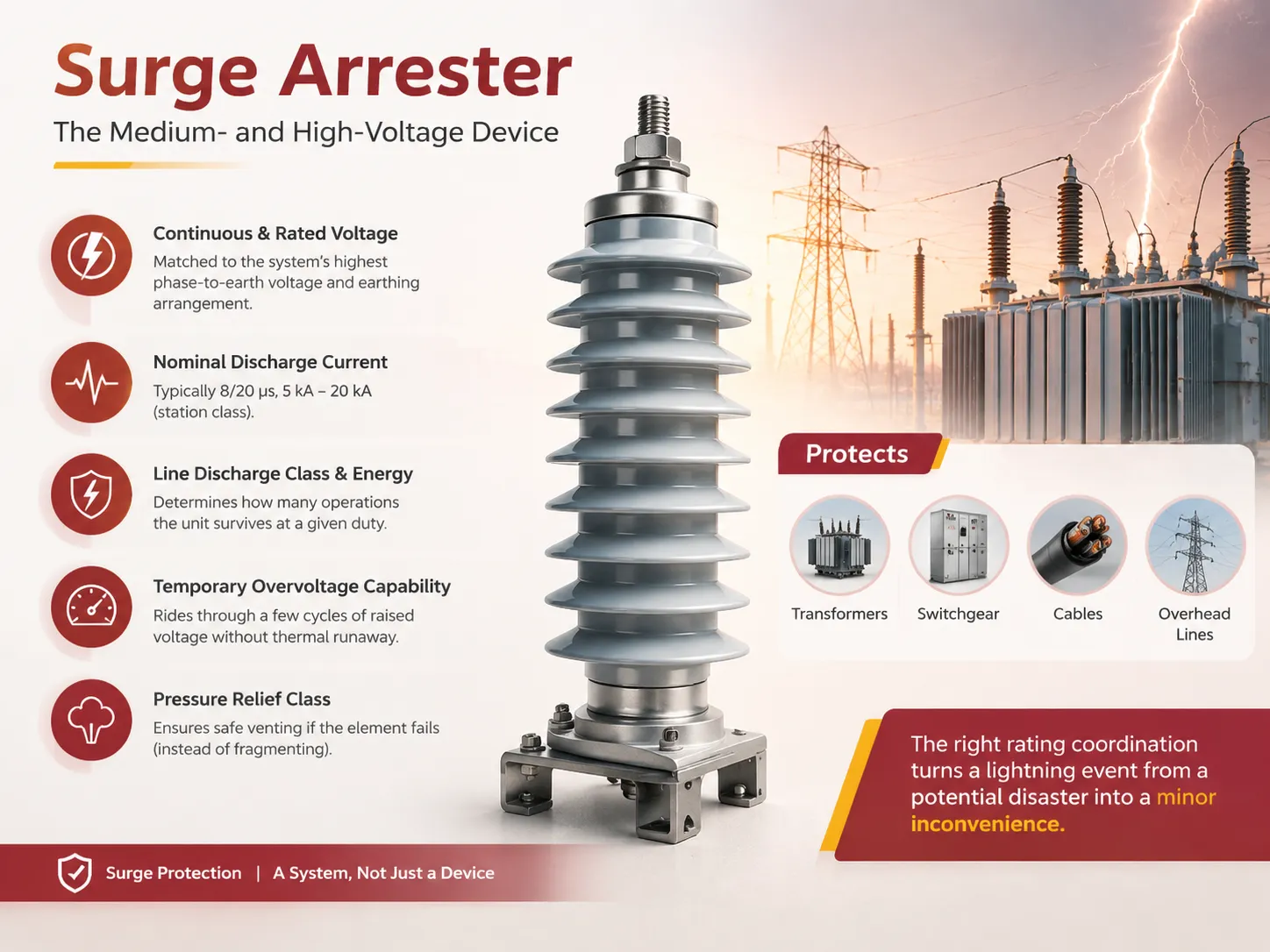
Surge Arrester: The Medium- and High-Voltage Device
At voltages greater than 1 kV, the surge protector is an important device that is selected based on a different basis.
- When selecting a surge arrestor, continuous voltage and the rated voltage, hierarchy of voltage of the system phase-to-ground in conjunction with the earth configuration of the system can determine the nature of the arrestors that are purchased.
- Nominal surge current, or the standard current that can be stated at 8/20 microseconds. Here, the surge arrestors start at 5 kA and go up to about 20 kA for superior stations.
- Hitting a discharge class of some sort and deciding on impact energy the device shall endure.
- Temporary luxury voltage endurance capabilities are taken into account as well.
- Pressure-relief rating is taken into account as well.
Surge arrestors are designed for protecting transformers, switchgear, cables and overhead wires, and they can mean a lot in defining the effects of lightning strikes. The rating coordination work behind them is mostly invisible to buyers, which is why surge protection for power grid and utility applications is specified as a system rather than as a bill of devices.
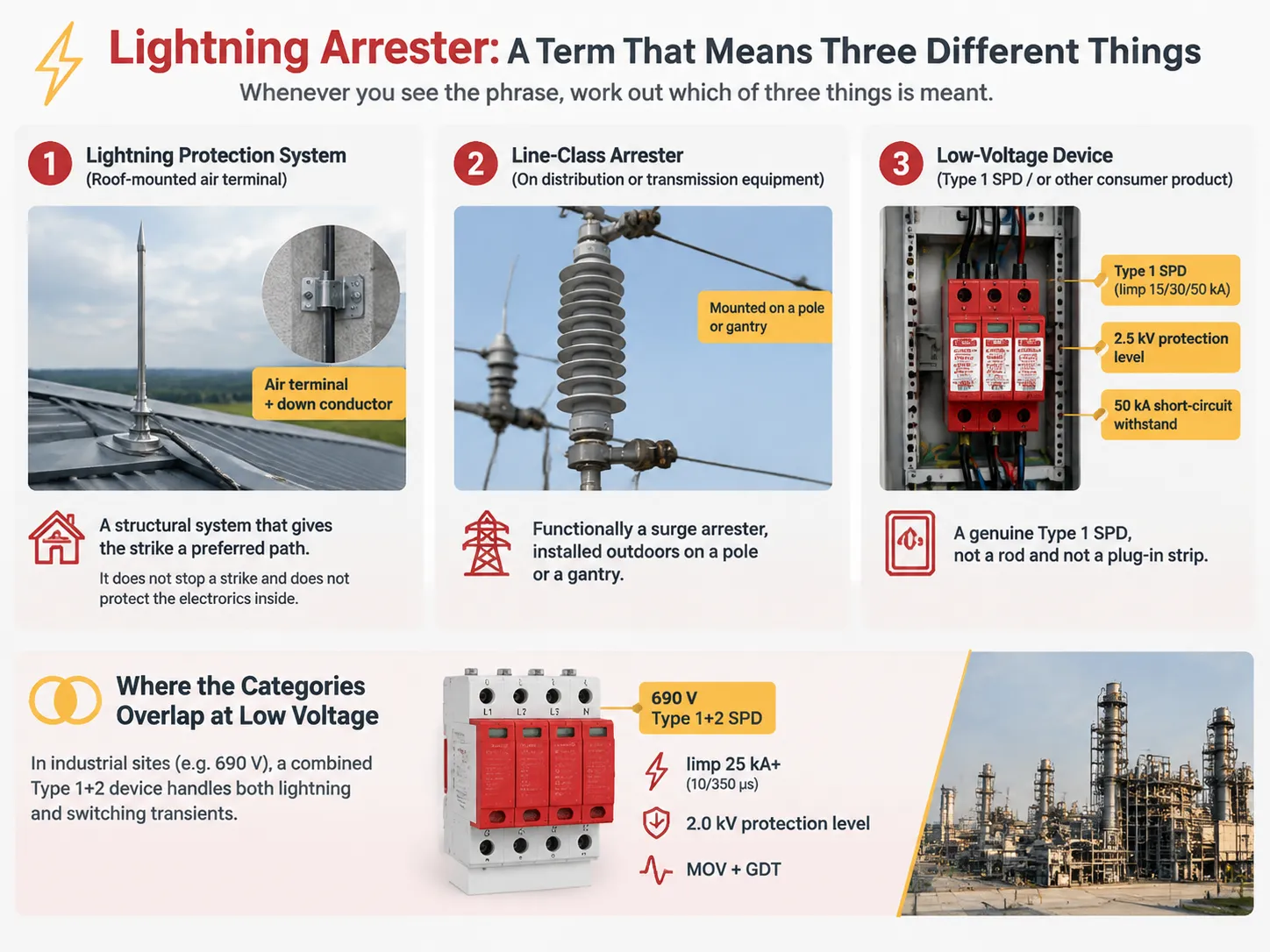
Lightning Arrester: A Term That Means Three Different Things
You will be able to better understand the meaning behind the term the next time you come across it as it could represent any one of the following three things.
- This refers to a lightning protection system comprising of the roof-mounted air terminal along with other components, including conductors and electrodes, as well as inspection procedures. It does not prevent lightning strikes but rather provides a path for the electricity from the strike to follow.
- As per the second point, this refers to a lightning arrestor on power equipment, which may not be distributed in an accurate manner but functions as a surge arrestor.
- The last point refers to any device being referred to as a lightning rod which causes confusion. A Type 1 lightning current arrester rated Iimp 15, 30 or 50 kA on the 10/350 µs waveform is the low-voltage member of that family, and it is a genuine Type 1 SPD with a 2.5 kV protection level and a 50 kA short-circuit withstand — not a rod, and not a plug-in strip.
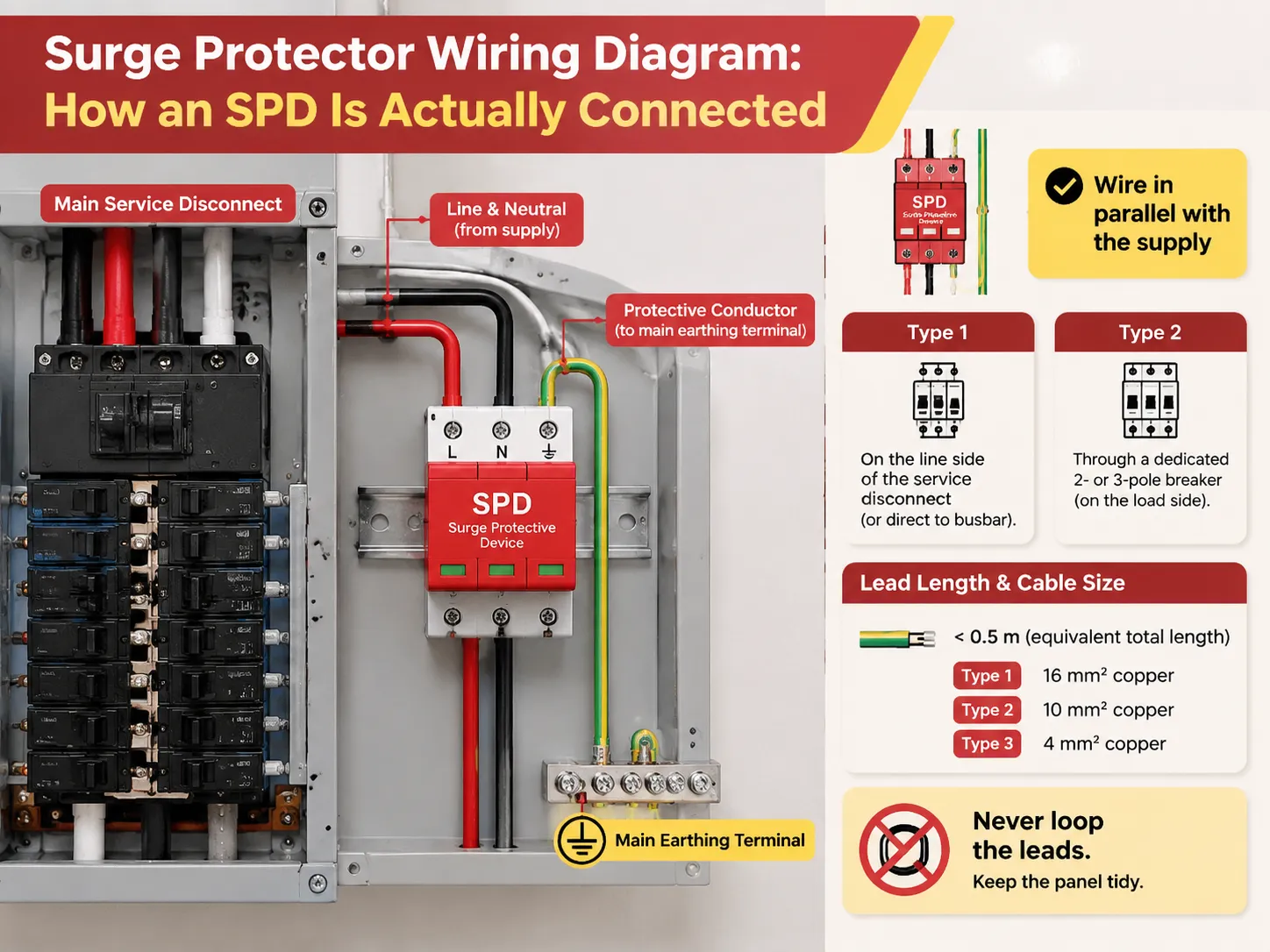
It’s a straightforward process of verification: if the device is attached to the top of the house and linked to the down conductor, it qualifies as lightning protection equipment. If the unit is fitted inside or near an electric panel and connected to line, neutral, and earth, it’s a surge protective device (SPD) or arrester and needs to be noted in this way.
Where the Categories Overlap at Low Voltage
The two terminologies are in some cases capable of representing the same phenomenon that is why the comparison is not exclusively semantic.
Imagine an industrial facility with the 690 V distribution supply — the mining sites, marine power installations, wind turbine converters, and some heavy processing facility would be operating with that voltage. A Type 1+2 combined device is supposed to serve two functions — dissipating temporary lightning current coming either from the overhead supply or the lightning protection of the building and keeping on functioning with the regular switching transients created by utilization equipment. This is a type of device which has two sets of parameters and usually two technologies of protection inside.
A 690 V combined arrester rated Iimp 25 kA and up to 120 kA maximum discharge current is the standard answer there, with a 2.0 kV protection level and MOV-plus-GDT protection, which is what makes the device able to clear the follow current that a spark gap alone would sustain. When it comes to industrial distribution, it is, for all intents and purposes, a surge arrester. If we refer to its IEC classification, on the other hand, we will know it as a Type 1+2 SPD. The labels depend on the documents, but not on the device.
Side by Side: What Actually Differs
- Task of Surge diverter: The role of a surge diverter is the diversion of transitory overcurrent. Task of Lightning protection: The purpose of a lightning protection system is to provide a controlled path for high current flowing through directly struck systems.
- Location of Surge diverter: surge diverter is positioned at the location of apparatus or line to be protected like a substation bay, transformer end, cable sealing end and panel. Lightning protection is located on the system, from terminals to down conductors to electrodes.
- Applicable regulations. Surges diverter: IEC 60099-4, IEEE C62.11 and their respective national standards. Lightning protection specifies NFPA 780 and UL 96A in the USA and IEC 62305 worldwide. For low voltage SPD: IEC 61643-11 and UL 1449.
- Specifications. Parameters of the surge diverters: the rated voltage, nominal discharge current, discharge class, and pressure relief class. For Lightning protection: parameters that characterize will include height and spacing of air terminals; wire size; resistance, and bonding of electrodes.
- Who performs installation? Surge diverter: utilities or industrial electricians. Lightning protection: a special installer usually certified. SPD: licensed electrician.
- Inspection of the installation. Surge diverters and SPD must be checked to check indicators after storms and for replacing them upon completion of their lifespan.
What both have in common is the reliance which both can’t overcome; earthing. An arrester (or an SPD with a high-resistance earth path) doesn’t have a efficient place to channel the current, and likewise, lightning protection systems with its electrodes connected to devices that cannot afford what is necessary create differences in potential, which results in side flashing.
What Each One Costs
Prices can differ a lot, which is exactly why we should use precise terminology: to compare a surge arrestor for a substation versus a power board, is not really a valid comparison.
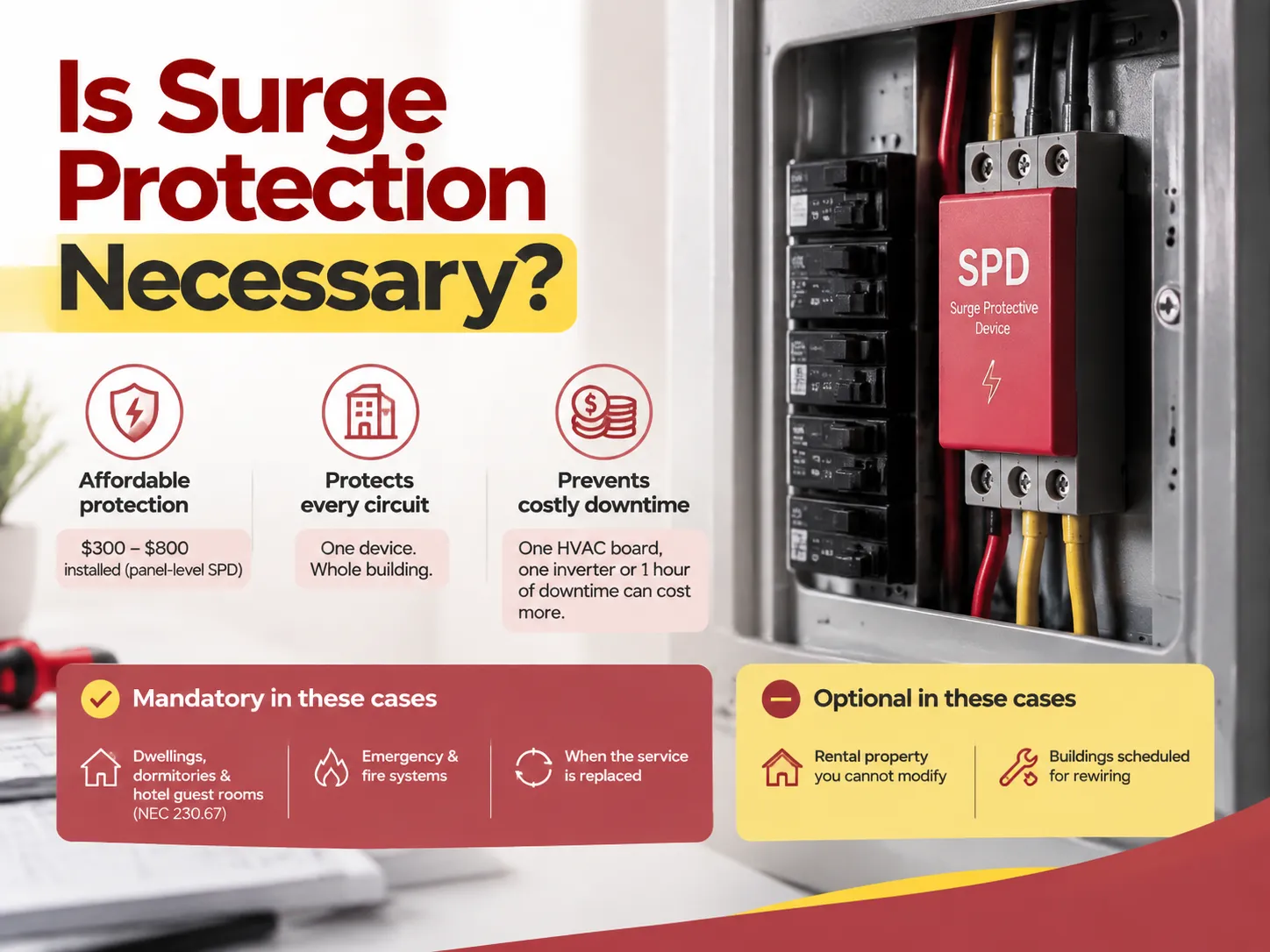
- Low voltage surge protection device for residential use costs anywhere from $60 to $300 for the device itself and $300 – $800 installed.
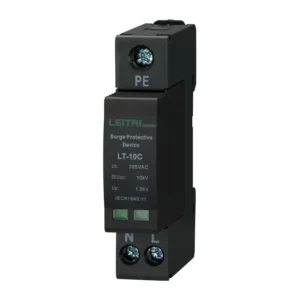
- Low voltage surge protection devices intended for industrial use (DIN) cost $100 – $1200 depending on their type and rating.
- Distribution surge arrestor prices start from hundreds of dollars for a device, not including the pole or supporting structure work.
- Station class surge arrestor applied for generation plants costs thousands of dollars for a device, not including the additional engineering work.
- Standard residential lightning protection system costs several thousands of dollars installed depending on such factors as roof area, number of connection terminals and down conductors, as well as the electrode location.
When buyers are obtaining quotes in the categories above they are actually looking at different scopes of work.Knowing which of them your project actually needs is the first question, and the full surge protection product range covering AC, DC and combined devices is the right place to check what exists at low voltage before assuming a specialist or a utility-grade product is required.
Frequently Asked Questions
Is a surge arrester the same as a lightning arrester?
In everyday usage, the differences between the terms can get obscure. A surge arrester is defined as a protective instrument in the circuit that diverts the surge current to the ground; for systems above 1 kV the classification must include specifications concerning the voltage rating, nominal discharge current, line discharge class, and pressure relief class per IEC 60099-4 and IEEE C62.11 standards. A lightning arrestor is usually the air terminal of a lightning protection system, being technical hardware according to NFPA 780 and UL 96A regulations which only provides the connection and the way for the lightning to take the place; in turn, surge protector must be used for equipment rated under 1kV.
What is another name for a surge arrester?
In different countries, based on the voltage level as well as the year of the document being looked at, the surge protector may be low-voltage surge protective device or SPD; transient voltage surge suppressor or TVSS for older North American documents; surge diverter, especially in references from Britain and IEC documents; and metal oxide arrester or MO arrester when talking about the technology. The ambiguous term “lightning arrester” is also used in older drafts where the word “surge arrester” is more appropriate and understanding meaning is of prime importance prior to any order placement.
Is a lightning arrester required?
It relies on what instruction you are following. The installation of a complete lightning protection system is not obligatory in every case but it is mostly required for buildings with many lives at stake, including places of assembly, poisonous chemicals user premises, monumental and tall structures with a great deal of priceless items inside. Insurers and governmental authorities usually require its implementation. Surge protective devices are obliged to be used in a narrower number of cases, which is rising. For instance, NEC sections 230.67 and 215.18 require such devices to be Type 1 or 2, and its maximum discharge current should equal at least 10 kA. It is obligatory for service feeds supplying apartments, dormitories, hotels and other healthcare facilities to use these devices. The requirement for a complete lightning arresting system does not exclude the one for the surge protective device in this case.
When not to use a surge protector?
When the issue is something other than overvoltage. If there is an ongoing tripping of any circuit breaker, either circuit overloading is involved or there is a problem with the wiring connections, then an SPD would still not solve the problem – these are completely different cases that require their separate protection. Don’t ever think you can use a consumer strip for equipment that generates heat, a consumer strip can never substitute the correctly rated circuit and do not place a panel protection device with fault current above the short circuit current rating. And finally, if you need a system for direct lightning protection then an SPD is of no use for this purpose, this means that you need an external lightning protection device but not SPD as it works together with but not instead of an SPD.
References
- International Electrotechnical Commission — IEC 60099-4 surge arresters and IEC 61643-11 low-voltage SPDs
- NFPA 780 — Standard for the Installation of Lightning Protection Systems
- UL Standards & Engagement — UL 96A, Installation Requirements for Lightning Protection Systems
- UL Standards & Engagement — UL 1449, Surge Protective Devices
- NFPA 70, National Electrical Code — Article 242, overvoltage protection
Conclusion
Make sure you use the correct terminology, and many of the issues will be resolved. A surge arrester is a device connected parallel to voltage sources of medium or high voltage, working in correlation with its nominal voltage and rated voltage. A lightning arrester most commonly refers to a conductor that catches and leads the lightning strike, which has a separate standard and structure. If you deal with systems developing less than 1 kV, use the term Surges Protection Device (SPD) and indicate its kind, discharge capacity, protection class, and fault resistance. By choosing the correct terms while doing the specifications stage, a person will save themselves from making the more costly error of purchasing the necessary protection for an unnecessary instrumentation.