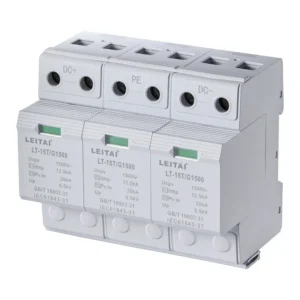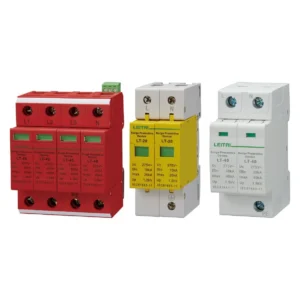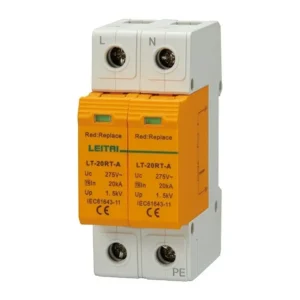

In part, it is about the qualifications involved. A surge protector will help you if lightning causes an electric surge in your system — the induction of energy to the conductor of the system from the electric discharge of lightning when it strikes the ground nearby and the presence of residual energy flows through the wires. However, it will be useless in the case of being directly hit by lightning or if anyone wants to carry the main lightning current to the ground.
To put it briefly: While an SPD does offer protection against surges caused by nearby lightning strikes, it falls short in protecting against lightning strikes that directly hit the building. An SPD works by clamping a transient overvoltage on the wires within a few nanoseconds, thus limiting it to a certain level published by manufacturers, which corresponds to the intensity of a nearby lightning strike. In case of a direct impact, the energy of the lightning will surpass any SPD’s ability to handle it and everything plugged into it will get damaged. So a holistic approach in lightning protection would employ a lightning protection system implemented in accordance with NFPA 780 or IEC 62305 standards for lightning strike conduction, use of Type 1 SPD on service entrance, Type 2 SPD on the distribution boards, and Type 3 SPD on the equipment—and disconnecting sensitive electronic devices before the impending storm is still the most effective single measure.
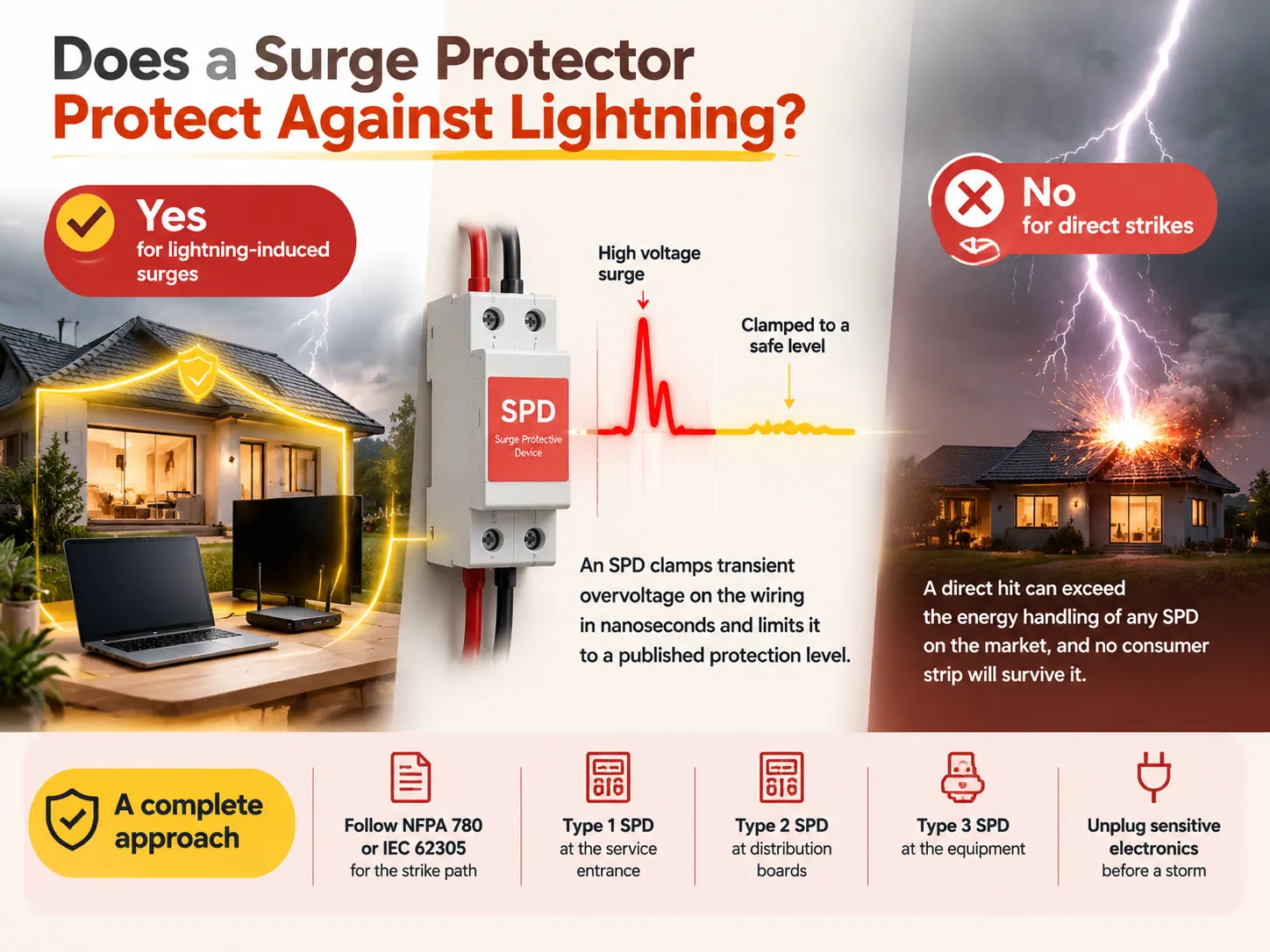
The Honest Answer
Retail packaging does make a lot of promises regarding this, but as always, the difference between the promise and the physics leads to a disappointment. Understanding this requires knowing which one of the three kinds of lightning event one is facing.
- A direct strike to the building. The strike current can be in the tens of kiloamps and flow through the building. The lightning protection system creates an intentional path of low impedance for the current. An SPD found in the panel is not part of that path and should not be treated as one — the conductors and terminals of a DIN-rail device were never meant to transfer the strike current.
- A strike at a close distance, some tens or hundreds of meters away. In this case, the electromagnetic field creates transients on all the conductors in the surrounding area, which makes their way to different power lines, data wires and pipes. The SPD is capable of handling this situation, while this is the most frequent case causing equipment damage.
- A strike on the supply network. The lightning strikes a wire of the power line or a pole, and the surge travels via the distribution network to the building. Again, the SPD has to deal with this, but only if it is installed at the power supply entrance with short connections.
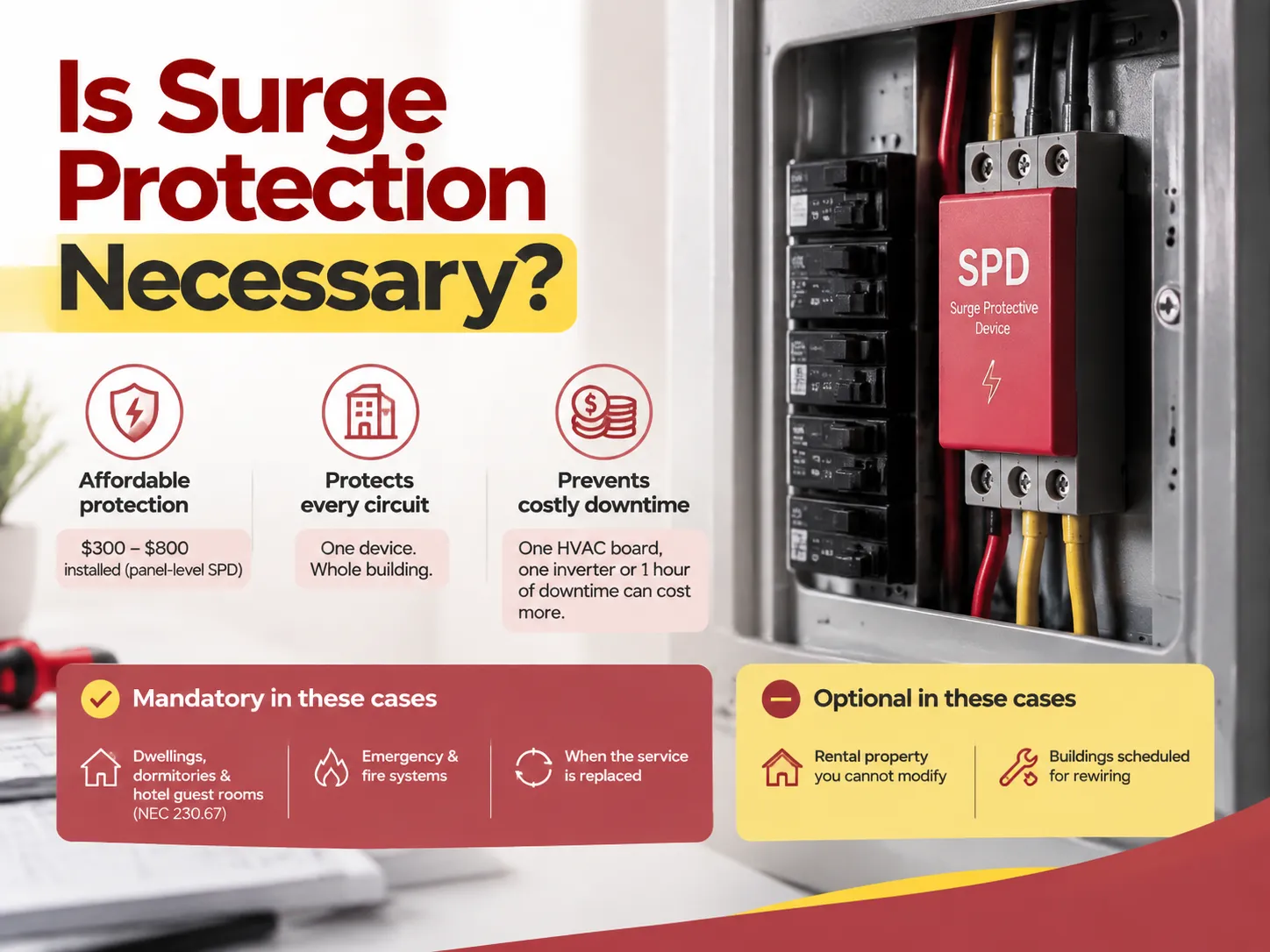
So the answer is not “yes” or “no” but “which event”. Readers who want the underlying device explained before the lightning-specific argument should start with what an SPD is and how the three types differ, because everything below depends on the type being matched to the position.
How an SPD Limits a Lightning Surge
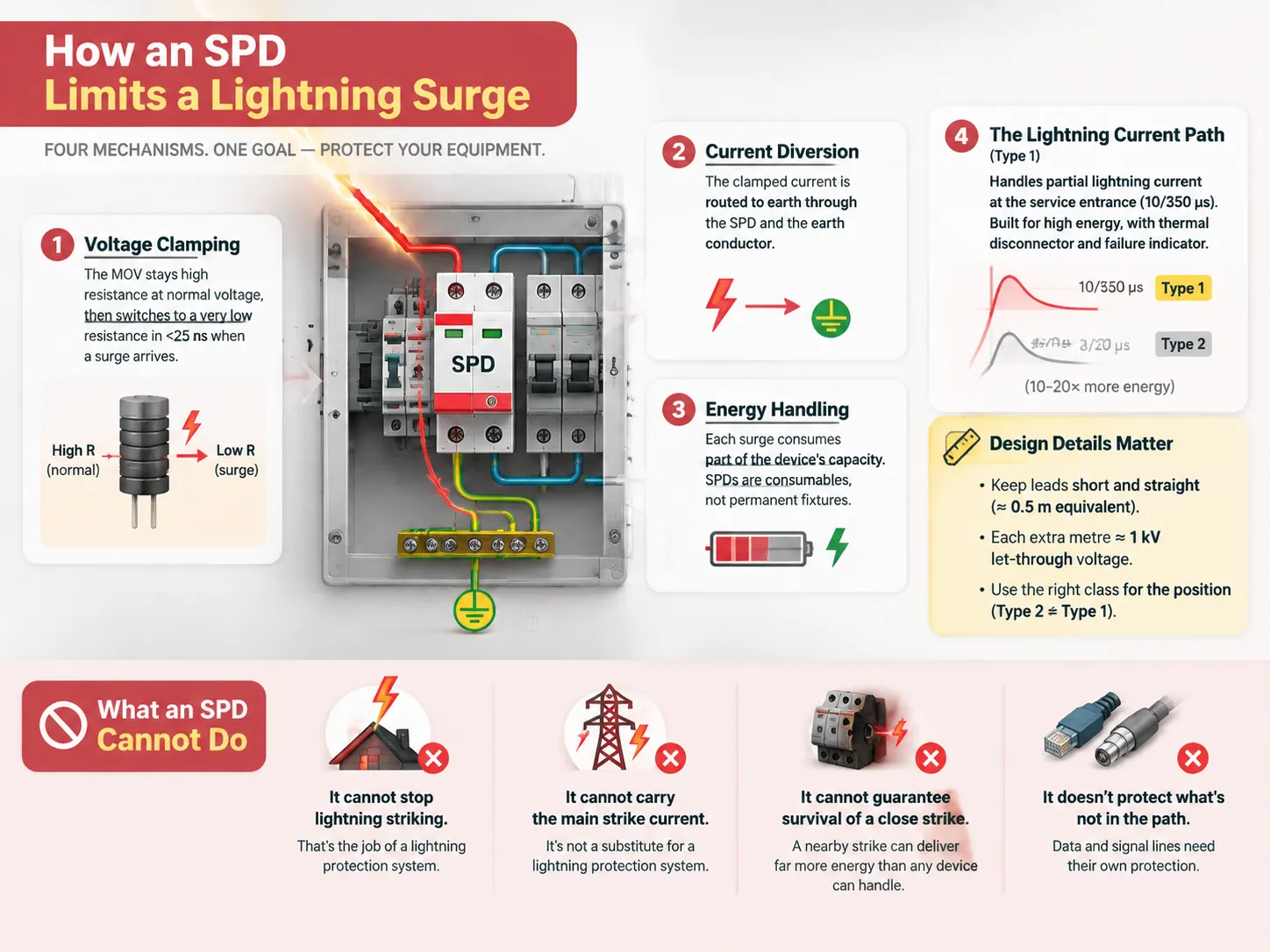
Four mechanisms interact, and they function based on how the energy has been introduced.
- The first mechanism is voltage clamping. A varistor is made up of a metal oxide and this device has an almost unlimited resistance at normal voltages. When a voltage surge happens and the voltage level is above that of the device, the resistance drops dramatically, and within a period of no longer than 25 nanoseconds, the excess voltage is guided to the earth conductor. As a result, the transients at the input will be sufficiently smooth for downstream devices, since the SPD will pass the surge to this level indicated in the specifications.
- Second, the current is diverted. Since current is limited, it needs to go somewhere, and it is transmitted to the Earth. This is the explanation as to why the earth wire is the most important wire of the whole installation and this is why having an earth path of a high impedance makes every performance parameter in the specifications a theoretical one.
- In addition, there is the energy absorption. Each instrument has the rating of the maximum energy it can absorb before its degradation. Each surge absorbs some part of the energy of that limit and that is the reason why SPDs are consumable devices instead of permanent devices.
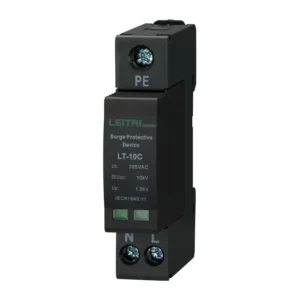
- Finally, there is the lightning current stream, wherever applicable. For example, a Type 1 device at the service entrance is supposed to handle a piece of lightning current coming from the installation having an external lightning protection or from an overhead electric supply. This is the reason why it is tested according to the 10/350 ms waveform whereas Type 2 devices are tested according to the 8/20 ms impulse having an energy ten to twenty times smaller than the former one. A Type 1 arrester rated Iimp 25 kA on the 10/350 µs waveform with a 1.4 kV L-N protection level is the low-voltage device built for that first line of defence, with a thermal disconnector and a visible failure indicator so it does not sit failed and unnoticed in the panel.
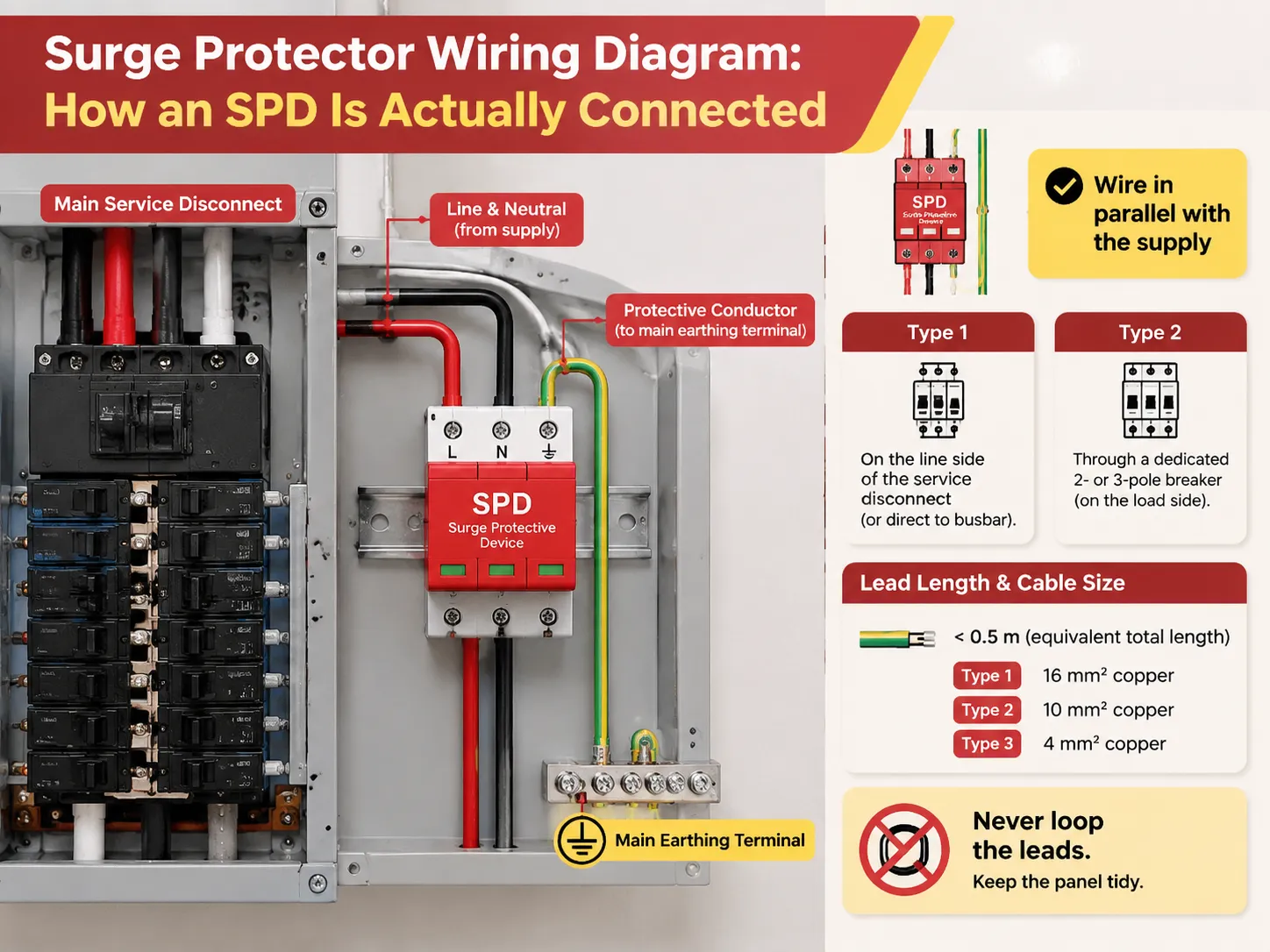
For any of this to reach the equipment, two design aspects come into play. The conductor length that connects the busbar, SPD and earth needs to be as short and as direct as possible according to what the enclosure allows. The target is somewhere around 0.5 m in length and anything above that raises the voltage let-through by about 1 kV for every additional 1 m. Additionally, it is also important for the device to be correctly classified according to the situation. For example, a Type 2 device would fail instead of performing poorly if it was installed in a situation that called for Type 1 devices to be used.
What an SPD Cannot Do
Understanding boundaries helps to avoid extravagance as well as being misled.
- It cannot prevent lightning from striking. Anything set up on a structure doesn’t mean it will prevent a strike that includes air rods that are believed to discharge the cloud. A lightning protection system can manage the strikes.
- It can’t help conduct the main strike current. SPD won’t work like a lightning protection system as it is not meant to conduct current. Many people think that SPDs can substitute transformers and thus they rely on it inappropriately.
- It cannot ensure that the nearby strike will be safe enough. There are moments when a very nearby event can make the energy exceed capacity of any device, e.g., strip or panel system. Consumer devices are usually the first ones to break down as their joule rating is much lower than that of a nearby stroke.
- It can’t protect devices that are not connected through it and irrelevant devices and signal wires can’t be protected either if they do not have their own protection.
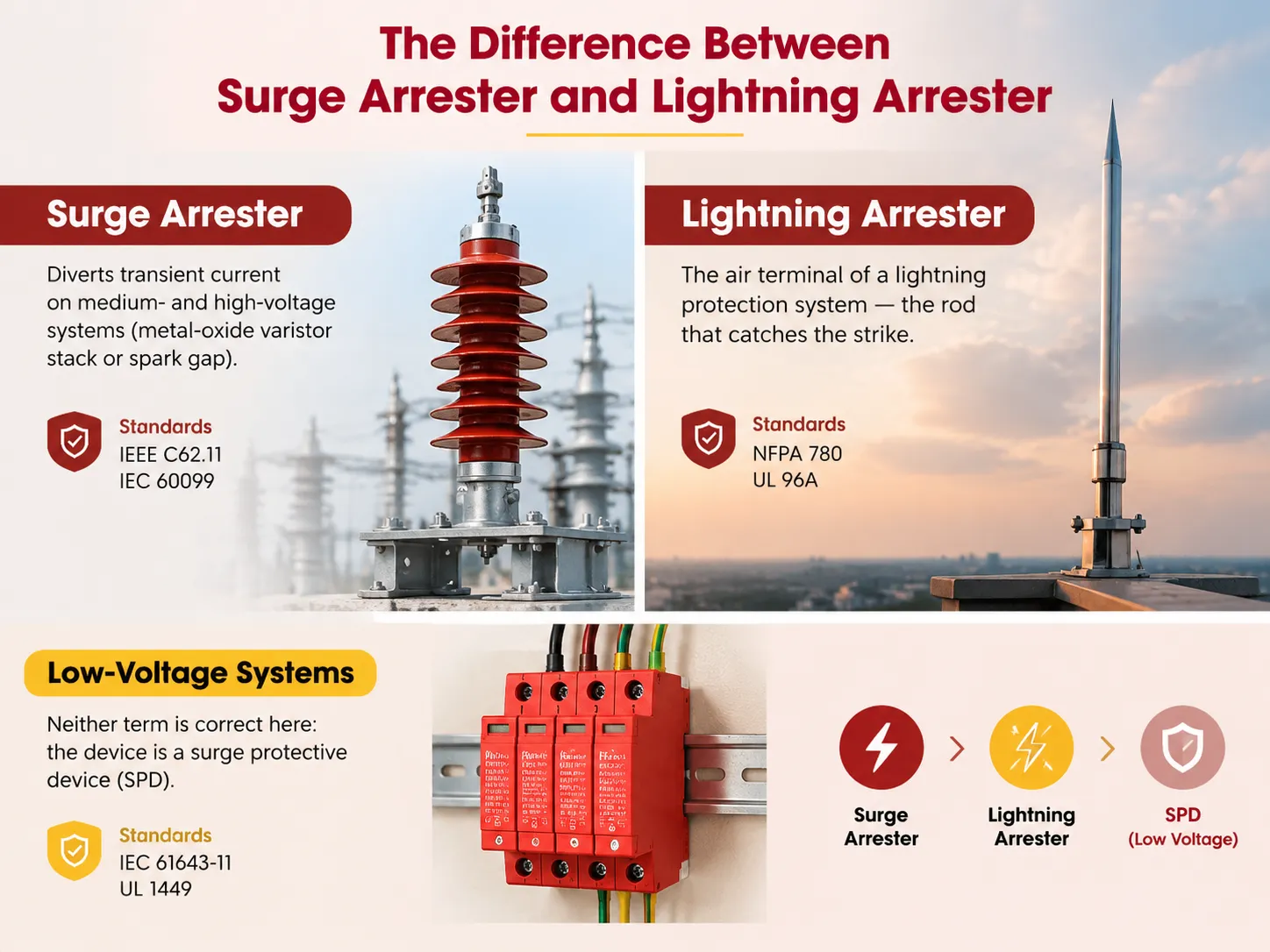
The vocabulary confusion in this area does not help, because the popular names for the two device families overlap. A surge arrester on a transmission system, the rod on a roof, and the DIN-rail device in a service panel are three different things with three different standards — the difference between a surge arrester and a lightning arrester is worth settling before anyone signs a purchase order, because the scope of work that follows is not the same.
Exposure Varies Enormously by Site
The same specification cannot be applied in all situations, and conditions must dictate the choice before one considers price.
- Urban buildings connected to underground supplies. Minimal exposure. They are only exposed to internal switching overvoltages, so the requirement is for Type 2 SPD at every distribution board and Type 3 SPD at the most sensitive loads.
- Rural and suburban areas supplied by overhead lines. Greater risk. Surges impact the supply line directly, meaning that Type 1 or Type 1+2 SPDs must be used at supply cable entry.
- Buildings equipped with external lightning protection an even greater risk because their bonding with electrical installation provides a path for partial lightning current. Type 1 at the supply entry is what all codes expect in this case.
- Photovoltaic power stations and rooftops: a special case since there are very long DC wiring either on an open ground or on the most vulnerable part of the roof. The DC side requires its own protective devices complying with the relevant certification but the AC will still use a device belonging to either Type 1 or Type 2.A combined PV arrester rated 1500 V DC with Iimp 6.25 kA and In/Imax 20/40 kA is a representative example of the class, with a remote signalling contact because the device sits somewhere nobody visits.
- High-rise buildings, hoisting machines, and constructions positioned on elevated sites. Approach all these scenarios as highly exposed and, thus, increase ratings rather than debating what an average is.
Critical Infrastructure and the Layered Approach
In situations where downtime cannot be tolerated, the strategy has to change. Instead of just one piece of equipment, coordination with specific zones comes into play.
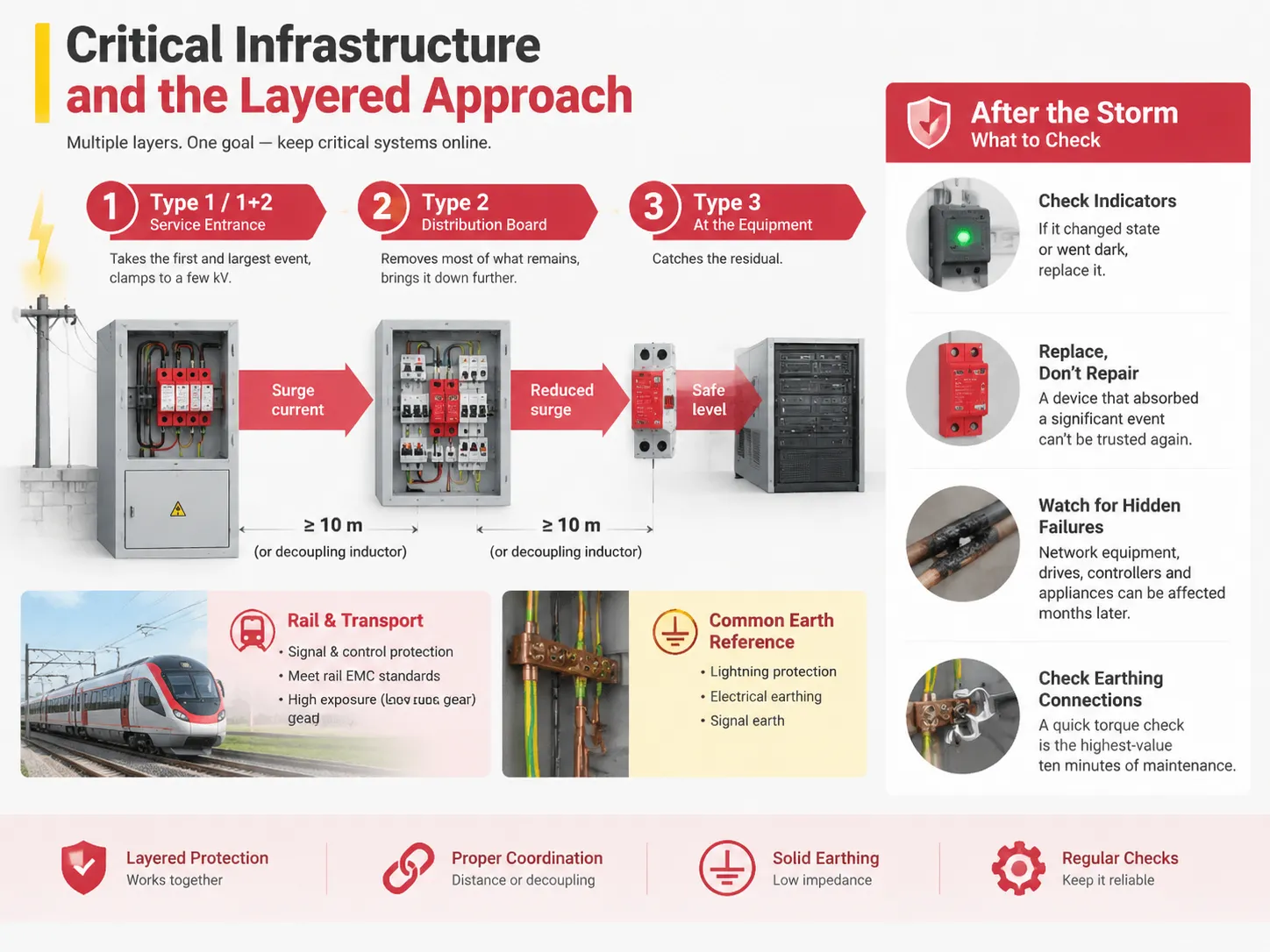
Three-tier model is used. A Type 1 or Type 1+2 device at the input feeds a lightning strike, getting rid of the bulk of the lightning energy and suppressing it to a few kV. Type 2 devices installed at each power supply board will clean-up significantly, with the remaining energy being at the level tolerable for electrical equipment insulation. A Type 3 device is installed at the electrical equipment itself and prevents the erosion of the last part of the discharge. All kinds of distance between the installations ensure that one device could not influence the work of the other one.
Moreover, regulated industries impose more restrictions regardless of what power system is being used. Rail and transport installations have requirements for control and signals protection, should adhere to the EMC rail standard and suffer from unusually concentrated exposure due to the long conductors and high voltage installations — the reason for which surge protection for the transport infrastructure differs when provided for traction assists, control equipment and the power stations, not being a certain installation.
One of the common aspects of all these schemes is the earthing aspect. The whole design is based on the fact that each installation relies on a reliable low-impedance path to the earthing point. Connecting the lightning protection system, electrical earthing system and the signals earthing system to the same earthing point prevents the EDF occurrence — if an earthing system is poor, any SPD will not work properly according to its specifications.
After the Storm: What to Check
- Verify the status indicators. The panel equipment indicates its operational status whether or not the point-of-use strips have a “protected” light. Any indicator that has changed state or dimmed shows that a device has lost its ability to perform its functions and it is necessary to call for replacement regardless of any failures downstream.
- Replace devices instead of repairing them. A strip or device that passed a failure does not deserve to be trusted again even if it still functions. The presence of damaged or discolored wires and casings has the same meaning.
- Search for invisible failures. Network gear, drives, controllers, and other devices can experience partial failure, which may not reveal itself until some time passes after failure. If several devices on the same circuit show strange behavior after a thunderstorm, it is more logical to investigate the case than replace devices one by one.
- Make sure that the earthing terminals are tight. Storm and heat cycles may loosen terminals. Performing a torque test of all SPD connections and the earthing bar will require at most ten minutes of your time but will give more benefit than any other operation you perform.
Frequently Asked Questions
What should never be plugged into a surge protector?
High-wattage appliances producing heat – space heaters, iron, hair dryers, toasters, kettles, microwave ovens and portable air conditioners – are an example of high-draw appliances because they create currents that approach 15 A limit of the strip, hence safety functions of the strip itself cannot replace the proper circuit. Healthcare devices of high importance must follow the instructions provided by the manufacturer instead of using strip for consumers. Furthermore, chaining strips and plugging them into extension cords is not allowed as mentioned in the description of the device.
What is the best protection against lightning?
Layers are required to protect the people, buildings, and equipment in case of lightning. For people, the National Weather Service recommends the 30/30 rule. If the time from seeing lightning to hearing thunder is less than 30 seconds, then it is likely that the storm will hit soon and outdoor activities should be ceased for 30 minutes after the last sound of thunder. For buildings, a lightning protection system that meets NFPA 780 or IEC 62305 should be installed. The system must consist of air terminals, down conductors, earthing electrodes, and bonding to the building grounding system. For protecting the electrical equipment, one needs to install surge protection of different types: Type 1 at the entrance point, Type 2 at the distribution boards, Type 3 at critical loads, and also surge protection devices must be installed on data and signaling lines. And for any equipment that shouldn’t be damaged, just unplug it before the storm starts, since any device that has no connection to the grid cannot receive a surge.
Can lightning go through a surge protector?
With induced surges, the SPD will reroute the transient to ground and perform this task correctly within its operational capacity. But with a direct or very close strike, the energy present could overload any device and lead to damage of SPD and possibly also of the connected equipment. The SPD does not work as an obstacle to lightning in the same way as a water valve could work with the water flows: SPD only provides the path with lower impedance than that of the equipment, and it only works until the voltage exceeds the SPD operational limits.
What is the 30/30 rule for lightning?
A safety rule provided by the National Weather Service. Whenever there is lightning, start counting after seeing the lightning and before hearing the thunder. If you count 30 seconds or less, the storm is close enough, and it will be wise to take shelter in a significant building or a tall vehicle. After the last role of thunder, sit tight for a minimum of 30 minutes. While the rule is mostly understood, most people ignore the sitting part. Yet it is the most important component. Lightning can strike up to 16 km away from the rain, and no rain does not mean that it is safe.
References
- National Weather Service — lightning safety, the 30/30 rule and indoor precautions
- NFPA 780 — Standard for the Installation of Lightning Protection Systems
- UL Standards & Engagement — UL 96A, Installation Requirements for Lightning Protection Systems
- UL Standards & Engagement — UL 1449, Surge Protective Devices
- International Electrotechnical Commission — IEC 62305 lightning protection and IEC 61643-11 surge protective devices
Conclusion
A surge protector indeed functions in protecting against lightning strikes but not in the way that most think it does. Such devices only manage to deal with generated transients and other residual energy caused by the lightning strike and do so very well, making them worth the money in virtually any structure. Unfortunately, they don’t stop the lightning strike itself, do not carry the current itself, and cannot provide any guarantees in the event of a direct strike. An honest specification would include a proper lightning protection system to carry the strike and SPDs to deal with the residual energy behind it, together with the earthing system to make both work.