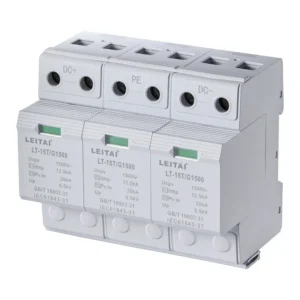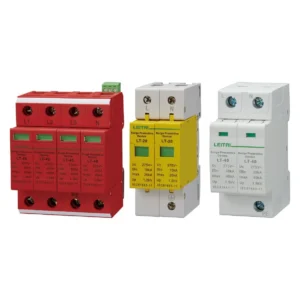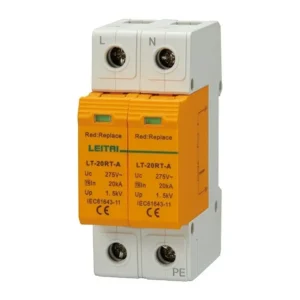

A surge protective device, or SPD, is a form of protection that aids in managing the sudden high voltage spikes by eliminating the respective voltage and letting the burst of electrical energy discharge to the earth to protect the electronic devices in any way possible. It differs from the normal fuses or circuit breakers as it does not disconnect the power supply in any manner. An SPD is always situated near the circuit where it operates and does not interfere with the current until high voltage occurs in the circuit.
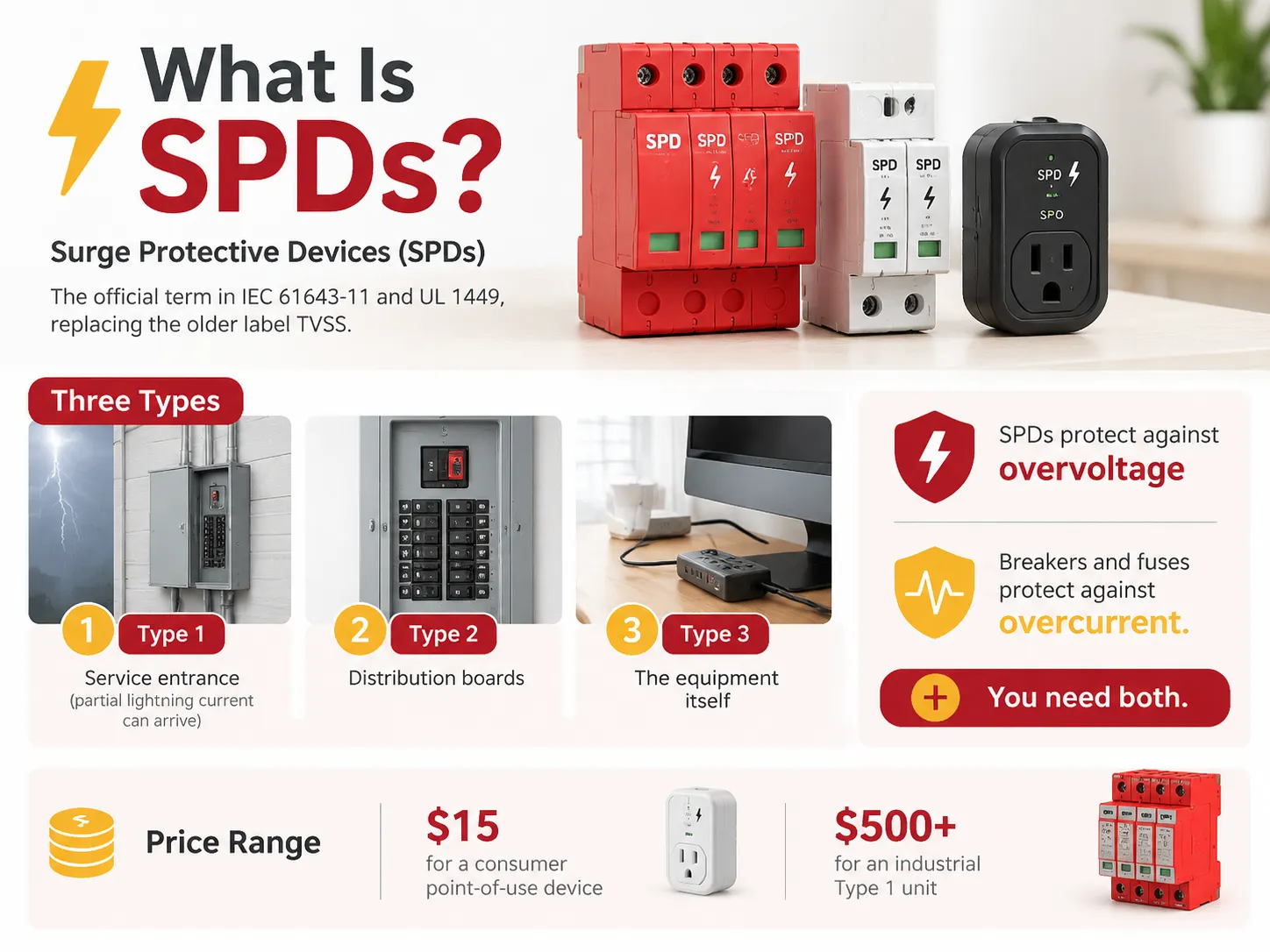
According to the IEC 61643-11 and UL 1449 standards, the SPD is a more modern version of the older TVSS. There are three types of SPDs: Type 1 is used in cases of lightning, Type 2 is for installation in junction boxes, and Type 3 is for installation inside appliances. The function of SPDs is to protect from overvoltage, whereas circuit breakers and fuses provide protection from overcurrent. Both SPDs and circuit breakers are used together.
The Name Matters More Than It Looks
In this area, two terms often create confusion among customers, and ensuring they understand these will prevent them from making any wrong decisions.
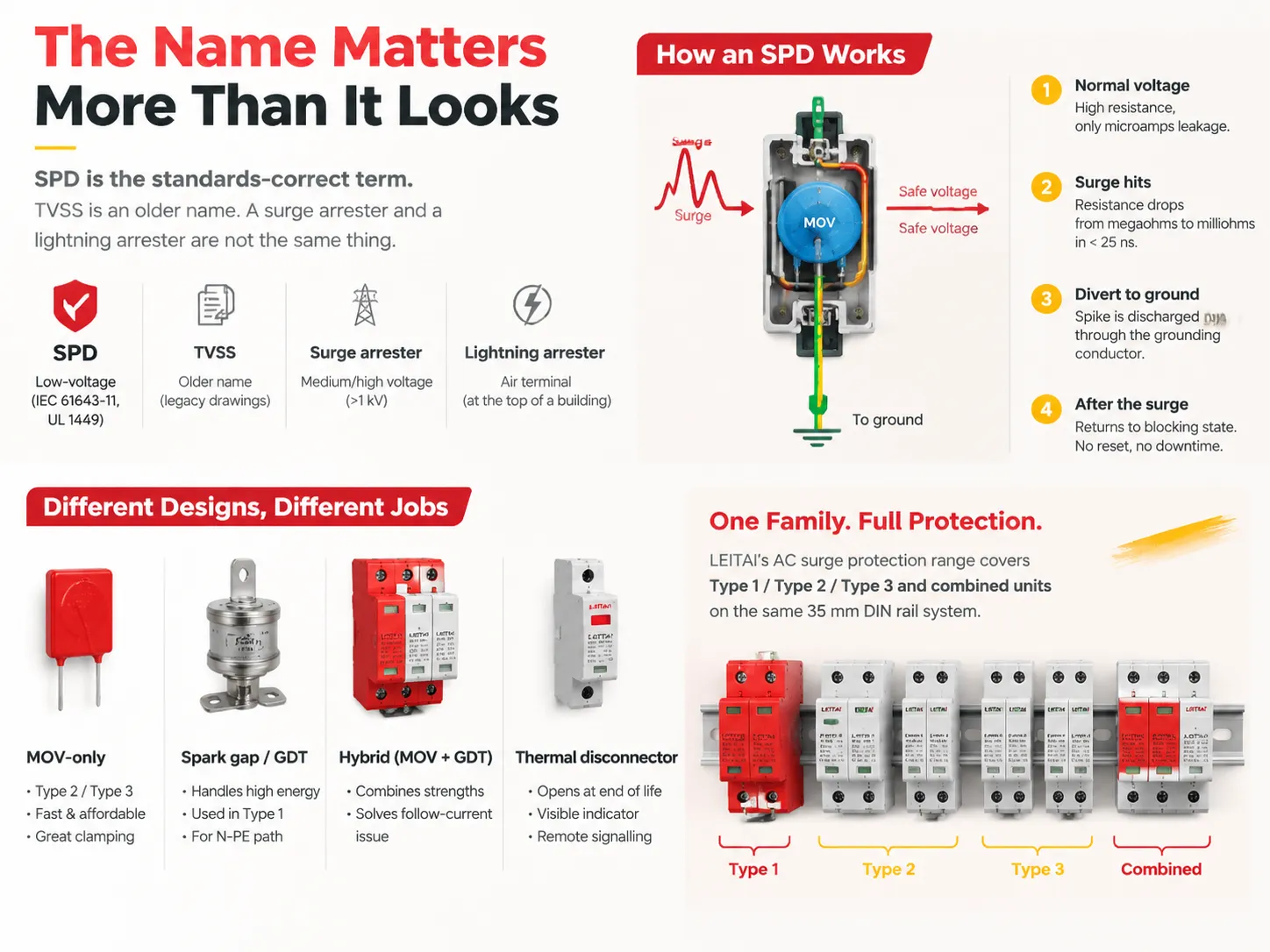
The standards-correct term is SPD. Surge protective devises or SPDs define their purpose by IEC 61643-11 in low-voltage electrical systems. UL 1449 uses the same terminology in North America. TVSS or transient voltage surge suppressor is quite an old category from UL, and although it appeared first in older drawings and specs, it still can be found there. If a datasheet offers you “TVSS” now, you are probably dealing with the outdated terminology because everything should be certified in compliance with UL 1449, but it is wise to check the year of the issuance, as the fourth edition changed test conditions and basic requirements.
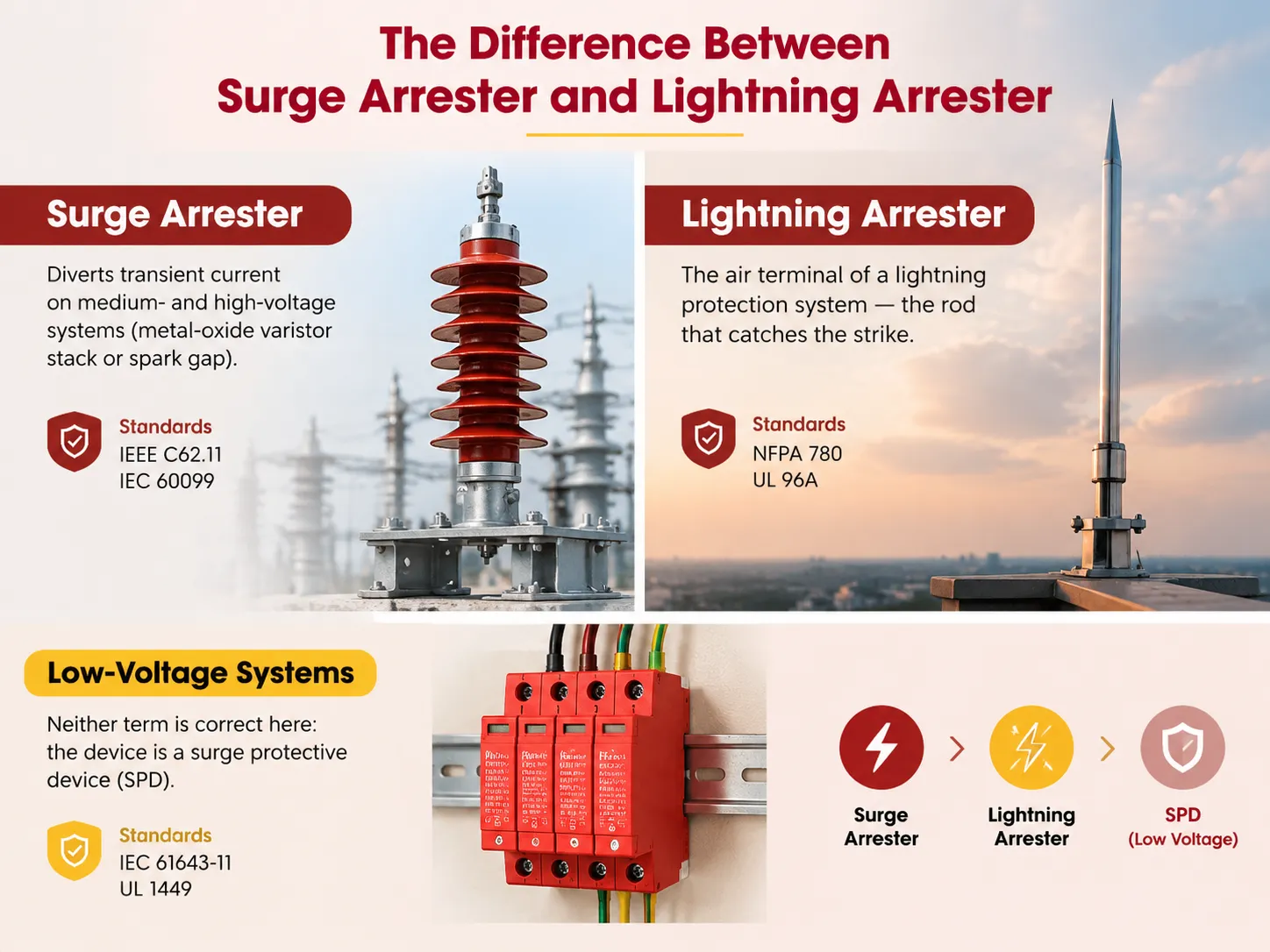
The third term is surge arrester, but it means something completely different. According to IEC, a surge arrester is a device that belongs to the medium- or high voltage category of devices installed on electrical systems higher than 1 kV in compliance with similar standards. A lightning arrester is not an SPD; it is a certain device on the top of the building catching the lightning. Retailers tend to mix up the terms, but it is vital in engineering.
How an SPD Actually Works
Metal oxide varistors, known as MOVs, comprise a significant part of virtually every low-voltage SPD. MOV has an incredibly high resistance and is a means to leak microamps when there is no SPD surge. If the voltage rises over a certain value, the previously high resistance will drop instantly to a very low value and the spike will be led to a ground wire. As soon as the surge vanishes, MOV returns to its previous non-working condition. There is no need for resetting, no manual intervention and no supply interruption.
Each of the systems described further has specific characteristics that depend on the specifications.
- Pure MOV systems are applied in most Type 2 and 3 devices. They are very cost-effective and reliable when it comes to their operation and opening up of the circuits.However, MOV is susceptible to damage over time and needs to be replaced after some time, which is why it usually comes with a light indicator.
- Spark gaps or gas tubes can safely cope with the high energy of lightning discharges. That is the reason why Type 1 SPDs utilize them as part of N-PE path throughout.
- Hybrid combinations of MOV and GDT are applied when both solutions are necessary in a single casing. They also overcome a danger of current following the spark gap.
- Thermal disconnectors work in series with SPDs to open the circuit when its lifetime ends in most ideal form.
It is easy to differentiate between an actual product and a decoration due to the differences in the composition of the product family. An authentic producer defines the common parameters — maximum continuous working voltage, rating of the discharge current, protection level and short circuit current rating — for the whole family of products.LEITAI’s AC surge protection range, for example, covers Type 1, Type 2, Type 3 and combined units on one 35 mm DIN rail system, so the Type 2 in a sub-board and the Type 1 at the service come from the same source with compatible coordination data.
The Three Types, and Why the Waveform Decides Them
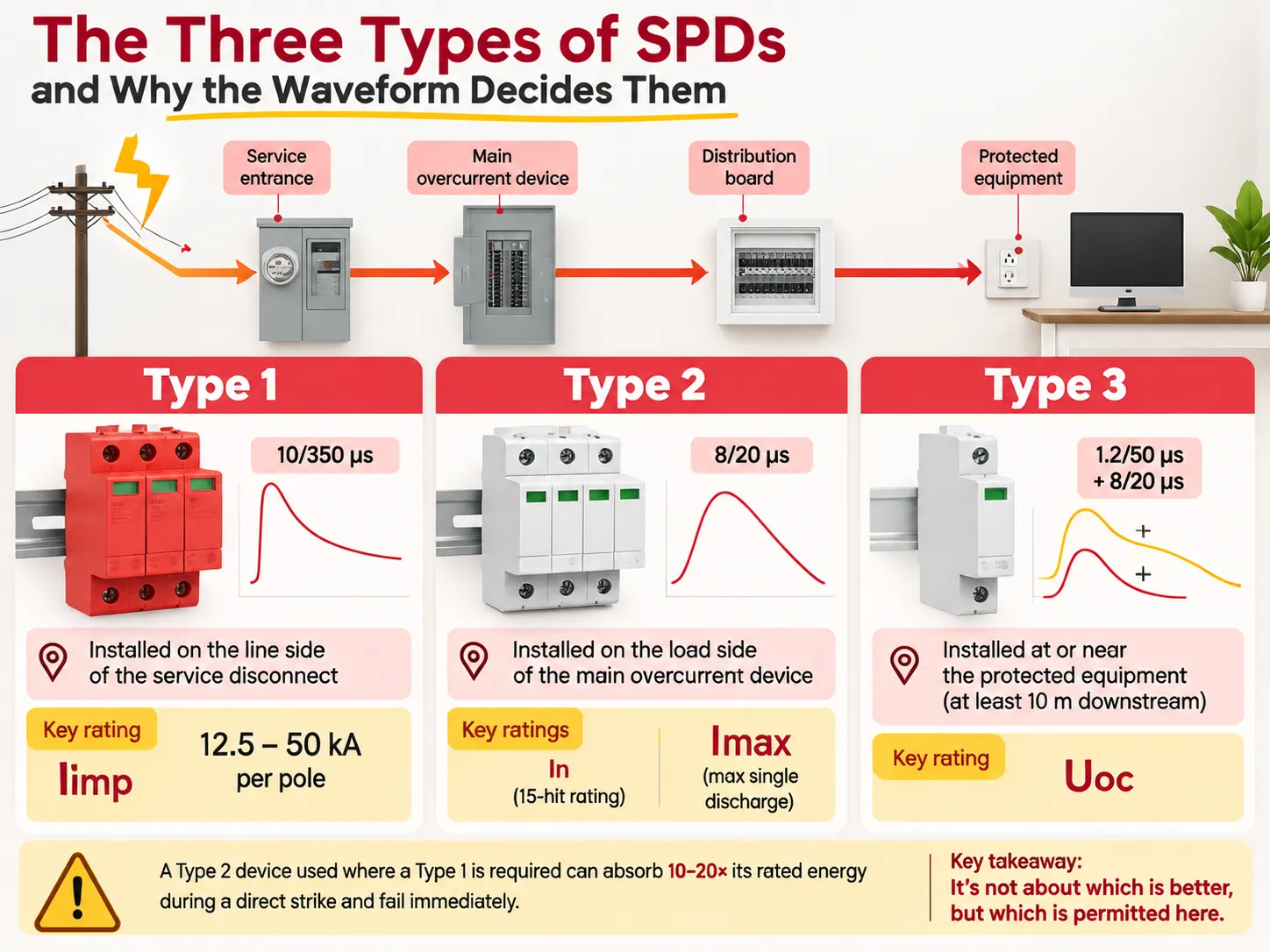
Types are referred to as electrical devices but they do not represent the quality ratings of electrical devices. They refer to the area of installation of electric appliances which change the test waveform that in turn changes the quality of electric appliances.
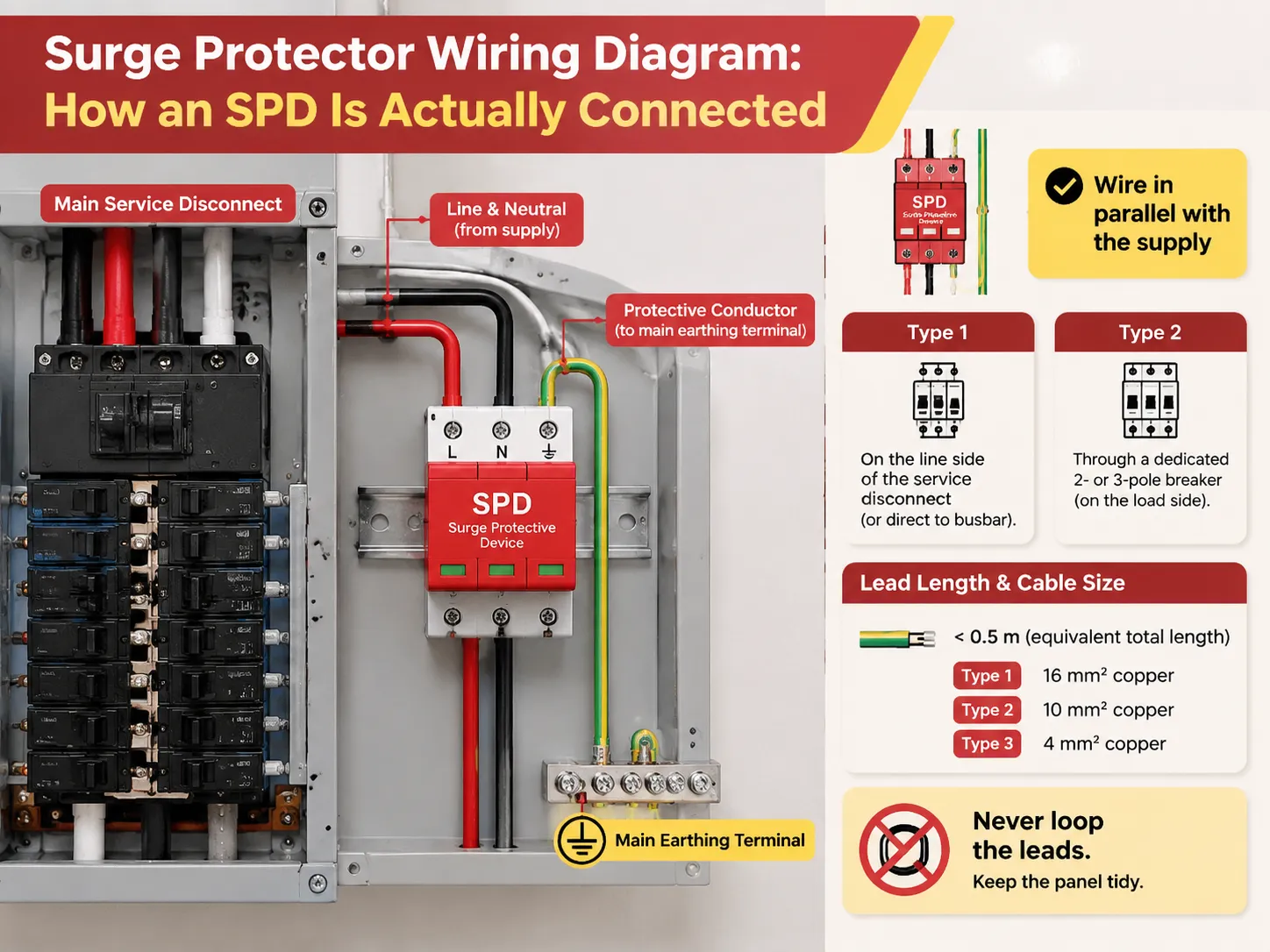
- A Type I device can be installed on the line side of the service disconnect ahead of the main overcurrent device. It is tested with a 10/350 µs impulse wave which is basically a replica of partial lightning current sent through the external lightning protection systems in order to test the device. The exact power of the device is measured in terms of Iimp which ranges between 12.5 and 50 kA for the device per phase.
- A Type II device is installed on the load side of the main overcurrent device. It is installed in the service equipment and distribution boards while the test is conducted using an 8/20 µs wave. It has nominal discharging current In which gives the 15 hits and maximum discharging current Imax. It is a must-have device for any installation as it protects against transients from outside and induced surges.
- The installation of a Type III device is conducted very near to the equipment being installed amounting to at least 3 feet of wire. It is validated using a combined wave which is a 1.2/50 voltage over above 8/20 m of the current.
Type II devices lose about ten times between 10 and 20 kJ while a Type I device is not able to function normally.The comparison of Type 1 and Type 2 SPDs comes down to that single waveform ratio, and it is why “which is better” is the wrong question — “which is permitted here” is the right one.
Installation window is also the narrowest for Type 3 and thus it is the starting point for many buyers, unfortunately, for the wrong reason – as it is the cheapest and readily available.
Where SPDs Actually Get Installed
The extent of utilization exceeds the common household application as the conditions are variable.
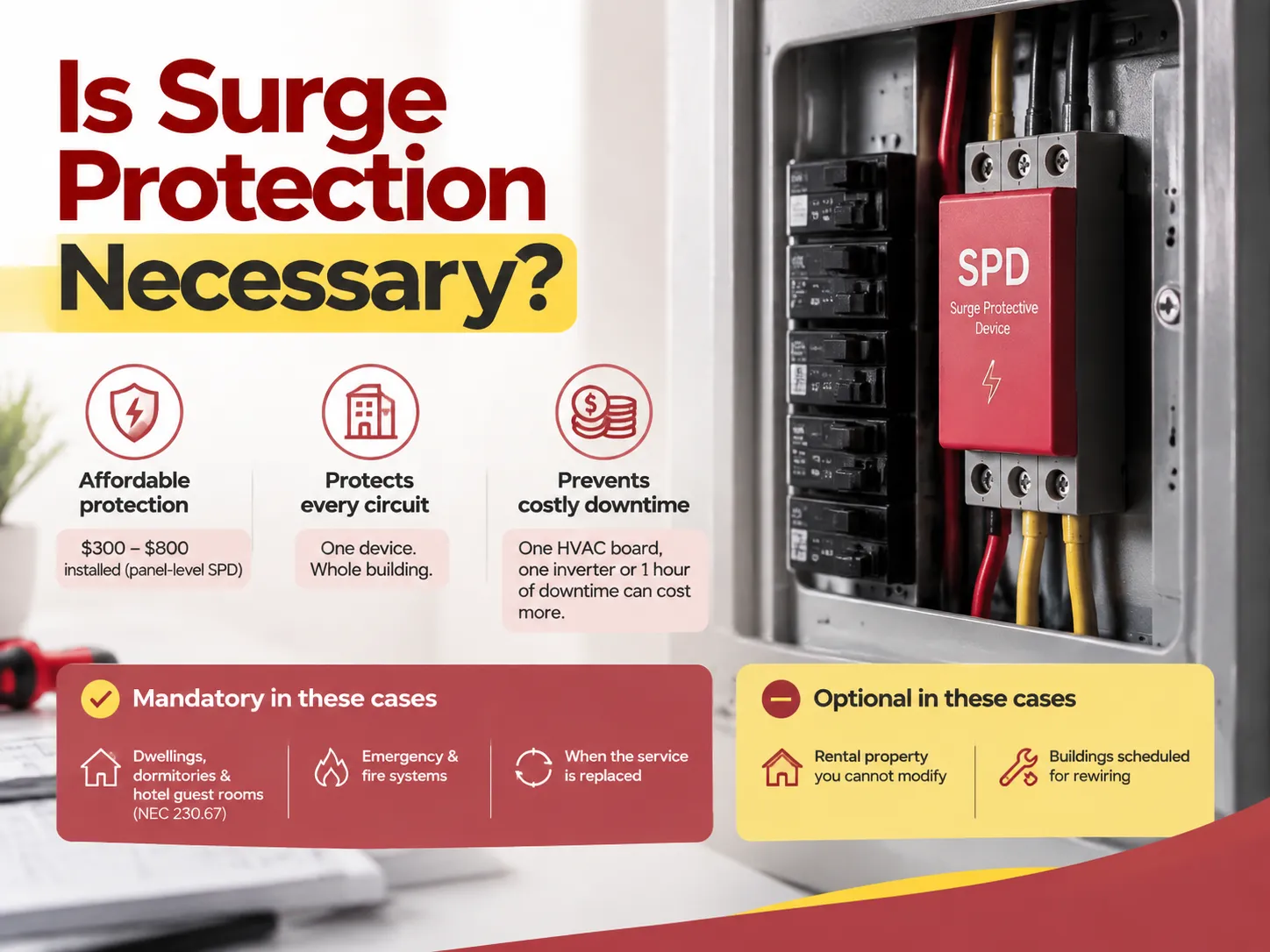
- Residential buildings. NEC introduced code 230.67 during 2020, which states that Type 1 or 2 SPD needs to be installed at the service point of any residential structure with minimal discharge of 10 kA. The latest 2023 code has included dormitories, hotels, motels, and hospitals under this rule, which is in effect when any service point is being replaced.
- Commercial buildings. This story of SPD application is governed mainly by the price to pay for the non-operation. The elevator controller, building management systems, access control, fire alarm panels, LED drivers are all using circuits initially designed for incandescent lamps and mechanical relays. The recently introduced add-on to NEC requires the presence of some level of the SPD in the emergency system switchboards or panelboards, covering the generator-based systems that until now were left unprotected.
- Manufacturing facilities. Every contactor, motor starter, and variable frequency driver causes switching spikes during operation. SPDs must deal with these background spikes while protecting PLCs, encoders, and communications. The recommended type of SPD is type 2 for MCC; and type 2 or 3 for driver control cabinetry.
- Solar panels and renewables. PV panels are long wires in the open space that act like antennas; their DC side is required to utilize certified SPD meeting IEC60643-31 standards and designed for 1000 or 1500 V DC.
- Railway, telecommunication, and transport. Signal and data streams require a separate set of protection devices and equipment must comply with the relevant EMC procedures besides SPD ones.
In larger commercial and mixed-use portfolios, the coordination between an SPD at the service and SPDs downstream is what actually determines outcomes, and it is often specified as a package — the same argument that surge protection for commercial buildings lays out for mechanical plant, tenant fit-outs and rooftop equipment.
SPD Versus the Devices People Confuse It With
One of the most costly misconceptions regarding this technology is using an SPD as a replacement for the overcurrent protection device, or vice versa.
- Circuit breakers are activated by overcurrent: that is, excessive current flow, or a single fault current that rises rapidly. The operation of circuit breakers is electromechanical and takes milliseconds to seconds. A 6 kV transient with a duration of 50 µs is ignored by a circuit breaker – nothing happens in its eyes, while the electronics downstream could already get damaged.
- An SPD reacts to an overvoltage in nanoseconds and works in parallel with the load without interrupting its operation. An SPD cannot clear a short circuit, or eliminate an overcurrent, or protect the circuit from tripping. If an SPD appears to eliminate a tripping problem, it does not mean that the problem has been fixed.
- RCDs and RCBOs detect ground faults for protecting people against electrocution. AFDDs detect both series and parallel arc faults. None of them is capable of detecting a transient overvoltage.
Layering is everything. A circuit comprising an MCB, RCD and SPD provides three layers of protection against three different physical effects, thereby removing any one layer leaves a particular risk unprotected.The difference between surge protection and overload protection is not a matter of degree — it is two different failure mechanisms, two different timescales and two different sets of hardware.
Brands, Prices and What Drives Them
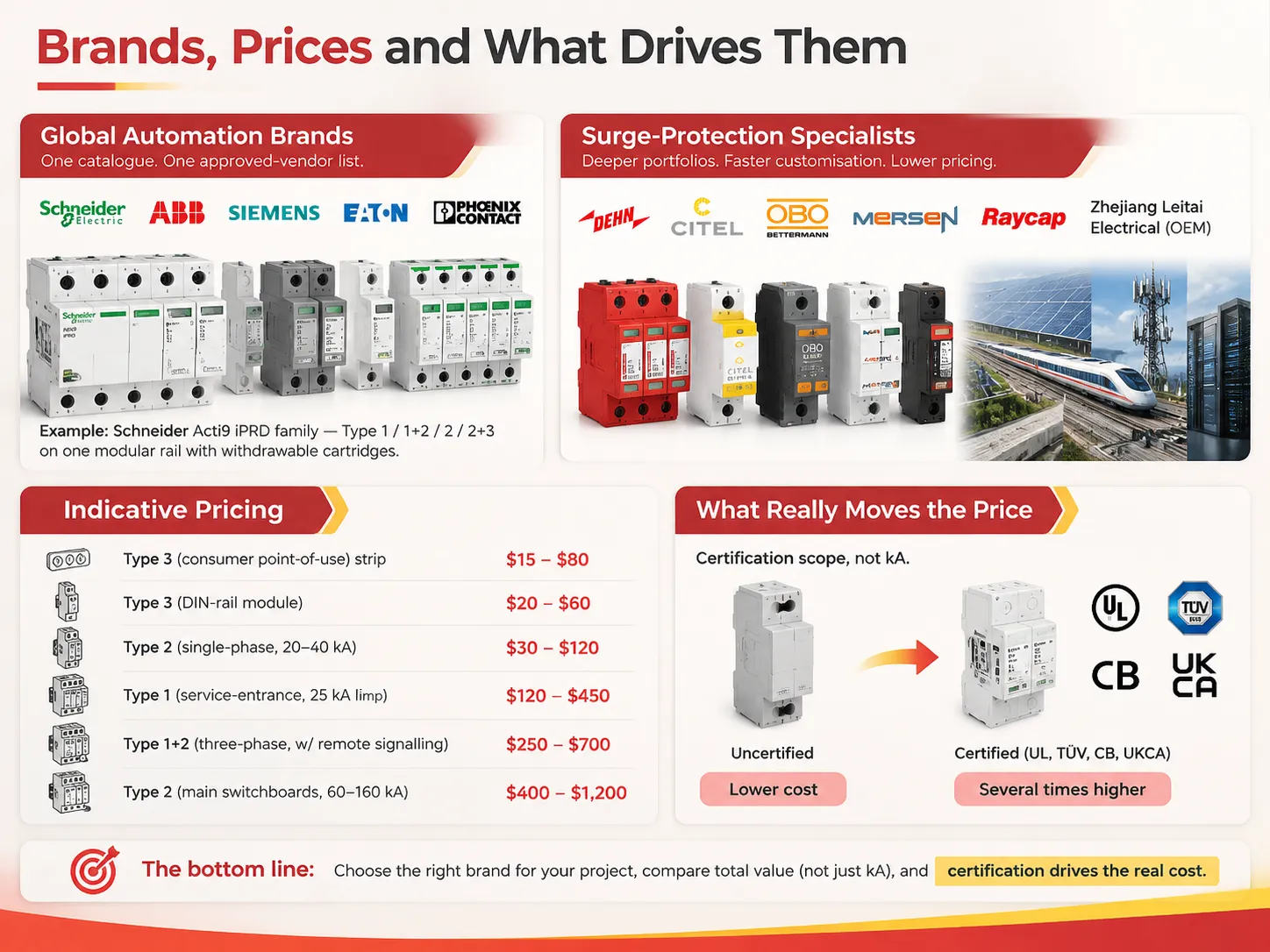
The market divides into two segments, and understanding which side of the market one is purchasing from helps one in comprehending the reason behind the price differences.
- The international automation corporations are: Schneider Electric, ABB, Siemens, Eaton, and others. Their competitive advantage consists in the fact that the SPD is included in the same catalogue and is on the same list of approved suppliers along with the electrical switchgear, which as a result makes the specification of this equipment for large orders simpler. The practical example of the range of products would be the family of Schneider Electric Acti9 iPRD having 1, 1+2, 2, and 2+3 types and having 4 surge protection devices on one modular rail.
- The surge protection specialists are: DEHN, CITEL, OBO Bettermann, Mersen, Raycap, and many manufacturers from China, for example, Zhejiang Leitai Electrical. The advantages here would be wider product selection compared to other suppliers in some segments such as power generation, railways, telecommunications, etc., faster time to market, as well as considerable price advantage.
The following prices serve as the basis for all estimates and differ according to the volume and extent of certification:
- Type 3 point-of-use consumer: $15-$80
- Type 3 module on a DIN-rail: $20-$60
- DIN-rail Type 2 1-phase 20-40kA: $30-$120
- Type 1 service entrance device for 25 kA Iimp: $120-$450
- Combined Type 1 and Type 2 3-phase remote signaling device: $250-$700
- Heavy-duty Type 2 device for main switchboard 60-160kA: $400-$1200
However, it should be taken into consideration that certification scope plays an important role in forming the price of the device rather than kA rating. The same piece of equipment that underwent an electrical design with proper UL certification, TÜV, CB, and UKCA certificates together with five years of tests may cost several times more than its non-certified analogs due to the fact that certification is costly.
Installation and Maintenance Notes That Decide the Outcome
Usually, the equipment makes up the smaller part of the operation.
- The conductor should be shorter. Total length of conductors from the busbar to the SPD to the ground must be as short and with minimum bends as enclosure allows, because for every meter of lead 1 µH is added, which means an additional 1 kV in the let-through voltage. Long leads do not improve protection but rather destroy it.
- Calculate grounding conductor correctly. Type 1 requires 16 mm² copper or larger, Type 2 – at least 10 mm², Type 3 – at least 4 mm² according to IEC 61643-11 norms. The most frequent mistake observed while auditing is installation of standard 2.5 mm² protective earth.
- Coordinated upstream device is needed. If SPD does not have back-up protection, a back-up fuse or circuit breaker must be installed. IEC standard specifies 63-125 A gG fuse or MCB of C32-C63 type, and manufacturer’s referencing clearly takes priority over specified parameters.
- Protection must be coinciding. L-N, L-PE, N-PE and L-L protection do not serve the same purpose. Wye connected equipment on delta system protects one circuit while leaving another one unprotected.
- SCCR must be checked. SPD can’t be installed in the areas where the possible short-circuit exceeds its SCCR value. This rule is a safety rule and not an aspect of the device’s performance – an underrated SPD will burn out during malfunction.
- Pay attention to the indicators. The units must be changed if there’s any unusual signal in the window or remote contact system is activated.
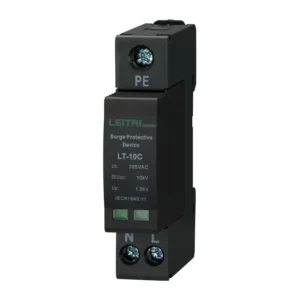
- Plan the replacement on existing premises. UPgrade of the existing board usually fails not due to the moral obsolescence of the technology, but due to lack of space.Adding a final-stage device to a full distribution board is far easier with a one-module design, which is why a compact Type 3 SPD rated Uoc 10 kA on an 18 mm module is the practical answer for protecting measuring instruments, drive controls and terminal equipment in a board that has no spare width.
Frequently Asked Questions
What does SPDs stand for?
Surge protective devices is the general term used for the whole category, while SPD refers to one of the units from this category. These two terms are defined by IEC 61643-11 for low-voltage AC power systems and they also have the definition in UL 1449 in the USA. The acronyms SPD and surge protective device replaced the older terminological abbreviation known as TVSS, which means transient voltage surge suppressor.
What does SPDs stand for in real estate?
Nothing new. In the case of a lease, property condition report or commercial fit-out specification, the term SPD means surge protective device, as always. Generally, in real estate, SPD is used in the comment to the electrical service indicating either that there are already panel-level SPDs in place, or that the serviced equipment has been replaced, and a SPD is now required according to the adopted electrical code.
How long do SPDs last?
No exact working life exists since the tool is being damaged by the events that it captures. Realistic values are estimated as 5 to 10 years in areas with low lightning activity, 3-7 years in a business environment, and 1 to 3 years in areas with abundant thunderstorms or where the supply is exposed. It is the status light and remote contact instead of the calendar, that inform one about the reached end of life of the module.
Are SPDs mandatory?
They are required throughout various types of occupancy in North America. According to the National Electric Code (NEC) 2020, it was required to have a Type 1 or Type 2 SPD at dwelling services with a nominal discharge current of 10 kA. In the 2023 version of the NEC, the requirement was introduced for dormitory occupancy, hotel rooms, garage rooms, hospitals, and also feeders as well as their service replacements. Emergency system switchboards and panel boards need to be fitted with SPD of suitable type. There are also unique requirements for fire alarms and fire pump circuits. Unless required, plants or installations outside those occupancies rarely use PDs but this is often justified by the cost of one lost unit. It is better to clarify with local authority what edition they follow.
References
- International Electrotechnical Commission — IEC 61643-11, low-voltage surge protective devices
- UL Standards & Engagement — UL 1449, Surge Protective Devices
- NFPA 70, National Electrical Code — Article 242 and Section 230.67
- Phoenix Contact — surge protection technical documentation
- Hager — surge protection device product and application information
Conclusion
An SPD is a protective voltage device that works in parallel and is self-resetting, so it is commonly used to provide protection for expensive equipment. The number of SPD types is determined not by any quality-related differences but by the fact that there are three levels of protection in a particular electrical system. To really mean what they claim and to be effective, it is essential that the selected SPD classes in the specific place should be suited to the particular applications, that its leads are as short as possible, that the size of the grounding device is appropriate and that the SPD device functions in coordination with the devices used upstream and without any extra connections.